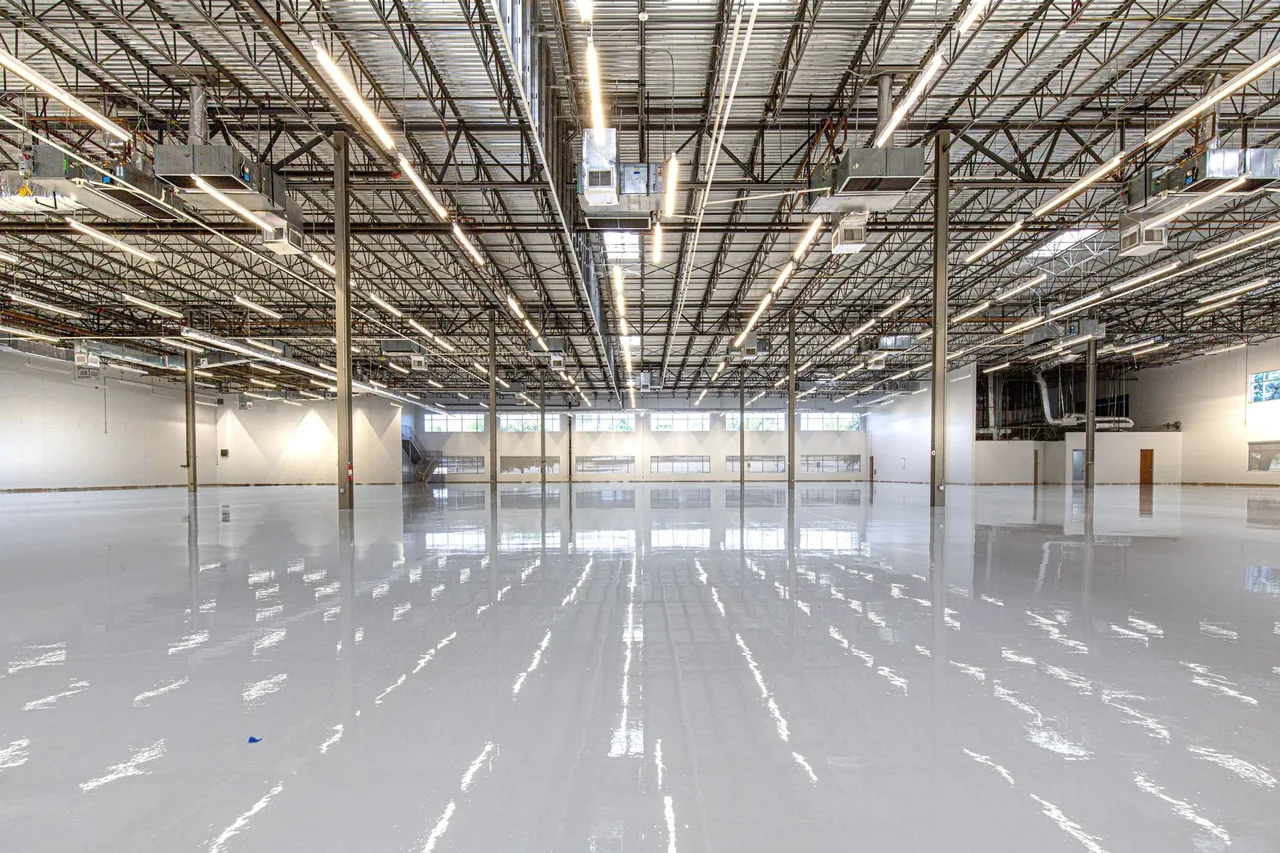
Commercial epoxy flooring is a resinous coating system — a liquid-applied epoxy or urethane build, troweled or rolled onto a concrete slab and cured to a seamless, bonded surface. Two things decide whether it lasts and almost nothing else does: how dry the slab is, and how well it was mechanically profiled before any resin touched it. Test the slab against the product's moisture limit by ASTM F2170 and profile it to the right ICRI texture, and the coating bonds for decades; miss either and it blisters or peels inside a year regardless of how good the product is. Done right over a sound slab, a system can run 4 to 40 mils thick and shrug off chemicals, forklifts, and washdowns. Get a free consultation and a written, itemized scope from a vetted commercial installer before any resin is ordered — that document, with the moisture test and surface profile named in it, is where a lasting floor is decided.
Epoxy Flooring Is a Slab-Prep Job First, a Coating Second
The glossy resin everyone pictures matters least to how long the floor lasts. What separates a coating still bonded in twenty years from one peeling in eighteen months is the measured slab work — moisture testing and mechanical profiling — done before the first coat.
A Coating You Build Up, Not a Product You Lay Down
Epoxy flooring is not a tile or a plank; it is a coating you build up. Two-part resin and hardener are mixed on site, react chemically, and cure into a hard, continuous film bonded to the concrete underneath. Because there are no joints, grout lines, or seams across the field, there is nowhere for liquid, bacteria, or debris to collect — but that bond to the slab is everything, and a credible installer treats the slab before the resin:
- A coating over a slab that reads too wet blisters and sheets off as vapor pressure pushes it from below.
- A coating over a merely cleaned, un-profiled slab releases under traffic because the resin has nothing to grip.
- A coating over a cracking or moving slab telegraphs and splits, because the film cannot bridge structural movement on its own.
None of those are resin defects — they are slab failures, the reason almost every epoxy floor that fails, fails.
Where the Seamless Resin Floor Genuinely Wins
Epoxy wins where a floor has to survive abuse and stay sanitary at the same time. Warehouses and manufacturing floors take forklift traffic and dropped tools on a coating that resists abrasion and impact. Commercial kitchens and food-processing plants need a surface that hoses down to bare resin and meets USDA and FDA expectations for a cleanable, non-porous floor, which is where a restaurant or food-service floor lives or dies. Labs, pharmacies, and clean rooms specify epoxy for chemical resistance and the ability to coat the whole assembly — including an integral cove base up the wall — so there is no seam at the floor-to-wall joint. The same logic carries into healthcare spaces, where seamlessness is an infection-control requirement, not a finish preference. Across a commercial surface program, epoxy is the default where a hard, sealed, custom-spec slab coating is the requirement — and one of the few surfaces engineered to be poured, not placed.
The Epoxy Readiness Gate: Six Checks Before Any Resin
Before any resin goes down, a competent installer runs the slab through the same six-check gate. Each check has a published metric or standard, each is a documented cause of coating failure when skipped, and a slab that fails any one is not ready. Call it the Epoxy Readiness Gate: pass all six and the coating has a slab to bond to; fail one and you are buying a future delamination.
- 1. Slab moisture
- The slab is tested before any resin — in-situ relative humidity by ASTM F2170 and surface emission by ASTM F1869, with ASTM F3010 governing moisture-mitigating coatings. The product publishes a maximum the slab must read below; coat above it and vapor pressure blisters the film off the slab.
- 2. Surface profile
- The concrete is mechanically profiled — diamond-ground or shot-blasted — to a CSP (Concrete Surface Profile) number set by the ICRI, typically CSP 2 to 4 for coatings. Epoxy bonds mechanically into that texture; a merely cleaned slab gives the resin nothing to grip, and the film releases under traffic.
- 3. Contaminant removal
- The profiling also strips laitance, curing compounds, old sealers, prior coatings, and surface oils — anything that stops the resin from gripping the slab. A surface that looks clean can carry a bond-breaking film; removing it is part of why profiling, not just cleaning, is the requirement.
- 4. Crack and joint treatment
- Cracks and spalls are routed and filled, and moving joints are detailed appropriately, because epoxy is rigid and cannot bridge structural movement — an untreated crack telegraphs straight through the cured film. The slab is repaired into a sound, continuous surface before coating.
- 5. System matched to duty and chemistry
- The build thickness and resin family are matched to the real traffic and the chemicals the floor will see — a thin coat for foot traffic, a quartz mortar for forklifts, a urethane or novolac topcoat for hot washdowns and harsh sanitizers. Specifying a thin coat for heavy duty, or standard epoxy for aggressive chemicals, is a built-in early failure.
- 6. Slip resistance
- A smooth resin film does not meet wet-floor slip safety on its own; the floor reaches DCOF ≥ 0.42 under ANSI A137.1 only when an aggregate — silica, aluminum oxide, or polymer beads — is broadcast into the coating. Anywhere water, oil, or product reaches the floor, the slip media is a spec line, not an upsell.
Three of these six — moisture, profile, and slip — are the corners cut on cheap quotes, because they cost testing, grinding labor, and broadcast media a low bid skips, yet every one is verifiable. That is why the gate is non-negotiable.
Want the slab tested and profiled before any resin?
We match you with a vetted commercial installer who tests moisture and profiles the slab to the right ICRI CSP, and puts the readings and the system spec in a written scope — before any coating is ordered.
Epoxy Flooring Specifications & Standards
Epoxy is specified by build and by standard, not by color. The numbers below are the ones that actually predict how the floor performs, and they are where a low bid quietly cuts corners.
The Prep Standards That Decide the Bond
The prep standards are the ones that determine whether the coating bonds at all — slab moisture and surface profile — and both are published, testable, and named in a competent scope.
Slab Moisture Testing
Slab moisture is the spec that decides whether a coating survives, because vapor trapped under an impermeable film has nowhere to go but back through the resin. How it is tested depends on whether you are reading internal humidity or surface emission.
ASTM F2170 In-Situ Relative Humidity
ASTM F2170 is the in-situ relative-humidity method: probes are sealed into holes drilled to 40% of the slab's depth, left to equilibrate, then read. It is the recognized way to know a slab is dry enough because it measures moisture at depth, where it lives, not at the surface, which can read deceptively dry while the core is still wet.
Why F3010 Mitigation Saves a Wet-Slab Floor
When the slab reads above the coating's limit, the answer is not a hopeful coat — it is a moisture-mitigation primer applied to the ASTM F3010 spec, a resin barrier that suppresses the vapor drive so the body coats can bond over it. F3010 is the standard test method for that two-component epoxy moisture-mitigation system. Skipping it on a slab that reads high is the single most common way an otherwise-good epoxy floor blisters — and the F3010 primer is exactly the line a low bid omits to win on price.
ASTM F1869 Surface Emission
ASTM F1869 measures the moisture-vapor emission rate with a sealed calcium-chloride dish that weighs how much vapor the slab surface gives off, expressed in pounds per 1,000 sq ft per 24 hours. Because it reads surface emission rather than internal humidity, installers often pair it with F2170 for a fuller picture before committing to a coating.
Build, Slip, and Profile Specs
Beyond moisture, three specs govern the floor. System thickness, in mils or millimeters: a thin roller coat runs 4 to 10 mils for light foot traffic, while a troweled quartz mortar runs 1/8" to 1/4" for forklifts and dropped loads. Slip resistance, by DCOF: a level interior walking surface is held to DCOF ≥ 0.42 under ANSI A137.1, reached only with broadcast aggregate. And surface profile, by ICRI CSP — typically CSP 2 to 4 — the mechanical key the resin grips. Buying a thin coat for a heavy-traffic floor, or a smooth film for a wet zone, is buying an early failure.
Epoxy Specs at a Glance
The table below collects the recognized specs a competent installer verifies. These are representative figures — the product's published data sheet always governs, and where it is stricter, the stricter number wins.
| Spec | What it controls | Recognized standard | Typical requirement |
|---|---|---|---|
| Slab moisture (RH) | Whether the coating bonds or blisters | ASTM F2170 | Below the product's published RH cap |
| Surface emission | Surface vapor drive | ASTM F1869 (CaCl₂) | Below the product's lb/1,000 sq ft limit |
| Moisture mitigation | Coating over a wet slab | ASTM F3010 | Mitigation primer where the slab reads high |
| Surface profile | Mechanical bond key | ICRI CSP | CSP 2 to 4 for coatings |
| System thickness | Traffic and impact resistance | Product build spec | 4–10 mils light; 1/8"–1/4" heavy |
| Slip resistance | Wet-floor safety | ANSI A137.1 (DCOF) | DCOF ≥ 0.42 with broadcast media |
The lesson is that a slab which looks dry can read far too wet at depth — the reason ASTM F2170 exists. Coating above the limit traps vapor beneath an impermeable film and is the fastest way to blister a floor and void the system warranty at once. Compare durability across systems in our material lifespan data first.
Epoxy vs. Polished Concrete, Vinyl, and Carpet Tile
How each commercial surface handles chemicals, comfort, light, and replaceability is the decision — never which is cheapest. Epoxy is one of four mainstream options, and comparing it against its siblings is the fastest way to know whether it is the answer or the wrong tool.
The Commercial Surface Comparison Matrix
The matrix below lines up the four surfaces on the factors that decide a commercial floor — hardness, chemical resistance, comfort, install downtime, and repairability.
| Surface | Hardness | Chemical resistance | Comfort underfoot | Install downtime | Repair / replace | Best for |
|---|---|---|---|---|---|---|
| Epoxy | Very hard, rigid | High — sealed, chemical-proof | Hard | Days — cures between coats | Strip-and-recoat | Wet, chemical, industrial |
| Polished concrete | The slab itself | Low — stains and etches | Hard, cold | Low — no cure film | Re-burnish, never recoat | Retail, warehouse, light |
| Commercial vinyl | Resilient | Moderate | Soft, quiet | None — reopens fast | Swap a tile / re-sheet | Corridors, healthcare, traffic |
| Carpet tile | Soft | Low — not wet-cleanable | Soft, warm, quiet | None — zone by zone | Swap a tile | Offices, acoustics |
Versus Polished Concrete and Vinyl
Against polished concrete, the trade is a coating versus the slab itself: polished concrete has nothing to delaminate because there is no separate film, but it offers no chemical barrier and stains where epoxy seals — choose epoxy when you need a protective, chemical-proof layer, polished concrete when the slab is sound and you want a near-zero-maintenance surface with no coating to recoat. Against commercial vinyl, the trade is hardness versus resilience and speed: epoxy is harder, more chemical-resistant, and truly seamless across the field, while vinyl is softer underfoot, faster to install with no cure time, and easier to replace in a damaged area. A processing plant wants epoxy; a clinic corridor that must reopen tomorrow morning often wants sheet vinyl.
Versus Carpet Tile, and Mixed-Surface Buildings
Against carpet tile there is barely a functional contest — carpet tile is for acoustic, comfortable office environments, while epoxy is for wet, chemical, or industrial floors — but the two often coexist in one building: hard resin in the back-of-house, soft modular carpet out front. The point is never to crown one surface; it is to match the surface to the room. A single facility might run epoxy in the kitchen, vinyl in the corridors, polished concrete in the warehouse, and carpet tile in the offices. For the full set of trade-offs, start at the commercial surfaces hub.
Is Epoxy Right for Your Floor?
Epoxy is the right surface for some rooms and the wrong tool for others, and which is the output of a short chain of facts about the slab, the duty, and the downtime you can absorb. Walk the decision in order; each branch eliminates an option the conditions do not support.
- Test the slab first. On a slab on grade, get an ASTM F2170 or F1869 reading against the product's limit. If it reads high, the path is an F3010 mitigation primer, not a hopeful coat — and a slab that cannot be mitigated economically may point to a vinyl or polished-concrete answer instead.
- Name what lands on the floor. Hot washdowns, harsh sanitizers, and aggressive chemicals defeat standard epoxy and call for a urethane or novolac system; mild cleaners and dry traffic live on standard epoxy. The chemistry decides the resin family.
- Name the traffic. Foot traffic and light carts can live on a thin roller or self-leveling build; forklifts, pallet jacks, and dropped loads need a quartz mortar or high-build system. Under-spec the thickness and the floor fails early.
- Confirm wet zones. Anywhere water, oil, or product reaches the floor, the system needs broadcast aggregate to hold DCOF ≥ 0.42 when wet. A smooth, glossy floor by a sink or a door is a liability, so the slip media is settled here.
- Budget the downtime. Multi-coat systems cure between coats, so the floor is out of service for days. A space that cannot close needs a phased, after-hours plan — and if even that is impossible, a no-cure resilient floor may fit the schedule better than epoxy.
Run honestly, this tree returns a clear yes-or-no on epoxy and the exact system — and an installer who quotes the same thin coat for every room, regardless of slab, chemistry, and traffic, is the red flag.
Not sure epoxy suits your slab and duty?
Tell us about your space and we'll match a vetted commercial installer who tests the slab, names the right system and chemistry, and explains where vinyl or polished concrete would fit better — in writing.

Why Epoxy Blisters, Peels, and Yellows — and How the Prep Stops It
Epoxy does not fail because the resin is weak; it fails because the slab beneath it was wrong, and almost every failure traces to one of these mechanisms — each paired below with its cause and the prep that prevents it.
Delamination From Moisture: The Number-One Killer
Delamination from moisture is the most common failure. Concrete on grade wicks water vapor up from the ground, and an epoxy film is largely impermeable — so vapor pressure builds under the coating until it pushes the resin off the slab in blisters and sheets. A slab never tested, or one reading above the product's limit, will lift its coating no matter how clean the prep looked. The prevention is upstream: test by ASTM F2170 or F1869, and where it reads high, apply an F3010 moisture-mitigation primer before the body coats.
Delamination From Poor Profile: A Bond Failure
The second mechanism is a weak mechanical bond: epoxy grips into the texture of roughened concrete, and a slab that was merely cleaned — not abraded — gives the resin nothing to hold, so the film releases under traffic. The prevention is mechanical profiling to the specified ICRI CSP, by diamond grinding or shot-blasting, before the first coat.
UV Ambering and Slip: Two Surface Failures
Standard epoxy ambers and chalks under direct sunlight — purely cosmetic but real, which is why an entrance with floor-to-ceiling glass needs a UV-stable urethane topcoat rather than bare epoxy. And freshly cured epoxy is slick when wet unless slip media was broadcast into it, so a polished, un-textured resin floor by a sink is a fall waiting to happen. The preventions are a UV-stable topcoat where sun reaches the floor, and broadcast aggregate to hold DCOF ≥ 0.42 in any wet zone.
Cracking Through the Film: A Slab-Movement Failure
Epoxy is hard and relatively rigid, so a slab that cracks or moves telegraphs that crack through the coating — the film cannot bridge structural movement on its own. The prevention is routing and filling cracks, detailing moving joints, and accepting that a structurally unstable slab needs its movement addressed before any coating. If a coating has already blistered or peeled, the honest path is a full strip-and-recoat over a tested, re-profiled slab through a commercial installation rather than a patch over the same wet or smooth slab.
Common Epoxy Mistakes, Consequences, and Prevention
Most epoxy failures are the same handful of shortcuts, each with a predictable consequence and a known prevention. Naming them is how you spot a corner being cut before it is buried under a peeling floor.
| Mistake | What it causes | The prevention |
|---|---|---|
| No moisture test on a slab on grade | Vapor pressure blisters and sheets the coating off | Test by ASTM F2170 / F1869 against the product limit |
| Coating a wet slab without mitigation | Delamination from trapped vapor within months | Apply an ASTM F3010 mitigation primer first |
| Cleaning instead of profiling | Weak bond; the film releases under traffic | Grind or shot-blast to ICRI CSP 2–4 |
| Thin coat on a heavy-traffic floor | Wear-through and failure under forklifts and loads | Spec a quartz mortar or high-build system for the duty |
| Standard epoxy under harsh chemicals | Chemical attack, softening, and breakdown | Use a urethane or novolac system matched to the exposure |
| Smooth film in a wet zone | A slick, hazardous floor by sinks and doors | Broadcast aggregate to hold DCOF ≥ 0.42 |
| Recoating too soon between coats | Poor intercoat adhesion and a compromised system | Honor each coat's full cure window before the next |
Every row is a documented warranty-denial trigger — which is why "the slab is tested and profiled, and the system is matched to the duty, in writing" is the most valuable sentence in an epoxy quote.
Grades and System Types — From Thin Coat to Quartz Mortar
"Epoxy floor" covers a family of systems, and choosing the wrong member for the duty is how a floor disappoints. The mainstream types, from lightest to heaviest:
- Roller-applied coating — a thin, economical film for light commercial and back-of-house areas. Fast and inexpensive, but the least durable and the first to wear through under real traffic.
- Self-leveling epoxy — a flowable build that levels minor slab imperfections into a smooth, seamless field. The common choice for clean, presentable warehouse and showroom floors.
- Color-flake (broadcast) system — vinyl flakes broadcast into a base coat and sealed under a clear topcoat, giving a decorative, slip-textured, hard-wearing finish popular in retail and garages.
- Quartz mortar (epoxy/quartz) system — colored quartz aggregate troweled into resin for a thick, impact- and abrasion-resistant floor. The heavy-duty answer for kitchens, labs, and processing.
- Urethane cement / mortar — a urethane-modified system for thermal-shock and aggressive-chemical environments, where steam, hot washdowns, and harsh sanitizers would defeat standard epoxy.
Within each type, the slip media, the cove-base detail, and the topcoat are separate decisions. A food plant might pick a urethane mortar with an integral cove and an aggressive non-slip broadcast; a car showroom might pick a flake system with a high-gloss UV-stable clear. The system is assembled to the room — there is no one epoxy. For how system choice and slab condition move the budget, weigh durability in our material lifespan data and the trade-offs in our guides, and see resin lines from the makers in our brands directory.

What Actually Drives the Cost of an Epoxy Floor
An epoxy quote is not a flat per-square-foot rate; the headline number a low bid leads with hides the items below, ranked by how much they move the total.
- Slab condition and prep. The biggest swing on most jobs. Grinding or shot-blasting to profile, removing old coatings, and filling cracks is real labor a sound, clean slab avoids — and exactly where a low bid cuts.
- Moisture mitigation. A slab that reads high needs an ASTM F3010 mitigation primer to the maker's spec — cheap insurance against blistering, but a real line item the lowest bid tends to omit.
- System thickness and resin family. A thin roller coat, a self-leveling build, a quartz mortar, or a urethane system span a wide range in material and labor — the duty and chemistry set this baseline.
- Slip media and topcoat. Broadcast aggregate for wet zones and a UV-stable or chemical-resistant topcoat are separate costs matched to the environment, not optional extras.
- Cove base and detailing. An integral cove base up the wall, drains, and edge detailing in a sanitary space are skilled work priced beyond the field coating.
- Downtime and phasing. Because the floor cures between coats and is out of service for days, an after-hours or zone-by-zone schedule in an operating building is a real coordination cost — and part of the true price.
- Area and access. Square footage drives material, but tight access, obstructions, and working around fixed equipment add labor an open slab does not.
- Demolition and disposal. Removing a failed prior coating or old flooring and hauling it away is labor and a fee separate from the new system.
Because these drivers swing so widely, the only honest number comes from an on-site assessment. Compare durability and lifecycle in our material lifespan data and the broader trade-offs in our guides so you can read a quote critically.
Get an itemized scope, not a headline rate.
A vetted commercial installer prices the slab prep, mitigation, system, and slip media as separate lines — so you see the whole job, free and with no obligation.
How Epoxy Is Installed, Step by Step
Installing epoxy is mostly preparing concrete; the resin is the easy part. The sequence is unforgiving because each step removes a specific failure mode. The six steps below are the full arc from testing to topcoat.
Test and Inspect the Slab
The slab is tested for moisture by ASTM F2170 or F1869 against the product's limit and inspected for cracks, contamination, and prior coatings. Failing readings stop the install until they are resolved — not after the resin is down.
Mechanically Profile the Surface
The slab is diamond-ground or shot-blasted to open the surface to the required ICRI CSP 2–4, removing laitance, old sealers, and contaminants and giving the resin its mechanical key. This is the step a mere cleaning cannot replace.
Repair and Mitigate
Cracks and spalls are routed and filled, moving joints detailed, and — where moisture reads high — a moisture-mitigation primer is applied to the ASTM F3010 spec before any body coats. The slab is made sound and dry-enough before resin.
Apply the Body Coats
The resin coats go down by the system's method — rolled, self-leveled, or troweled with quartz — at the specified thickness for the duty. Each coat is mixed to ratio and applied within its working window.
Broadcast Slip Media
Where slip resistance is required, aggregate is cast into the wet film and locked under the next coat, so the finished floor holds DCOF ≥ 0.42 when wet. The media is built into the system, not added later.
Topcoat and Cure
A topcoat seals the assembly — UV-stable urethane where sun reaches the floor, chemical-resistant where needed — and each coat is given its full cure window before traffic returns. A correct commercial installation phases this around operations, because the floor is closed until the system cures.
Skip or rush any one of these six steps and the failure it was meant to prevent shows up as a peeling floor within the year — which is why a vetted installer treats the sequence and the cure windows as fixed, not optional.
Talk through your project — free.
A free consultation and a written, itemized quote from a vetted installer. No pressure, no obligation.
Epoxy Flooring Glossary
The terms below recur in every epoxy quote, spec sheet, and warranty — each defined as its working meaning on an actual job site, so you can read a scope and judge whether it is complete.
- Resinous coating system
- A liquid-applied, site-mixed epoxy or urethane build cured into a seamless film bonded to concrete. A coating you build up, not a product you lay down — which is why the slab beneath it decides everything.
- Delamination
- The coating lifting off the slab in blisters or sheets, the signature epoxy failure. Almost always from slab moisture or a poor surface profile — the resin separating from the concrete it never properly bonded to.
- ICRI CSP
- The Concrete Surface Profile scale that sets how rough the slab is ground or blasted — typically CSP 2 to 4 for coatings. The mechanical key the resin grips; the wrong profile means a weak bond regardless of resin quality.
- ASTM F2170
- The in-situ relative-humidity test that reads slab moisture from probes sealed at 40% of slab depth — the recognized way to know a slab is dry enough to coat.
- ASTM F1869
- The calcium-chloride test that measures the slab's surface moisture-vapor emission rate in pounds per 1,000 sq ft per 24 hours, often paired with F2170 for a fuller moisture picture.
- ASTM F3010
- The standard for a two-component epoxy moisture-mitigation system — the resin barrier applied when a slab reads above the coating's limit, so the floor can bond over a slab that would otherwise blister it.
- DCOF
- Dynamic Coefficient of Friction — the wet-slip safety measure held to ≥ 0.42 under ANSI A137.1 for a level interior floor. A smooth resin film does not meet it; broadcast aggregate does.
- Moisture-mitigation primer
- An epoxy barrier applied to the F3010 spec on a slab that reads too wet, suppressing the vapor drive so the body coats bond. The line a low bid omits on a wet slab.
- Quartz mortar
- A thick, troweled system of colored quartz aggregate in resin — the heavy-duty build for forklifts, kitchens, labs, and processing, far more impact- and abrasion-resistant than a thin coat.
- Cove base
- An integral, coved transition that carries the resin up the wall so there is no seam at the floor-to-wall joint — an infection-control and sanitation detail in kitchens, labs, and healthcare.
- Self-leveling epoxy
- A flowable build that levels minor slab imperfections into a smooth, seamless field — the common presentable finish for warehouses and showrooms.
- UV ambering
- The yellowing and chalking of standard epoxy under direct sunlight — cosmetic but real, prevented by a UV-stable urethane topcoat where sun reaches the floor.
Standards, Warranty, and When a Permit Applies
An epoxy system's warranty is a contract with conditions, and most denials are not about the resin — they are about how the slab was tested, profiled, and coated.
Warranty Conditions That Hinge on the Install
The conditions are specific and testable: slab moisture below the product's stated limit, a surface profiled to the specified ICRI CSP, a mitigation primer where the slab reads high, the system applied to spec thickness, and each coat cured before the next. An installer who skips the moisture test or substitutes a thinner build has voided the warranty before you notice. Ask in writing for the moisture readings, the CSP target, the system and thickness, the slip-media spec, and the cure schedule — that document is what a claim is judged against, and one more reason the cheapest quote is rarely the cheapest floor.
The Standards Bodies That Set the Bar
Standards govern the assembly. ASTM defines the moisture tests F2170 and F1869 and the F3010 mitigation method; the ICRI sets the CSP profile scale; ANSI A137.1 defines the DCOF slip threshold; and USDA/FDA expectations govern food-contact and sanitary systems. A floor built to these holds its bond and its warranty.
When an Epoxy Permit or Approval Applies
A floor coating itself rarely needs a building permit, but the context can: food-service and healthcare floors are subject to health-department and sanitation requirements that the seamless, coved system is chosen to meet, and work tied to a larger build-out may fall under that project's permits. Volatile-organic-compound and ventilation rules can also apply during application in occupied buildings. A reputable installer tells you which approvals and sanitation standards apply rather than working around them — and where a prior coating has failed, the honest path is a strip-and-recoat through a maintenance program over a tested slab rather than a coat over the failure.
A Real Epoxy Flooring Decision
One representative scenario shows why the slab decides everything: moisture, not the resin, drove every call below.
How to Vet an Epoxy Installer
Most epoxy failures are prep failures, so the installer matters more than the resin brand. These questions separate a crew that builds coatings to last from one that rolls resin over whatever is there.
- They test slab moisture before they quote a system
- An installer who commits to a system and price without testing the slab is guessing. Ask which moisture test they run and what limit the product requires — a real answer names ASTM F2170 or F1869 and a number, and names F3010 mitigation if it reads high.
- They profile the slab, not just clean it
- Ask how they prepare the surface and to what profile. A credible answer names diamond grinding or shot-blasting to an ICRI CSP 2–4 — not degreasing and rolling over the existing slab.
- They match the system to the duty and the chemistry
- Ask which system and resin family they will use and why. A professional ties the thickness to the traffic and the resin to the chemicals the floor will see — not one thin coat for every room.
- They broadcast slip media for wet zones
- Ask how a wet area holds traction. A credible answer names an aggregate broadcast to hold DCOF ≥ 0.42 when wet — built into the system, not a later add-on.
- They phase the downtime around your operations
- Ask how long the floor is out of service and how they schedule it. A real answer gives cure windows between coats and an after-hours or zone-by-zone plan — because rushing the cure compromises the system.
- They put the scope and a workmanship warranty in writing
- Ask for the moisture readings, CSP target, system, thickness, slip media, cure schedule, and labor warranty in writing before work starts. A crew willing to name a workmanship guarantee — and to return if the coating lifts — is accountable for the install, not just the resin the maker covers.
Why Route Your Epoxy Project Through Pro Work Home Surface
Pro Work Home Surface is not a contractor and does not coat your floor — we are a national authority on home and commercial surfaces that matches operators with vetted commercial installers and holds them to a published bar.
- A free consultation and an itemized written scope
- Every connection starts with a no-obligation consult and a written quote that lines out slab prep, mitigation, the system, and slip media separately — so you read the whole job, not a headline rate.
- A real vetting standard, applied before we connect you
- Installers are screened on what decides a coating's life: whether they test slab moisture, profile to the specified ICRI CSP, match the system to the duty and chemistry, and cure to spec rather than rushing the schedule.
- Test and profile before any resin, every time
- The slab's moisture is measured against the product's limit by ASTM F2170 or F1869, the surface is profiled to ICRI CSP 2 to 4, an F3010 primer is applied where the slab reads high, and slip media is broadcast wherever the floor gets wet — before the first coat.
- National coverage, local crews
- We match you with commercial installers in your area nationwide, so the standard is consistent even though the crew is local — whether your project is a single kitchen or a full warehouse.
Commercial epoxy is one surface within the commercial floors we cover. If your project also touches polished concrete elsewhere in the building or an ongoing recoat maintenance program, the same standards apply — compare durability in our material lifespan data, dig into the how-and-why in our guides, and start from the commercial surfaces hub. Commercial surfaces are one of eight categories we cover across home surfaces; the same slab discipline underpins every flooring project we connect.
Brands & Material Authority
Quality and construction drive long-term performance more than the label. These are widely respected names in this category:
- Shaw Contract
- Mannington Commercial
- Interface
- Armstrong Flooring
- Sherwin-Williams