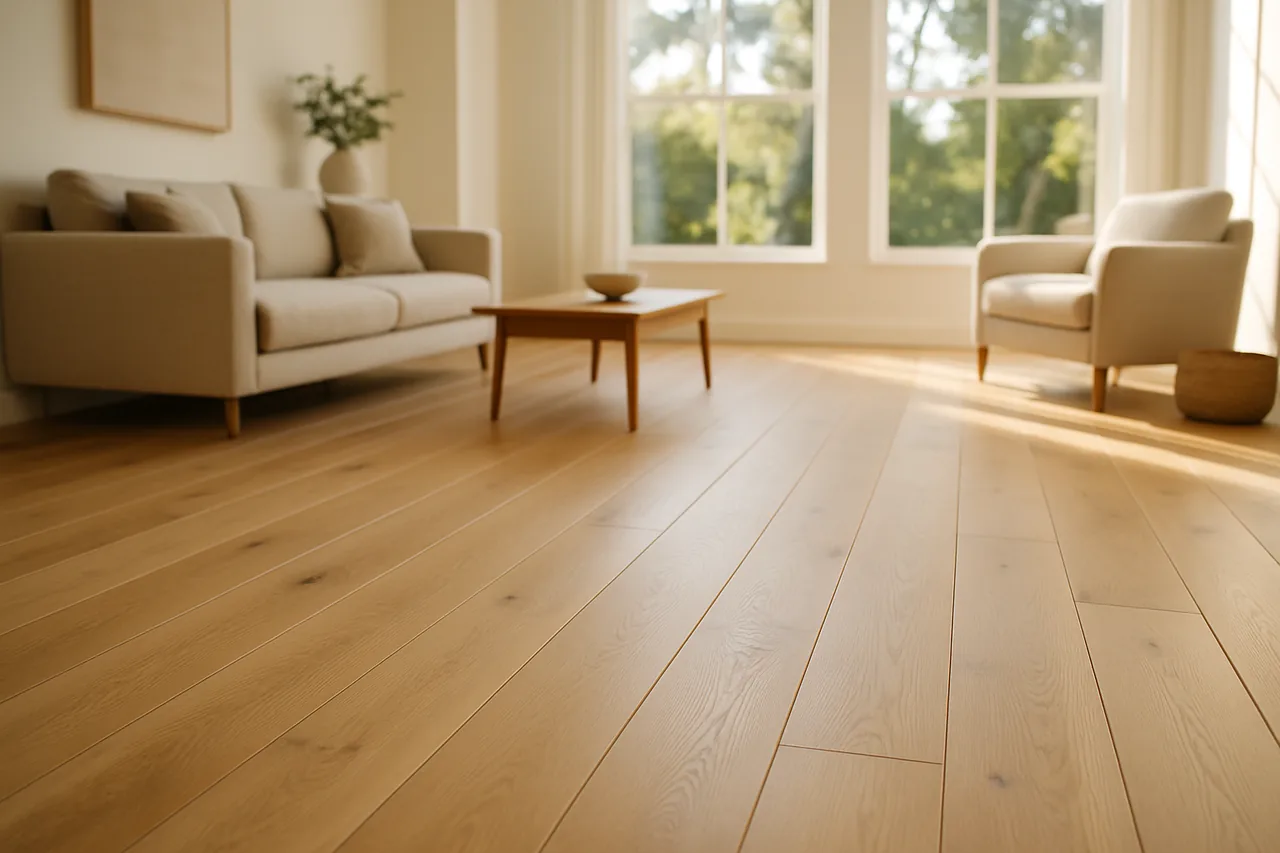
The material comparison tool puts any two flooring materials side by side on the four specs that decide most projects: whether the floor is waterproof, how long it lasts, where it sits on cost, and what upkeep it demands over its life. Pick a Material A and a Material B — solid hardwood, engineered wood, luxury vinyl plank, porcelain tile, laminate, or carpet — and it returns a clean, honest table drawn from documented industry ranges, not marketing. It does not name a winner, because the right floor is the one whose specs match your room's moisture, traffic, and budget. Use it to line two candidates up spec-for-spec, then confirm the finalist against your actual space with a free consultation and a written quote.
Enter values and calculate.
Specs are documented industry ranges; relative cost is positioning, not a quote.
How to Use the Material Comparison Tool
The tool answers one question well — how do these two materials differ on the specs that matter? — but a good comparison starts with picking the right two candidates and reading the result against your room. Walk these six steps.
Start From Your Room, Not the Showroom
Before you pick materials, name your room's conditions: dry or wet, light or heavy traffic, pets or kids. A bathroom floor and a bedroom floor demand opposite specs, so the room decides which materials are even worth comparing.
Choose Two Realistic Candidates
Select the two materials you're actually weighing — say solid hardwood against luxury vinyl plank, or laminate against LVP. Comparing two you'd never install wastes the exercise; comparing your real shortlist sharpens it.
Set Material A and Material B, Then Compare
Pick each material from its dropdown and press Compare. The tool returns a four-row table — waterproof status, lifespan range, relative cost tier, and upkeep — for both at once, so the differences are visible in a single glance rather than across two browser tabs.
Read Waterproof Against Your Moisture
The waterproof row is the first filter for any wet room. If your space is a basement, kitchen, or bath, a material that reads "No" or merely "water-resistant" may be disqualified before the other specs matter. Match this row to the room first.
Weigh Lifespan Against Cost
A material with a shorter lifespan at a lower cost tier can beat a long-lived premium floor on cost-per-year — or lose to it if you plan to stay decades. Read the lifespan and cost rows together, not in isolation, against how long you'll own the floor.
Confirm the Finalist With a Free Consultation
The tool narrows the field; your substrate and room make the final call. A vetted installer tests moisture and flatness, confirms the material suits the space, and puts the recommendation and price in writing. Start that at the free consultation.
Run this way, the comparison stops being trivia about materials and becomes a filter that removes the wrong floor before you fall for a showroom sample.
How the Comparison Works — and the Documented Specs Behind It
The tool isn't guessing. Each cell traces to a documented, public property of the material, and cost is shown as an ordinal tier because a real dollar figure depends on your room and quote. Here is the logic and the sourcing, honestly.
The Four Specs and What Governs Each
Every comparison rests on four columns, and each column maps to a specific, testable property rather than an opinion.
Waterproof Versus Water-Resistant
Waterproof means the material's wear surface and core will not be damaged by standing water for the rated time; water-resistant means it tolerates spills wiped up promptly but can swell or delaminate under prolonged wetness. The distinction is real and consequential: most waterproof vinyl and glazed porcelain tile are genuinely waterproof, while solid hardwood is not, and laminate and engineered wood sit in the water-resistant middle. That single property decides whether a material belongs in a wet room at all.
How Tile Water Absorption Is Actually Measured
Tile's water behavior isn't marketing — it's graded. Under ANSI A137.1, porcelain is defined by a water-absorption rate of 0.5% or less, which is why it's classed as impervious and suitable for the wettest floors, while other ceramic bodies absorb more. The TCNA publishes the setting and substrate standards that keep that performance intact once installed.
Why "Waterproof Core" Still Needs a Dry Substrate
A waterproof floor surface does not make the assembly moisture-proof. Vapor rising from a slab can still damage what's underneath or trap moisture and mold, which is why even waterproof LVP over concrete depends on the substrate reading below the flooring maker's limit — tested per ASTM F2170 during subfloor prep. Waterproof describes the plank, not the whole floor.
Lifespan Ranges, and Why They're Ranges
The lifespan column shows a documented range, not a single number, because how long a floor lasts depends on traffic, care, and whether it can be renewed. Solid hardwood commonly reads 50–100 years because it can be sanded and refinished many times; engineered wood reads shorter because its wear veneer limits refinishing; LVP and laminate read 15–25 years as replace-not-refinish products; porcelain tile reads 50+ years as an inert, wear-resistant surface; carpet reads 8–12 years as a consumable. These are typical service-life ranges from industry and manufacturer data, not guarantees.
Cost as an Ordinal Tier, Never a Fabricated Number
Cost is shown as $ to $$$$ positioning — relative, ordinal, and honest — because a real per-square-foot price depends on grade, region, substrate prep, and your installer. We do not invent a dollar figure. To turn the tier into a number for your project, size it with the flooring cost calculator using your own quote, and read what moves the price in the matching cost guide such as hardwood or vinyl.
Upkeep: What the Floor Asks of You Over Its Life
The upkeep column names the maintenance model — refinish, replace planks, regrout, or replace — because that model shapes both cost-per-year and daily living. A floor you refinish once a decade behaves very differently from one you replace whole, and neither is universally better; it depends on your tolerance for renewal work versus replacement cost.
The Full Spec Comparison Across All Six Materials
The tool compares two at a time; the table below expands the same documented ranges across every material in the selector, so you can see where each sits before you pick your pair.
| Material | Waterproof | Typical lifespan | Relative cost | Upkeep model |
|---|---|---|---|---|
| solid wood | No | 50–100 yrs | $$$$ | Sand & refinish |
| Engineered wood | Water-resistant | 25–40 yrs | $$$ | Refinish 1–2× |
| rigid-core luxury vinyl | 100% waterproof | 15–25 yrs | $$ | Replace planks |
| porcelain floor tile | Waterproof | 50+ yrs | $$$ | Regrout, reseal grout |
| Laminate | Water-resistant | 15–25 yrs | $ | Replace |
| Carpet | No | 8–12 yrs | $ | Replace |
The lesson the full table makes plain is that no material wins every column — waterproof, long-lived, cheap, and low-upkeep never coexist in one product, so the comparison is about which trade-offs your room can accept.
The Durability Ratings Underneath the Lifespan Column
Lifespan is an outcome; the durability ratings below are what predict it. Each material category carries its own published scale, and matching the number to your room's traffic is how you avoid a beautiful floor failing in the wrong space.
The Rating Scale for Each Material
Because every category grades durability differently, comparing raw numbers across materials is meaningless — you compare each material against its own scale and its intended traffic.
| Material | Durability scale | What it measures | Busy-home target |
|---|---|---|---|
| Hardwood | Janka hardness (lbf) | Force to embed a steel ball halfway — dent resistance | Harder species; red oak near 1290 lbf |
| Laminate | AC rating (AC1–AC5) | Abrasion Class — wear resistance of the surface | AC4 or higher |
| Luxury vinyl | Wear layer (mil) | Thickness of the clear protective top layer | 12–20 mil for heavy traffic |
| Tile | PEI rating (I–V) | Porcelain Enamel Institute surface-wear class | At least PEI III–IV |
| Carpet | Face weight & twist | Fiber density and yarn twist — resilience | Higher face weight, tighter twist |
These ratings are the spec sheet behind the lifespan range — a floor bought below its room's rating wears out early no matter what the lifespan column promised.
Common Mistakes When Comparing Flooring Materials
A comparison tool only helps if you read it correctly. These are the recurring errors that lead people to the wrong floor even with the specs in front of them.
| Mistake | What it causes | The fix |
|---|---|---|
| Comparing on looks, not spec | A beautiful floor in a room its spec can't survive | Filter by waterproof and durability first, aesthetics second |
| Ignoring the waterproof row for a wet room | Cupping, swelling, or mold in a bath, kitchen, or basement | Disqualify non-waterproof materials for wet spaces up front |
| Reading cost tier as a price | Budget set on positioning instead of a real quote | Convert the tier to a number with the cost calculator |
| Judging lifespan without upkeep | Surprise at refinishing, regrouting, or replacement demands | Read lifespan and the upkeep model together |
| Comparing durability numbers across materials | Meaningless conclusions — Janka and PEI aren't the same scale | Compare each material against its own scale and its room |
| Forgetting the substrate | A great material failing over an untested, wavy, or wet subfloor | Plan substrate preparation as part of every candidate |
| Skipping cost-per-year math | Overpaying for lifespan you won't use, or under-buying for a forever home | Divide relative cost by expected years of ownership |
Each mistake is a failure to read across columns — the specs only mean something in relation to your room, your moisture, and how long you'll own the floor.
Get the Most From This Tool: The Material Fit Framework
Six disciplines turn a spec table into a confident material choice. Apply the framework and the comparison does real work instead of confirming a showroom crush.
- 1. Define the room's demands first
- Write down moisture, traffic, and household (pets, kids) before you open a dropdown. The room's demands are the filter every material must pass; picking materials first inverts the logic.
- 2. Filter on waterproof for wet spaces
- For any bath, kitchen, laundry, or basement, treat the waterproof row as pass/fail. A non-waterproof material in a wet room is disqualified before its other specs are worth reading.
- 3. Match durability to traffic, on the right scale
- Read each material against its own rating — Janka for wood, AC for laminate, mil for vinyl, PEI for tile — and aim above your room's traffic, never at the minimum.
- 4. Think cost-per-year, not sticker tier
- Weigh the relative cost against the lifespan range and how long you'll own the home. A cheaper short-lived floor can win, or lose, on cost spread across the years you'll actually keep it.
- 5. Price the upkeep you'll really do
- Be honest about whether you'll refinish, regrout, or replace. A low-upkeep floor is worth a premium to some households and irrelevant to others — factor your own tolerance in.
- 6. Verify the finalist against your substrate
- End with an on-site check of moisture and flatness. The best material on paper still fails over a substrate it can't handle, so confirm fit before you commit.
Six Questions to Ask Before You Commit to a Material
Once the tool narrows your pair, these questions turn a spec comparison into a decision you can defend.
- Will this room ever see standing water?
- If yes, the material must read waterproof, not water-resistant — this single question eliminates several candidates for a bathroom or a below-grade basement.
- How hard will the floor live?
- Match the durability rating to real traffic — a pet household or entryway needs a harder, more scratch-resistant surface than a guest bedroom.
- How long do I plan to own this home?
- A forever home rewards a long-lived, refinishable floor; a five-year hold favors a lower cost tier that recovers its cost faster.
- Can my substrate carry this material?
- Solid hardwood needs a nailable wood subfloor; over a slab, engineered or vinyl fits better. The substrate quietly removes options — confirm it early.
- What upkeep am I honestly willing to do?
- Grout needs sealing, wood needs refinishing, carpet needs replacing. Pick the maintenance model you'll actually keep up with, not the one you admire.
- What does the real number look like?
- Turn the cost tier into a figure for your square footage with the the cost estimator and your own quote, so budget enters the decision as a number, not a symbol.
Answered honestly, these six turn two dropdown picks into a floor you won't second-guess — because the choice was made on your room's terms, not the sample's.
Which Two Materials Should You Compare First?
If you're not sure where to start, this short chain points you to the right pair to line up — each branch narrows the field to materials your room can actually use.
- Is the room wet or dry? A wet room — bath, kitchen, laundry, basement — starts the comparison among waterproof options: LVP versus porcelain tile. A dry room opens the full field, including hardwood and carpet.
- How hard does it live? Heavy traffic, pets, or kids pushes toward the higher durability ratings — harder wood species, AC4+ laminate, 12–20 mil vinyl, or PEI III–IV tile. A low-traffic room can compare softer, more comfortable options.
- What's the budget posture? Value-first shortlists laminate against LVP; a premium, long-term posture compares a solid-wood floor against porcelain tile. Compare within your tier, not across the extremes.
- How long will you own it? A forever floor compares refinishable, long-lived materials; a shorter hold compares faster-payback tiers. This decides whether lifespan or cost carries more weight in the table.
- Confirm against the substrate. Whatever pair survives, check that your subfloor can carry it — a slab rules out nail-down solid wood and steers the comparison toward engineered, vinyl, or tile. Then set your Material A and B and compare.
Walked in order, this tree hands you a defensible pair to line up — and a comparison that reflects your room instead of a random matchup.
Get a spec-matched recommendation
Tell us your surface, room, and goals — free, independent guidance and a vetted installer, nationwide.
Flooring Material Comparison Glossary
These terms carry the meaning behind every cell in the comparison — each defined as it functions when you're actually choosing a floor.
- Waterproof
- A surface and core that resist damage from standing water for a rated time — the property that qualifies a material for wet rooms like baths and basements.
- Water-resistant
- Tolerates spills wiped up promptly but can swell or delaminate under prolonged wetness — the middle ground between waterproof and not.
- Janka hardness
- The pounds-force needed to embed a steel ball halfway into a wood species — the dent-resistance rating that predicts how hardwood survives traffic; red oak sits near 1290 lbf.
- AC rating
- Laminate's Abrasion Class, AC1 through AC5, grading how the wear surface holds up to traffic; AC4+ suits busy homes.
- Wear layer
- The clear protective top layer on luxury vinyl, measured in mil — 12–20 mil for heavy traffic; it predicts how long the printed pattern survives.
- PEI rating
- The Porcelain Enamel Institute scale (I–V) grading tile surface wear — floor tile in a busy home wants at least PEI III–IV.
- Water absorption
- The percentage of water a tile body absorbs; ANSI A137.1 defines porcelain at 0.5% or less, the impervious class.
- Refinishing
- Sanding back a wood floor's surface and reapplying finish to renew it — the upkeep model that lets solid hardwood last generations.
- Cost tier
- An ordinal position ($–$$$$) showing relative price among materials — deliberately not a dollar figure, which depends on your room and quote.
- Cost-per-year
- Relative cost weighed against expected lifespan and years of ownership — the honest way to compare a cheap short-lived floor to a premium long-lived one.
- Substrate
- The surface the finished floor attaches to — subfloor or underlayment — whose type and moisture quietly determine which materials are even possible.
- Upkeep model
- How a floor is maintained over its life — refinish, replace planks, regrout, or replace whole — which shapes both cost-per-year and daily living.
A Real Material-Comparison Decision
One representative scenario shows how the tool resolves a common standoff — the specs did the arguing, the room settled it.
Related Tools, Guides, and Material Resources
The comparison narrows your material; these resources turn a narrowed choice into a specced, priced, room-ready decision.
To turn a cost tier into a real number, size your room with the the flooring calculator using your own quote, and read what drives price in the hardwood, vinyl, tile, and carpet cost guides. To go deeper on any single material, open hardwood, vinyl, tile, laminate, or carpet from the flooring hub. For the head-to-head verdicts behind the specs, read hardwood vs. vinyl, laminate vs. vinyl, tile vs. LVP, and engineered vs. solid hardwood, or start from how to choose flooring. To let the room pick for you, try the surface selector; to see a style in place, the room visualizer. Cross-check the documented lifespan values in the material lifespan dataset, browse every estimator at the tools hub, and step back to the full range at the home surfaces hub.