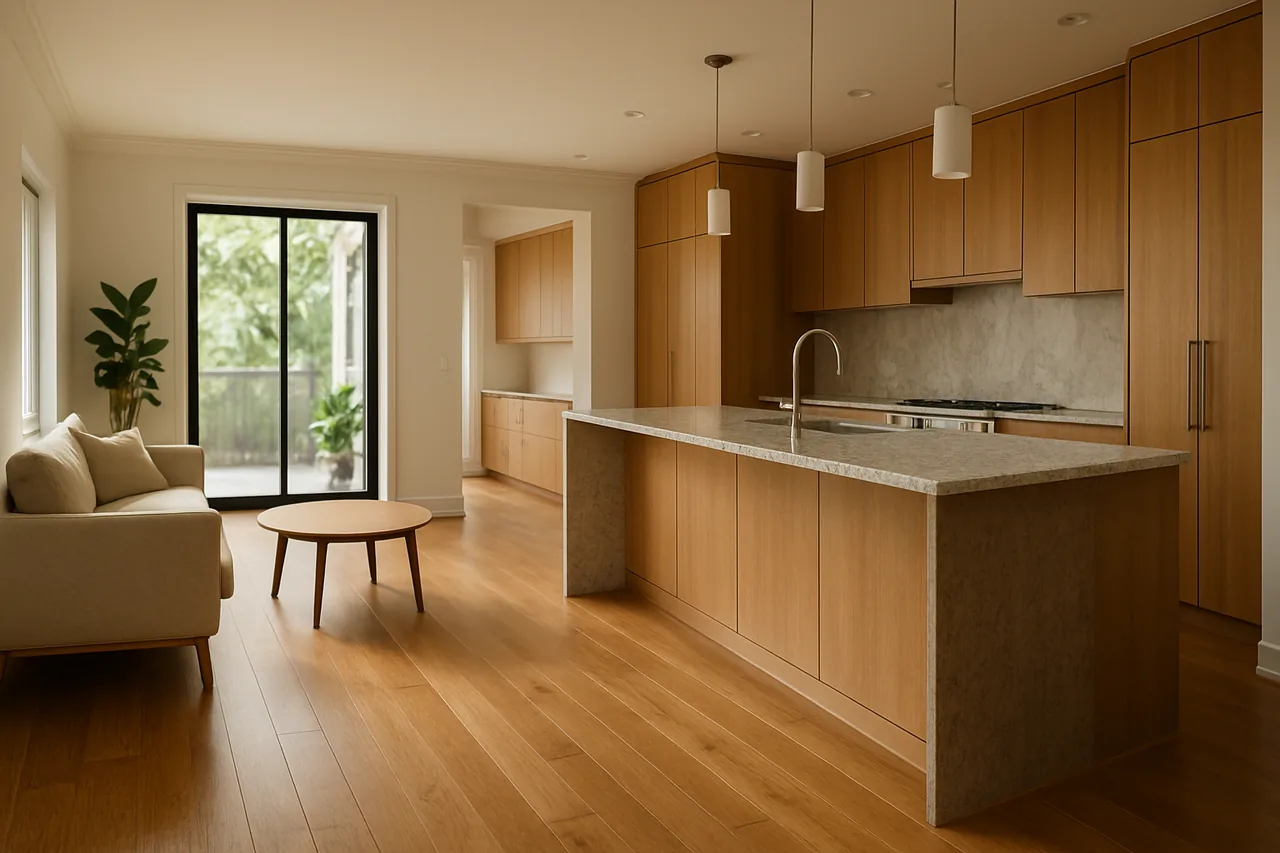
This is a qualitative trend report on where home surfaces are heading in 2026 — an editorial read on the materials, finishes, and colors gaining ground, deliberately built without a fabricated survey, invented percentage, or made-up "X% of homeowners" statistic. A trend report earns trust by being honest about what it is: a documented, reasoned reading of direction, not a poll. The direction is clear and consistent across categories — warm-toned, wide-plank woods replacing cool gray; matte and honed finishes over high gloss; large-format and textured tile; and natural-look quartz and rising quartzite on counters — and the through-line beneath all of it is performance: warm, tactile, low-maintenance materials chosen for how little upkeep they demand. Below, each trend is paired with the documented material property that explains why it is durable, not just fashionable. Read it to plan a surface that will still look current in five years, then get a free, spec-matched recommendation for your project.
What This Trend Report Is — and Is Not
This report reads direction; it does not poll a population. That distinction is the whole point: a trend read grounded in documented material behavior and design demand is defensible, while a report leaning on invented statistics is not — and the difference matters most when you are about to commit a floor for twenty years.
Editorial Analysis, Not a Statistical Survey
The observations here are a qualitative reading of manufacturer launches, product-line direction, and durable design demand — not a measured survey with a sample size and a margin of error. Where the report says a look is "gaining ground," it means the pattern is visible and reasoned, not that a specific percentage of homeowners was counted. No such number is claimed anywhere on this page.
Why Trends Are Anchored to Documented Specs
A fashion that has no performance behind it fades fast; a trend that also happens to be durable persists. So every trend below is paired with the documented material property that gives it staying power — the wear rating, the water behavior, the hardness — from the same public sources used across this Data Center. The look is the surface; the spec is why it lasts.
The Difference Between a Trend and a Fad
A fad is a look with no durability logic — it dates the moment the showroom moves on. A trend, in this report's sense, is a direction backed by a material property that keeps paying off after the style peaks: warm wood tones hide wear, matte finishes disguise scratches, large-format tile means fewer grout lines to maintain. The spec is what separates the two, and this report only reports the latter.
How to Read the "Why It Has Staying Power" Column
Each trend row names the documented property that makes the look durable, not just current. That column is the actionable part: it tells you which trends are safe to commit to a permanent surface and which are better kept to easily-changed accents. Follow the spec, and a trendy choice becomes a lasting one; ignore it, and you are betting a floor on fashion alone.
The 2026 Surface Trends, With the Spec Behind Each
This is the core of the report — the direction each surface is moving in 2026, paired with the documented material property that gives the look staying power. Qualitative reading of design direction; no survey statistics.
| Trend | Surface | What it looks like | Why it has staying power (the spec) |
|---|---|---|---|
| Warm tones return | Flooring | Honey, caramel, and natural woods replacing cool gray | Warm mid-tones and matte finish hide dust, scratches, and wear better than cool or glossy floors |
| Wider, longer planks | Flooring | Fewer seams, a calmer floor, a larger-feeling room | Fewer joints mean fewer places to fail; rigid-core and engineered formats keep wide planks stable |
| Waterproof wood looks | rigid-core luxury vinyl | Rigid-core LVP and waterproof engineered in wood visuals | Waterproof core plus a 12–30 mil wear layer delivers the wood look in wet, busy rooms |
| Natural-look quartz | Countertops | Convincing marble and natural-stone veining | Engineered quartz is non-porous (Mohs ~7) and needs no sealing — the look of marble without the care |
| Quartzite rising | Countertops | Genuine stone with dramatic natural movement | Among the hardest natural stones (Mohs ~7) — harder than marble, for buyers who want real stone |
| Large-format tile | Tile / Walls | Big panels with minimal grout lines, seamless looks | Fewer grout joints reduce the maintenance point that usually fails before the tile (50+ yr body) |
| Matte & honed finishes | All surfaces | Texture and low sheen over high gloss everywhere | Matte surfaces disguise scratches and smudges a glossy finish telegraphs |
| Handmade & textured looks | Tile / Walls | Zellige-style tile and textured feature walls | Depth and craft read as intentional; texture hides minor wear on high-touch surfaces |
The pattern across the whole table is a single idea: 2026's surfaces are chosen for how little they ask of you. Warm tones and matte finishes hide wear, wide planks and large-format tile cut the joints that fail, waterproof cores survive the rooms real life happens in. The style everyone sees is downstream of the performance — which is why these directions have staying power that a gloss-and-gray moment did not.
Methodology & Sources
This report is explicit about being qualitative, and this section states exactly what it is based on and what it deliberately excludes.
What the Reading Is Based On
The trend direction reflects manufacturer product-line launches, the finishes and formats makers are bringing to market, and durable, recurring design demand for warm, tactile, low-maintenance surfaces. It is a reasoned synthesis of that direction, not a measured poll, and it is stated as such throughout.
What It Deliberately Excludes
Two things are absent by policy, and their absence is the report's integrity.
No Fabricated Statistics, No Invented Prices
This page claims no survey percentage, no "X% of homeowners chose Y," no sales-volume figure, and no market-share number — because none was measured, and inventing one would be dishonest. It also contains no prices: relative cost lives as ordinal tiers in the surface cost index, the levers behind a quote in the surface price index, and a real dollar figure comes only from the calculator using your own quote.
The Documented Specs That Ground Each Trend
The performance figures paired with each trend are documented public values: service-life ranges from NWFA and manufacturer guidance and ASTM-tested wear classes; hardness on the Mohs, Janka, and PEI (via ANSI/TCNA and ISO 10545) scales; and wear-layer mils and water absorption from manufacturer data. The full figures are in the material lifespan comparison.
Why a Qualitative Report Is More Honest Here
A trend is a direction, and direction is genuinely qualitative — dressing it in a fabricated percentage would add false precision, not truth. The honest form is to read the direction clearly, ground each observation in a documented spec, and say plainly that no survey was conducted. That is a report you can act on without being misled by a number that was never real.
How to Cite This Data
This report is published under a Creative Commons Attribution 4.0 (CC BY 4.0) license and is free to reference with attribution and a link back to this page. Cite it as: “Home Surface Trends Report 2026,” Pro Work Home Surface Data Center, proworkhomesurface.com. Because it is a qualitative editorial read, cite it as reasoned direction — not survey data — and attribute the documented spec behind any trend (an ASTM wear class, or the Mohs or PEI scale) so no invented statistic is ever implied.
How to Read These Trends for a Real Decision
A trend report is only useful if it improves a choice you have to live with. Here is how to turn direction into the right surface for your home.
Commit Trends With a Spec; Keep Fads to Accents
The safest way to follow a trend is to commit only the ones with a documented performance reason to a permanent surface — a warm-toned, matte, wide-plank floor earns its place because the spec backs the look. Save the purely stylistic moves for surfaces you can change cheaply: paint, a backsplash, an accent wall. That way a shift in taste costs a weekend, not a floor.
Let the Room Still Gate the Trend
A trend does not override the room. A warm solid-wood floor is on-trend and wrong for a wet basement; the waterproof-wood-look trend exists precisely so the same warmth survives moisture. Cap every trend by the room's demands first — the same moisture-and-traffic gate that governs the how-to-choose guide — then pick the on-trend material that clears it.
Favor Trends That Are Also Timeless
The strongest 2026 directions are the ones that read as classic, not merely current — natural wood tones, real and convincing stone looks, honest matte texture. These age into "timeless" rather than "dated," which is exactly what you want on a surface you will own for decades. When a trend and a timeless quality coincide, it is a safe long-term bet.
Cross-Cut: What's Rising vs. What's Fading
A trend read is sharpest as a contrast. This cross-cut sets the 2026 direction against what it is replacing, so you can see which choices now read as dated.
| Surface area | Rising in 2026 | Fading / now reads dated |
|---|---|---|
| Floor color | Warm honey and caramel tones | Cool gray and washed-out floors |
| Plank format | Wide, long planks with few seams | Narrow strips and busy, seam-heavy floors |
| Surface finish | Matte and honed, low sheen | High-gloss floors and counters |
| Tile scale | Large-format, minimal grout | Small tiles with heavy grout lines |
| Countertop look | Natural stone and convincing veining | Flat, pattern-free solid colors |
| Overall feel | Warm, tactile, natural, low-maintenance | Cold, glossy, high-upkeep statement surfaces |
The contrast makes the through-line unmistakable: 2026 moves away from cold, glossy, high-maintenance statements toward warm, tactile, durable materials. If a surface you are considering sits in the right column, it is not wrong — but know that it may read dated sooner, and weigh that against how long you plan to keep it. Compare the options across the full range of home surfaces.
Cross-Cut: How the Trends Land Room by Room
A trend is not universal — the same direction shows up differently in a kitchen than a bedroom. This cross-cut maps the 2026 look to each room and the material that delivers it.
| Room | On-trend look | The material that delivers it |
|---|---|---|
| Kitchen | Warm wood-look floor, natural-stone counter | Waterproof LVP or engineered + quartz |
| Living room | Wide-plank warm wood, matte finish | Solid or engineered hardwood |
| Bathroom | Large-format tile, honed surfaces | Porcelain tile + quartz vanity |
| Basement | Warm wood look that survives moisture | Rigid-core LVP |
| Bedroom | Warm, quiet, tactile floor | Engineered wood or soft carpet |
| Accent wall | Texture and craft — the changeable trend | Handmade-look tile or wood paneling |
The room map doubles as a reassurance: you do not need a different trend per room, you need one warm, matte, natural direction expressed in whatever material each room's moisture and traffic allow. The accent wall is where the purely stylistic, easily-changed trend belongs — the one place to be bold without betting a permanent surface.
Common Mistakes in Interpreting Trend Data
A trend report is easy to misread, and each misread leads to a regret you live with for years. These are the errors to avoid, with the correct reading.
| The misinterpretation | Why it is wrong | The correct reading |
|---|---|---|
| "This is based on a survey of homeowners" | It is a qualitative reading of direction — no poll, no percentage | Treat it as reasoned direction, not measured statistics |
| "On-trend means right for my room" | A trend can conflict with the room's moisture and traffic | Cap the trend by room fit first, then pick the on-trend material that clears it |
| "I should chase the newest look everywhere" | Purely stylistic looks date fast on permanent surfaces | Commit spec-backed trends; keep fads to changeable accents |
| "Trendy and durable are the same thing" | A fad has no performance logic; a trend is backed by a spec | Follow the "why it has staying power" column, not the look alone |
| "Gray floors are now a mistake" | A fading look is not a failure — it just dates sooner | Weigh how long you will keep it against how current it reads |
| "A trend report tells me what it will cost" | This report claims no prices — cost is a separate question | Get relative rank from the cost index and dollars from your own quote |
| "Natural-look quartz is the same as marble" | The look is similar but the Mohs hardness and upkeep differ sharply | Match the spec to your habits, not just the veining you see |
Every row reduces to one discipline: read the direction, verify the spec, and let the room decide. A trend followed with its spec becomes a lasting choice; a trend followed on looks alone becomes next decade's regret.
Get a spec-matched recommendation
Tell us your surface, room, and goals — free, independent guidance and a vetted installer, nationwide.
The Trend-to-Timeless Framework
To turn this report into a decision you will not regret, apply a repeatable six-part read. Named the Trend-to-Timeless Framework, it keeps the durable directions and filters out the fads before they reach a permanent surface.
- 1. Direction over statistics
- Read the report as a reasoned direction, not a poll — there is no percentage to chase. The value is knowing which way surfaces are moving and why, so you plan toward it rather than away from it.
- 2. Spec-backed or accent-only
- Split every trend into those with a documented performance reason and those that are purely stylistic. Commit the spec-backed ones to permanent surfaces; confine the rest to paint, backsplash, or an accent wall you can change cheaply.
- 3. Room fit before fashion
- Cap each trend by the room's moisture and traffic before the look decides anything. The waterproof-wood-look trend exists precisely because the room, not the style, has the final say in a wet space.
- 4. Timeless overlap
- Favor the trends that also read as classic — natural tones, real or convincing stone, honest matte texture — because they age into timeless rather than dated. When trend and timeless coincide, the long-term risk is low.
- 5. Maintenance match
- Confirm the trend's upkeep fits how you live. Natural-look quartz gives the marble look without marble's care; a genuine soft stone gives the look and the maintenance. Choose the spec that matches your habits, not just the appearance.
- 6. Cost and longevity check
- Cross the chosen look against its rank in the cost index and its range in the lifespan data, so a trendy choice is also a sound value over the years you will keep it.
How to Use This Report for Your Project
The framework governs the read; this second list turns the report into concrete steps you can take now, in order.
- Identify the directions you actually like
- Note which 2026 trends genuinely appeal to you — warm tones, wide planks, large-format tile, natural-look counters. Starting from real preference, not obligation, keeps the result a home you like rather than a showroom you copied.
- Separate the permanent from the changeable
- Sort your chosen looks into surfaces you will keep for decades (floors, counters) and ones you can swap (paint, accent tile). Commit spec-backed trends to the first group and stylistic ones to the second.
- Match each trend to a room-appropriate material
- Use the room cross-cut to pick the material that delivers the look within the room's moisture and traffic — a warm wood look via rigid-core LVP in a basement, via hardwood in a dry living room.
- Verify the spec behind the look
- Confirm the documented property that gives your chosen trend staying power — wear layer, hardness, water behavior — against the lifespan data, so the look is backed by performance.
- Check cost position and price it honestly
- Place the material on the cost-tier index, then price your real project with your own quote in the the cost estimator — the report never assigns a price, and neither do the tools.
- Get a spec-matched second opinion
- Bring the look you want to a free consultation. A vetted installer confirms the on-trend material fits the room and the substrate — the check between a look you saw and a surface that lasts.
A Decision Tree for Following a Trend Safely
Walk this chain in order; each step filters a trend against durability, room, and permanence, so what survives is a look worth committing.
- Does the trend have a documented spec behind it? If the look is backed by a performance property — warm matte hides wear, large-format cuts grout, waterproof core survives moisture — it is safe for a permanent surface. If it is purely stylistic, route it to a changeable accent instead.
- Does it fit the room's moisture and traffic? Cap the trend by the room. If a warm-wood look is wanted in a wet or below-grade space, choose the waterproof version (rigid-core LVP, waterproof engineered) rather than solid wood. The room gates the material.
- Is it timeless as well as current? If the look also reads as classic — natural tone, real stone, honest texture — it will age well on a long-lived surface. If it is sharply of-the-moment, keep it to a surface you can change when taste shifts.
- Does its upkeep match how you live? Confirm the maintenance the look requires fits your habits — choose natural-look quartz over genuine marble if you will not maintain soft stone. Match the spec, not just the veining.
- Is it sound on cost and longevity? Check the material's rank in the cost index and range in the lifespan data, then price it with your own quote. A trend that clears all five steps is a look you can commit for the long term.
Run this way, the report guides taste while the spec, the room, and your own quote keep the choice sound — a trendy surface that is also a durable, well-priced one.
A Real Trend-Driven Surface Decision
One representative scenario shows the report used correctly — to guide a current look while the spec and the room kept the choice from becoming a regret.
Surface Trends Glossary
The terms below recur across this report and the specs behind the trends — each defined as its working meaning for a design decision, so you can tell a lasting direction from a passing one.
- Qualitative trend report
- A reasoned reading of design direction based on documented material behavior and market launches — not a survey. It reports which way surfaces are moving and why, without claiming a measured percentage.
- Trend vs. fad
- A trend is a direction backed by a performance property that keeps paying off after the style peaks; a fad is a look with no durability logic that dates the moment it passes. This report tracks only the former.
- Staying power
- The documented reason a look outlasts its moment — warm matte tones hiding wear, large-format tile cutting grout joints, a waterproof core surviving moisture. The spec beneath the style.
- Large-format tile
- Big tile panels that reduce the number of grout lines — a seamless look and, because grout usually fails before the tile, less of the maintenance point that ends a tile floor's life.
- Matte / honed finish
- A low-sheen surface that disguises the scratches, smudges, and wear a high-gloss finish telegraphs — the finish trend with a durability payoff.
- Rigid-core LVP
- Luxury vinyl plank with a dense, waterproof core that delivers a warm wood look in wet, busy rooms — the material behind the waterproof-wood-look trend.
- Wear-layer mil
- The thickness of luxury vinyl's clear top layer in mils — the spec that sets how long a wood-look floor survives traffic. 12–30 mil spans light residential to heavy use.
- Natural-look quartz
- Engineered quartz with convincing marble or stone veining — non-porous and hard (Mohs ~7), giving the on-trend stone look without the sealing and care of soft natural stone.
- Mohs hardness
- A mineral's scratch-hardness rating, 1–10. It explains why on-trend quartzite (Mohs ~7) is a harder, lower-care choice than the marble look it often replaces (Mohs ~3).
- Wide-plank format
- Wider, longer floor boards that create fewer seams and a calmer, larger-feeling room — the format trend, kept stable in rigid-core and engineered constructions.
- Timeless overlap
- When a current trend also reads as classic — natural tone, real stone, honest texture — so it ages well on a permanent surface. The safest kind of trend to commit.
- Changeable accent
- A surface you can update cheaply — paint, backsplash, an accent wall — where a purely stylistic, of-the-moment trend belongs without risking a permanent floor or counter.
Applying the 2026 Trends Across a Whole-Home Project
Because this report spans flooring, countertops, tile, and walls, it is a planning tool for a cohesive whole-home look — one warm, matte, natural direction expressed appropriately in every room.
Carry One Direction, Vary the Material
The cleanest way to apply the report is to hold a single warm, tactile, low-maintenance direction across the home and let each room's moisture and traffic choose the material that delivers it — hardwood where it is dry, rigid-core LVP where it is wet, large-format porcelain in the bath. One direction, many materials, reads intentional and ages together, the same cohesion the how-to-choose guide and the Learning Center teach.
Verify the Look Is Sound on Spec, Cost, and Life
Before committing the palette, run each material through the Data Center: confirm the spec that gives its trend staying power in the lifespan comparison, its position on the cost-tier index, and the levers behind its quote in the price index — then price the real project with your own quote in the the flooring calculator. Where the work touches a kitchen remodel or a bathroom remodel, the trend report sets the look and the rest of the Data Center keeps it sound — the same discipline across the full range of home surfaces.