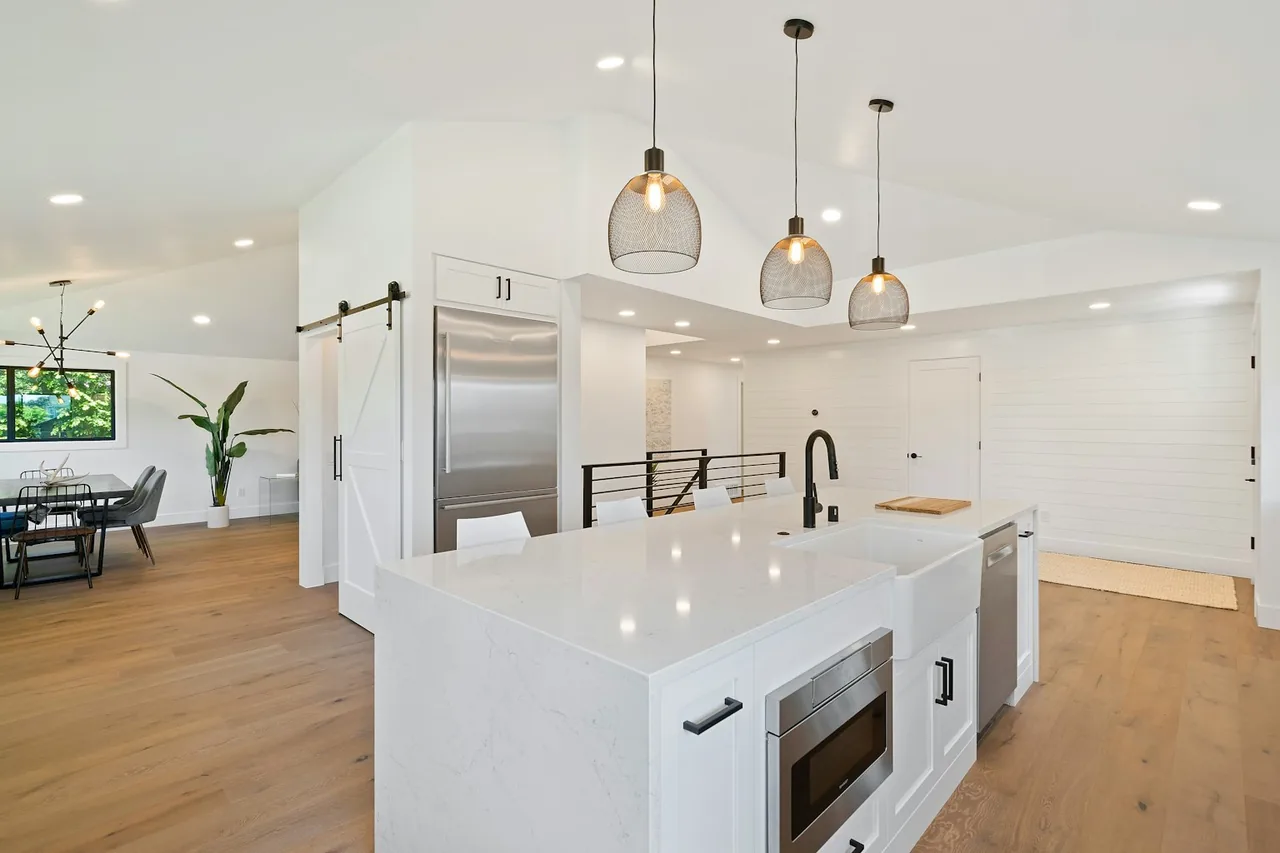
Quartz is an engineered stone — roughly 90–93% ground natural quartz bound in polymer resin and pigment, then vibro-compacted and cured into a slab. One property decides whether it's right for your space and almost nothing else does: heat. Because the binder is plastic, quartz is the most stain- and bacteria-resistant counter you can buy and it never needs sealing — but a pan straight off the burner can scorch the resin permanently. Engineered quartz is non-porous, hard at Mohs 7, and uniform across slabs, which is exactly why it dominates busy kitchens. Get a free consultation and a written, itemized scope from a vetted fabricator before a slab is ordered — the layout, seams, and overhang support decided in that document are what separate a seamless counter from one that telegraphs every joint.
Quartz Is a Manufactured Slab, Not a Quarried One
The single fact that explains every strength and every weakness of quartz is that it is built, not dug. Granite and marble are cut from the earth as finished stone; quartz is engineered to behave like stone while solving stone's biggest liability — porosity.
How the Slab Is Engineered
Crushed natural quartz, one of the hardest common minerals, is blended with about 7–10% resin and pigment, vibro-compacted under vacuum to drive out air, and cured into a dense sheet. The mineral gives the slab its hardness; the resin gives it its color, its consistency, and its one fatal flaw under heat. Because the body is sealed from the factory, there are no capillaries for liquid to seep into — red wine, coffee, oil, and citrus sit on the surface until you wipe them away.
Why Non-Porous Changes Everything
That non-porous body is why quartz wins in the rooms that punish a counter hardest. In a working kitchen countertop it shrugs off the spills and acids that etch marble and stain unsealed granite, and because nothing soaks in, bacteria have nowhere to live without any sealing routine. On a bathroom vanity it resists toothpaste, cosmetics, and standing water indefinitely. It also delivers a consistency natural stone cannot: the pattern is designed, so two slabs from the same line look alike, and a large kitchen with multiple runs and a big island reads as one continuous material instead of a patchwork of unique slabs.
The Character Trade You Accept
The trade you make for that consistency is geological character. Quartz can imitate marble veining or a granite speckle convincingly, but it is a printed-and-pressed pattern, not a one-of-a-kind slab. If you want the irreplaceable look of natural stone, that argues for granite, marble, or quartzite instead. If you want a hard, low-drama surface that performs the same on day one and year fifteen, quartz is built for it — and the learning center walks the full decision.
Where Quartz Fails — Heat and UV, the Two Real Limits
Quartz has exactly two genuine weaknesses, and both trace to the same source: the resin. Understanding the failure mechanism is what keeps you from the two mistakes that ruin quartz tops, and what tells you when quartz is the wrong stone entirely.
Heat: The Resin's Hard Ceiling
The quartz mineral itself is nearly inert to temperature, but the polymer binder that holds the slab together is not. Set a pan straight off a burner or a hot oven onto quartz and the localized heat can soften, discolor, or scorch the resin, leaving a dull white or yellowed mark — or a fine crack from thermal shock, the stress fracture that forms when one spot expands faster than the slab around it. Unlike a natural-stone burn, it is permanent. The fix is simple and non-negotiable: always use a trivet or hot pad. This is the single most important difference between living with quartz and living with heat-tolerant granite, which takes a hot pan without flinching.
UV: Why Quartz Stays Indoors
The same resin that yellows under a hot pan also yellows under sustained sunlight, so most quartz is not warranted for outdoor use and will fade in a sunroom or an outdoor kitchen. For full sun, the right engineered choice is porcelain, which is UV-stable by design. Even indoors, keep a quartz run out of a long stretch of direct light to avoid slow discoloration over the years.
The Lesser Limits: Edges and Harsh Chemicals
Beyond heat and UV, quartz is hard but not indestructible. A sharp impact on an unsupported edge can chip the resin-rich rim, which is why overhang support matters at fabrication. And while the surface resists almost everything, high-pH and abrasive cleaners — bleach, oven cleaner, drain cleaner, paint remover — can dull or discolor the finish over time, so they get wiped up immediately if they ever touch the slab. None of these is a reason to avoid quartz; they are reasons to fabricate and clean it correctly.
Quartz vs Granite, Marble, Quartzite, and Porcelain
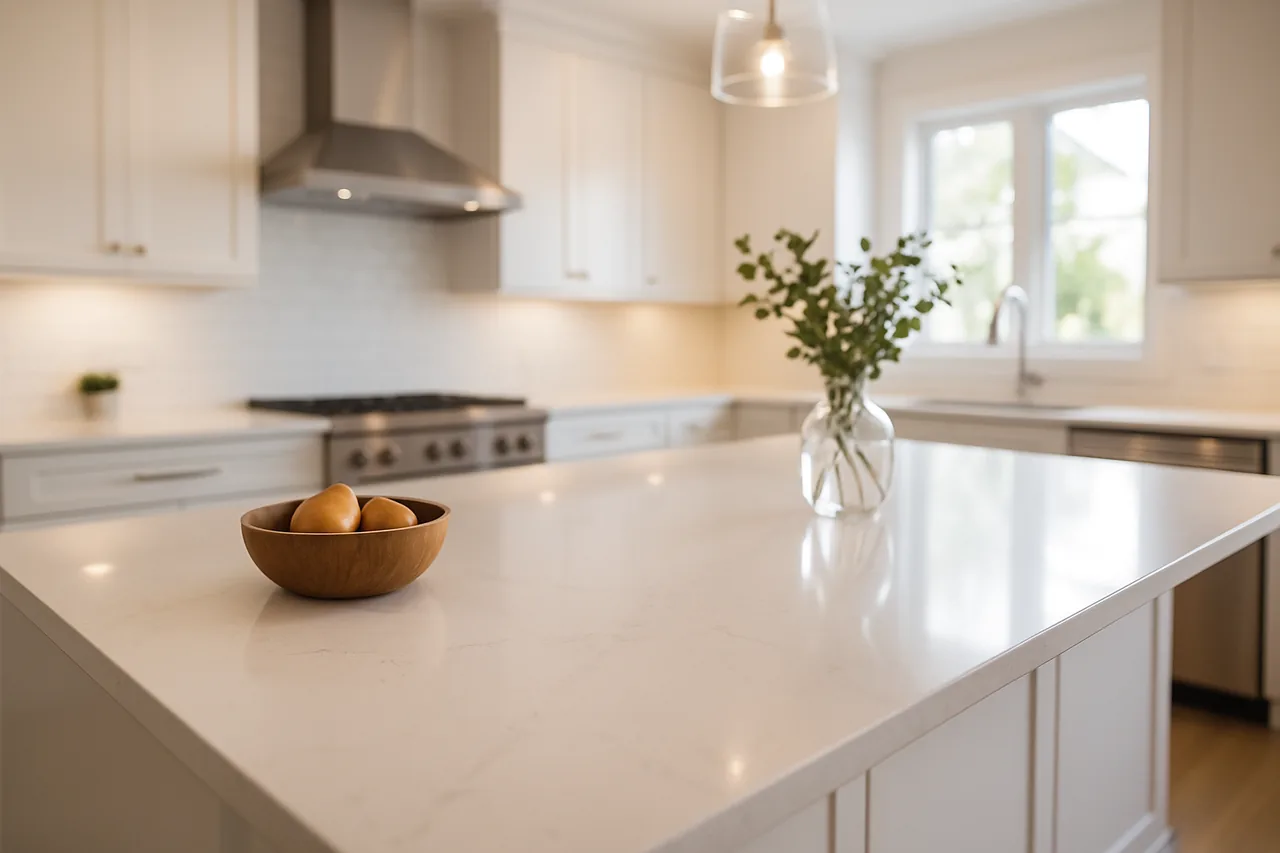
Quartz sits in the middle of the countertop field: lower-maintenance than the natural stones, more pattern-controlled, but heat-sensitive and confined indoors. The cleanest way to place it is against the four materials it's most often cross-shopped with, rated on the specs that actually decide a kitchen.
The Countertop Material Comparison Matrix
The table below is the decision a buyer is really making — porosity, sealing, heat, hardness, and where each surface belongs, side by side. Quartz's profile is the non-porous, never-sealed, heat-sensitive column.
| Material | Type | Porosity / sealing | Heat tolerance | Hardness | Best fit |
|---|---|---|---|---|---|
| Quartz | Engineered | Non-porous, never sealed | Low — resin scorches | Mohs 7 mineral | Busy indoor kitchens, uniform look |
| Granite | Natural igneous | Porous, periodic seal | High — takes hot pans | Mohs 6–7 | Heavy cooking, natural character |
| Marble | Natural metamorphic | Porous, frequent seal | Moderate, but etches | Mohs ~3 | Baths, baking, statement pieces |
| Quartzite | Natural metamorphic | Porous, periodic seal | High — natural stone | Mohs ~7 | Marble look with real durability |
| Porcelain | Engineered sintered | Non-porous, never sealed | Very high — heat-proof | Glass-hard, brittle edge | Outdoors, full sun, ultra-thin |
Quartz vs Granite and Marble
Quartz vs granite is maintenance versus heat. Quartz is non-porous and never sealed; granite is porous and wants periodic sealing — but granite is genuinely heat-tolerant and quartz is not. Choose quartz for a hands-off surface and a uniform look; choose granite if you set hot pans down without thinking. The full breakdown lives in our quartz vs granite guide. Quartz vs marble looks like a close call and lives like opposites: marble is soft calcite that etches the instant acid touches it; quartz mimics the veining and ignores the lemon juice. If you love the marble look but cook with citrus and wine, quartz is the practical answer — see marble vs quartz.
Quartz vs Quartzite and Porcelain
Quartz vs quartzite is the comparison the names sabotage. Quartzite is a natural metamorphic stone — extremely hard and heat-tolerant, but porous and requiring sealing. Engineered quartz is manufactured, non-porous, and heat-sensitive. They are different products with opposite care profiles, not two grades of the same thing. Quartz vs porcelain pits two engineered, non-porous surfaces against each other: porcelain is fully heat- and UV-proof and far thinner, making it the choice for outdoors and ultra-slim profiles, while quartz offers more depth and a wider resin-rich palette indoors. Line them all up spec-for-spec with our material comparison tool.
The Specs and Ratings That Actually Matter for Quartz
Quartz is not graded by one industry scale the way tile uses PEI or laminate uses AC, so you compare it on the handful of numbers and certifications that genuinely predict performance. Each has a published meaning, and each is a question a credible fabricator can answer.
Mineral Content and Hardness
Reputable engineered quartz runs about 90–93% ground quartz by weight, with the balance resin and pigment. Higher mineral content generally means a harder, more durable, more stone-like slab; very cheap material with more filler and resin is softer and more heat-prone, so ask for the percentage before you buy.
What Mohs 7 Means in a Kitchen
The quartz mineral rates about Mohs 7 on the Mohs hardness scale — the 1-to-10 scratch-resistance ranking where a material scratches anything softer than itself. At 7, quartz is harder than a steel knife blade, which is why quartz tops resist everyday scratching well. The finished slab is slightly softer than pure quartz because of the resin, but it still outperforms marble at Mohs ~3 by a wide margin.
Why Hardness Doesn't Mean Chip-Proof
Hardness measures resistance to scratching, not to impact. A Mohs-7 surface laughs off a dragged pot but can still chip at an edge under a sharp blow, because chipping is a fracture, not a scratch. That distinction is why the resin-rich rim of an unsupported overhang is the one place quartz is vulnerable.
The Edge Is Where the Fracture Starts
An impact in the field of the slab, fully backed by the cabinet, has nowhere to propagate; the same impact on an unsupported cantilever past 10 inches meets a slab carrying its own leverage, and the resin-rich edge is where the crack opens. This is why fabrication support — not the Mohs number — governs whether a quartz edge survives a dropped pan, and why overhang engineering is a fabrication line item rather than an afterthought.
Porosity, Thickness, and Silica
Quartz is effectively non-porous, with water absorption near zero — the spec behind "never needs sealing" and behind its stain and bacteria resistance, because there is no path for liquid to enter. Slabs are commonly 2 cm or 3 cm thick: a 3 cm slab is more robust and is often run as a single-thickness edge, while a 2 cm slab is lighter and cheaper but usually needs a laminated (built-up) edge and more continuous support. One current supply-chain note belongs here: because fabricating engineered quartz generates respirable crystalline silica dust, fabricator safety — wet-cutting, ventilation, respirators — matters, and some makers now offer reduced-silica or mineral-alternative slabs. It doesn't change your finished counter's performance, but it is a real and active consideration.
The Quartz Spec Sheet at a Glance
The table below collects the properties a credible fabricator can speak to, with the practical meaning of each. None is a marketing grade; every one predicts how the slab lives.
| Spec | Typical value | What it predicts |
|---|---|---|
| Mineral content | 90–93% ground quartz | Hardness and durability; lower means more filler and more heat risk |
| Hardness | Mohs 7 mineral | Scratch resistance — well above marble's ~3, not impact resistance |
| Water absorption | Near zero | Non-porous: never sealed, stain- and bacteria-resistant |
| Heat tolerance | Low (resin-bound) | Scorches under hot pans; a trivet is mandatory |
| UV stability | Poor | Yellows in sun; indoor use only |
| Thickness | 2 cm or 3 cm | 3 cm = single-thickness edge; 2 cm = built-up edge, lighter |
Not sure which quartz line fits how you cook?
We match you with a vetted fabricator who reads your space — heat, light, traffic — and recommends a slab and finish, with a free, written quote.
Grades, Finishes, and Brands — What to Buy
Quartz quality and look are set by the brand line, the finish, and the slab thickness. There are no quarry "grades" as with natural stone, but the range across product lines is wide, and the choices change daily upkeep as much as looks.
Finish, Pattern, and Thickness
Polished is the default — reflective, vivid, and the easiest to keep looking clean. Honed (matte) is softer and more contemporary but shows fingerprints and watermarks more readily. Textured, suede, and leathered finishes hide smudges and add grip. Pattern scale runs from near-solid colors and fine speckles to large-format, marble-style veining that runs through the body of the slab so seams and mitered edges keep the vein flowing — big dramatic veining usually carries a higher price and needs careful slab layout. For thickness, 3 cm gives a substantial single-thickness edge; 2 cm finishes with a built-up edge to read as thicker.
The Major Engineered-Quartz Brands
The major brands each have their own recipes, palettes, and warranties, so it is worth comparing lines directly. See Cambria, Caesarstone, and Silestone for three of the most established — the brand sets the warranty terms and the pattern library, and your fabricator turns the slab you pick into the counter. Browse the full roster on the brands hub.
How Quartz Is Fabricated and Installed
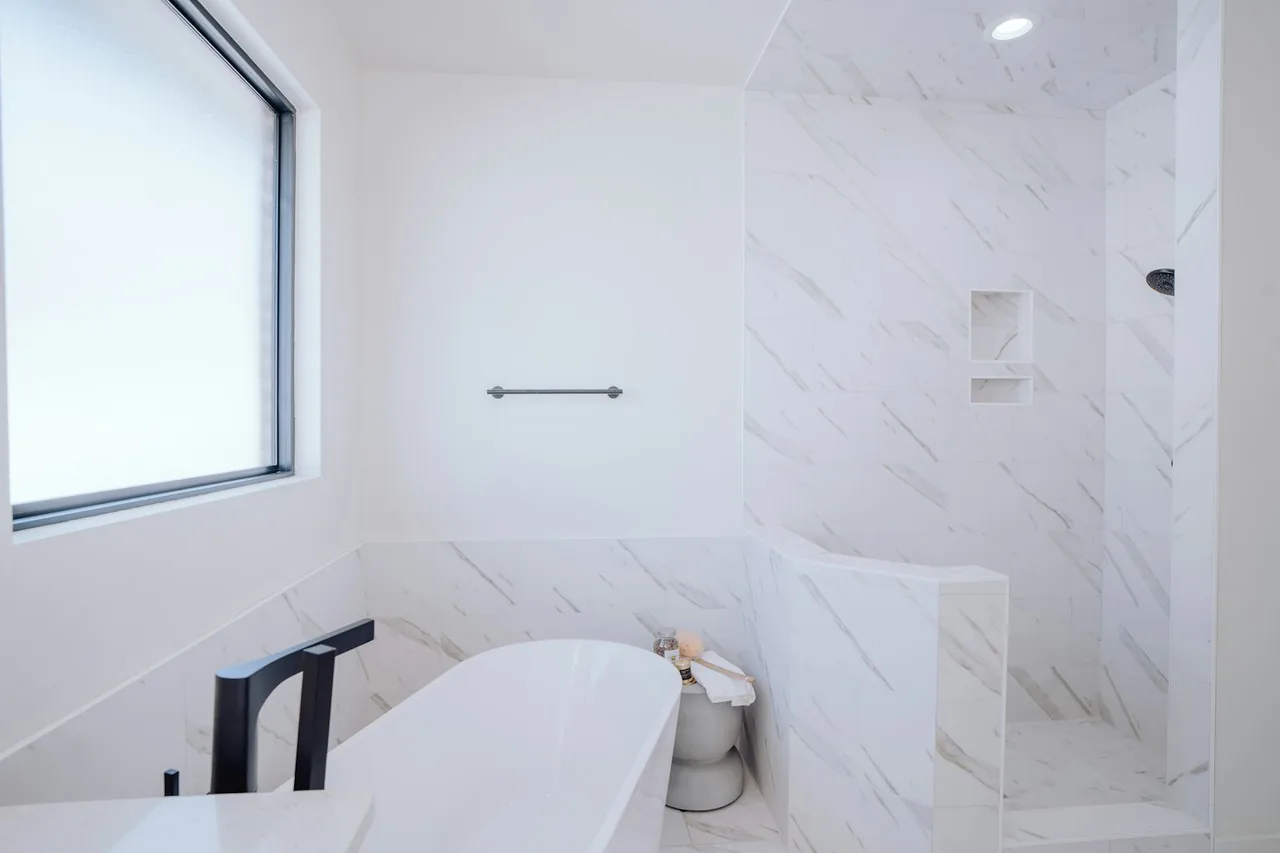
Quartz is a slab material, so it is templated, cut, and set as large pieces — and several realities are specific to engineered stone. The six steps below are the full arc from measuring the cabinets to the final walkthrough, and getting each right is the difference between a counter that looks seamless and one that telegraphs every joint.
Template After Cabinets Are Set
A precise template is taken from cabinets that are already installed and level, because quartz is cut to exact dimensions in the shop and there is no trimming a slab to fit on site the way you can with wood. The template captures every wall, overhang, and appliance gap so the slab lands right the first time.
Digital Layout and Seam Planning
The fabricator lays the template across the slab digitally to place seams in low-sightline runs, align veining across each joint, and minimize waste. On marble-look quartz this step decides whether the vein flows unbroken or jumps at the seam — it is planned before a single cut.
CNC Cutting and Radiused Cutouts
The slab is cut with diamond tooling, and cutouts for the sink and cooktop are made in the shop with the inside corners radiused, not square. A square inside corner is a stress riser — a point where load concentrates and a slab can crack under thermal or mechanical force.
Edge Profiling and Polishing
Edge profiles — eased (square), beveled, bullnose, ogee, or mitered — are ground and polished into the slab. A mitered edge that builds up a thick apron from a thinner slab uses more material and a precise glue-up to keep the seam invisible, so the profile is chosen before cutting.
Setting, Seaming, and Overhang Support
The slabs are set on level cabinets and seams are bonded with a color-matched epoxy that reads as a thin tight line on a quality install. Any overhang past roughly 10 inches for 3 cm material — less for 2 cm — gets steel rods, corbels, or a substructure, because an unsupported cantilever eventually cracks at the resin-rich edge.
Sink Mounting and Final Walkthrough
Undermount sinks are carried on brackets or a rail system and sealed to the non-porous underside, which holds beautifully because the slab doesn't absorb water. The fabricator then cleans the site and walks the counter with you to confirm seams, edges, and cutouts before signing off. The full sequence is in countertop installation.
Skip or rush any one of these six and the failure it was meant to prevent — a visible seam, a cracked corner, a sagging overhang — shows up later, which is why a vetted fabricator treats the sequence as fixed.
Talk through your project — free.
A free consultation and a written, itemized quote from a vetted installer. No pressure, no obligation.
Is Quartz Right for Your Space?
Whether quartz fits is not a matter of taste — it is the output of a short chain of facts about how your room lives and where the counter goes. Walk the decision in order; each branch either confirms quartz or points you to the surface that fits better.
- Is the counter indoors and out of sustained direct sun? If yes, quartz is a candidate. If it's an outdoor kitchen, a sunroom, or a window-flooded peninsula in constant light, the resin will yellow — switch to UV-stable porcelain before going further.
- Will you reach for a trivet under hot cookware? Quartz scorches under a pan straight off the burner. If you'll use a trivet without fail, it stays on the table; if you routinely move hot pots straight to the counter, choose heat-tolerant granite or porcelain instead.
- Do you want a uniform look or one-of-a-kind character? If matched slabs across a big island and perimeter matter, quartz's engineered consistency wins. If you want an irreplaceable natural slab, that points to granite or quartzite.
- Are big overhangs or a waterfall edge in the design? Quartz handles them, but only with engineered support past 10 inches. Raise it before templating so the fabricator specs steel and lays the slab to keep veining clean.
- Confirm the finish against your tolerance for smudges. Polished hides watermarks and wipes cleanest; honed and matte look modern but show fingerprints. Pick the finish for your daily reality, then size the job with our countertop cost calculator.
Run honestly, this tree almost always returns a clear answer — and the most common reason quartz disappoints is skipping question one or two and discovering the limit after the slab is in.
Common Quartz Mistakes, Consequences, and Prevention
Most quartz disappointments are the same handful of avoidable choices, each with a predictable consequence and a known prevention. Naming them is how you spot a corner being cut before it is permanent.
| Mistake | What it causes | The prevention |
|---|---|---|
| Hot pan straight on the slab | Permanent scorch, discoloration, or a thermal-shock crack in the resin | Always use a trivet or hot pad; treat heat as quartz's one hard rule |
| Quartz in full sun or outdoors | The resin yellows and fades; warranty typically voided | Use quartz indoors only; choose porcelain for sun and outdoor kitchens |
| Unsupported overhang past 10 inches | Cantilever cracks at the resin-rich edge over time | Engineer steel rods, corbels, or a substructure before the slab is set |
| Square inside corners on cutouts | Stress risers crack the slab at the sink or cooktop | Radius every inside cutout corner in the shop |
| Sealing quartz like natural stone | Wasted product and a hazy, treated-looking finish | Never seal — quartz is non-porous; soap and water is the whole routine |
| Harsh or high-pH cleaners | Dulled, discolored finish that can't be polished back easily | Use mild dish soap or a non-abrasive cleaner; wipe spills of bleach or solvents at once |
| Templating before cabinets are level | Gaps, lippage at seams, and a slab that rocks | Set and level cabinets first, then template |
Every row is either a warranty trigger or a permanent defect — which is why "trivet, indoors, supported, and templated off level cabinets" is the entire discipline of living well with quartz.
Caring for Quartz
Quartz is the lowest-maintenance counter on the market, but "low" is not "none," and the few rules that exist all protect the resin rather than the mineral.
The Daily Routine
Daily care is just warm water, a soft cloth, and mild dish soap, or a non-abrasive surface cleaner. Because quartz is non-porous, spills never need to be feared — even wine and oil wipe away — and it never needs sealing, ever. That's the whole cleaning routine, and over-treating it with stone sealer or polish does more harm than the simple soap-and-water habit.
What to Keep Off the Slab
What matters more is what you keep off it. Always use a trivet under hot pots, pans, slow cookers, and bakeware — heat is the one thing that damages quartz permanently. Use a cutting board, not because the slab scratches easily (it doesn't) but because cutting on any stone dulls your knives and a hard impact can chip an edge. Avoid harsh chemicals — bleach, oven cleaner, drain cleaner, paint remover, and high-pH or abrasive products can dull or discolor the finish, so wipe them up immediately if they ever contact the surface. Keep the run out of sustained direct sun indoors to avoid slow yellowing. Follow those and quartz stays factory-new with essentially no upkeep — the opposite of a high-maintenance stone like marble, and lighter even than periodically sealed granite.
What Actually Drives the Cost of a Quartz Countertop
A quartz quote is not a flat per-square-foot rate; the headline number hides the items below, ranked by how much they move the total. We don't publish dollar figures here — see the quartz countertop cost guide for ranges and the cost guides hub to compare across materials.
- Brand line and pattern. The biggest swing. A near-solid color from a value line and a large, dramatic through-body vein from a premium line are different prices for the same square footage, and bold veining also demands careful slab layout.
- Total square footage and slab count. More area means more slabs, and a layout that pushes past one slab adds material, a seam, and labor — sometimes a whole extra slab to keep veining matched.
- Edge profile. An eased or beveled edge is standard; a built-up or mitered edge to make a 2 cm slab read as thick uses more material and precise glue-up, raising both.
- Seams, cutouts, and complexity. Each seam, sink or cooktop cutout, and faucet hole is shop labor, and an L-shaped or multi-run kitchen costs more to fabricate than a single straight counter.
- Overhang support. An island or breakfast bar past 10 inches needs steel rods, corbels, or a substructure — a real line item the lowest bid tends to omit.
- Thickness. A 3 cm slab costs more than 2 cm but skips the built-up edge; the choice trades material cost against edge labor and the look you want.
- Removal and disposal. Tearing out and hauling away an old counter is labor and a fee, and it belongs in the written quote up front rather than as a surprise.
Because these drivers swing so widely, the only honest number comes from an on-site assessment. Size your own kitchen first with the countertop cost calculator so you can read a quote critically.
Want an itemized quartz quote, not a headline rate?
We match you with a vetted fabricator who prices the slab, edge, seams, and overhang support as separate lines — free and with no obligation.
The Quartz Fit Test: Six Checks Before You Buy
Before you fall for a sample, run your space through the same six-check test a good fabricator would. Each check matches the slab and finish to how the room actually lives, and a quartz that passes all six is a quartz that stays factory-new for years. Call it the Quartz Fit Test.
- 1. Be honest about hot pans
- If you routinely move cookware straight from heat to counter and won't reach for a trivet, quartz's heat sensitivity is a real risk. Either commit to trivets or choose heat-tolerant granite or porcelain — there is no sealing or finish that makes resin take a hot pan.
- 2. Confirm the room is indoors and shaded
- Quartz belongs inside and out of constant light. A sunroom, a window-flooded peninsula, or any covered outdoor kitchen will yellow it over time; for those, porcelain is the engineered surface that holds its color.
- 3. Match the finish to your tolerance for smudges
- Polished hides watermarks and wipes cleanest; honed and matte look modern but show fingerprints and need more frequent wiping. Pick the finish for your daily reality, not just the showroom lighting.
- 4. Confirm mineral content and thickness
- Ask for the quartz percentage — aim for the 90%+ range — and decide between 2 cm and 3 cm: 3 cm for a solid single-thickness edge, 2 cm with a built-up edge for lighter weight or lower cost.
- 5. Plan overhangs and seams up front
- If you want a big island overhang or a waterfall edge, raise it before templating so the fabricator can spec support past 10 inches and lay the slab to keep veining and seams clean.
- 6. Compare the line against the budget
- Brand and pattern move the price most, so weigh the line you love against the quartz countertop cost guide and size the job with the cost calculator before you commit to a slab.
Pass all six and quartz is almost certainly the right call for your kitchen; fail one or two and the test has just saved you from a surface that fights how you actually cook.
Quartz Countertop Glossary
The terms below recur in every quartz quote, spec sheet, and warranty — each defined as its working meaning on an actual job, so you can read a scope and judge whether it is complete.
- Engineered stone
- A manufactured slab of ground natural quartz bound in polymer resin and pigment, pressed and cured — distinct from quarried natural stone like granite or marble. The category quartz counters belong to.
- Resin binder
- The polymer (about 7–10% of the slab) that holds the crushed quartz together and gives the slab its color and consistency. It is also the source of quartz's heat and UV sensitivity.
- Mohs hardness
- The 1-to-10 scratch-resistance scale; the quartz mineral rates about Mohs 7, harder than a steel knife and far above marble's ~3. Measures scratching, not impact resistance.
- Non-porous
- Having near-zero water absorption, so liquids can't soak in. This is the spec behind quartz's stain and bacteria resistance and its "never needs sealing" property.
- Thermal shock
- A crack that forms when one spot of the slab heats and expands faster than the surrounding material — the mechanism by which a hot pan can fracture quartz, not just scorch it.
- Seam
- The joint where two slabs meet on a layout too large for one piece. A quality seam is placed in a low-sightline run, pattern-aligned, and bonded with color-matched epoxy to read as a thin tight line.
- Overhang
- The portion of counter that extends past the cabinet, as on an island or breakfast bar. Past roughly 10 inches for 3 cm material it needs engineered support or it cracks at the edge.
- Undermount sink
- A sink mounted below the counter so the slab edge forms the rim. On quartz it's carried on brackets and sealed to the non-porous underside, which holds because the slab doesn't absorb water.
- Mitered edge
- An edge built up by joining two pieces at 45 degrees to make a thin slab look thick. It uses more material and a precise glue-up to keep the seam invisible.
- Stress riser
- A point — like a square inside corner on a cutout — where load concentrates and a crack can start. Radiusing the corner removes it.
- Crystalline silica
- The respirable dust generated when engineered quartz is cut dry. Fabricator safety (wet-cutting, ventilation, respirators) and reduced-silica slab options are the response to it.
- UV stability
- Resistance to fading and yellowing under sunlight. Quartz lacks it because the resin degrades in UV, which is why quartz stays indoors and porcelain goes outside.
Standards, Warranty Conditions, and Fabricator Safety
A quartz warranty is a contract with conditions, and the most common denials are not about the slab — they are about how it was used and installed.
Warranty Conditions That Hinge on Use and Install
Most quartz warranties cover manufacturing defects but explicitly exclude heat damage, UV exposure, and improper installation. Translated: a scorch from a hot pan, yellowing in a sunroom, or a crack from an unsupported overhang are typically on you, not the maker. The conditions that keep coverage intact are testable — installed by a qualified fabricator, supported per spec, used indoors with trivets — and a vetted pro puts the install commitments in the written scope so the brand's terms are honored.
Fabrication Safety and the Silica Question
Because cutting engineered quartz releases respirable crystalline silica, responsible fabrication means wet-cutting, ventilation, and respirators in the shop — a worker-safety standard, not a counter-performance one, but a real reason to choose a professional fabricator over the lowest bid. Some manufacturers now offer reduced-silica or mineral-alternative slabs; they perform the same on your counter and shift the dust exposure in the shop. A fabricator who can speak to their silica practices is one who runs a serious operation.
A Real Quartz Decision
The clearest way to see where quartz fits is to follow one realistic kitchen choice where the homeowner's habits, not the showroom sample, decided the material.
How to Vet a Quartz Fabricator
With an engineered slab, the brand sets the warranty but the fabricator decides whether your counter looks seamless or telegraphs every joint. These questions separate a shop that builds quartz tops to last from one that simply cuts and sets fast.
- They template off installed, level cabinets
- Quartz is cut to exact size in the shop, so the template must come from finished, leveled cabinets — not from drawings or rough framing. A fabricator who templates before the cabinets are set is guessing at fit.
- They show you the seam plan before cutting
- Ask where the seams will land and how veining aligns across them. A credible answer points to low-sightline placement at a sink or in a corner and a digital layout — not "wherever the slab runs out."
- They radius cutout corners and spec overhang support
- Confirm that sink and cooktop cutouts get radiused inside corners and that any overhang past 10 inches is engineered with steel or corbels. Square corners and unsupported cantilevers are the two avoidable cracks.
- They run safe silica-dust practices
- A serious shop wet-cuts, ventilates, and protects its crew from respirable silica. A fabricator who can speak to their dust controls runs a professional operation — and may offer reduced-silica slab options.
- They explain the brand's warranty honestly
- The right pro tells you up front that heat, UV, and improper install are typically excluded, and commits in writing to installing per spec so the coverage holds. Vagueness about exclusions is a red flag.
- They put scope, schedule, and a labor guarantee in writing
- Ask for the full scope, the timeline, and a workmanship warranty before work starts. A shop willing to name a labor guarantee — and return if a seam lifts or an edge chips — stands behind the install, not just the slab the maker covers.
Want a fabricator who answers all six of these?
Tell us about your kitchen and we'll match you with a vetted quartz pro who templates off level cabinets, plans the seams, and supports the overhang — in a written scope, free.
Why Route Your Quartz Countertop Through Pro Work Home Surface
Pro Work Home Surface is not a fabricator and does not cut or set your slab — we are a national authority on home surfaces that matches homeowners with vetted local countertop pros and holds them to a published bar.
- A free consultation and an itemized written scope
- Every connection starts with a no-obligation consult and a written quote that lines out the slab, edge, seams, and overhang support separately — so you read the whole job, not a headline rate.
- Template after cabinets are set and level
- Quartz is cut to exact size in the shop, so we expect the template taken from installed, leveled cabinets, with sink and cooktop cutouts radiused at the corners to prevent stress cracks.
- Seams placed, matched, and supported to spec
- Seams are located in low-sightline runs, pattern-aligned, and bonded with color-matched epoxy; any overhang past 10 inches is engineered with proper support before the slab is set.
- Real product, safe sourcing, honest warranty
- The slab delivered matches the line and thickness you selected, the fabricator follows safe crystalline-silica practices, and the brand's written warranty terms — including the heat and UV exclusions — are explained before work begins.
Countertops are one of eight categories we cover across home surfaces. Compare quartz against the rest of the field at the countertops hub, weigh the budget in our quartz countertop cost guide, dig into the trade-offs in our quartz vs granite and marble vs quartz comparisons, and line materials up spec-for-spec with the material comparison tool. Explore the full range of home surfaces — and if you're planning new cabinets at the same time, template both together so the counter lands level the first time.
Brands & Material Authority
Quality and construction drive long-term performance more than the label. These are widely respected names in this category:
- Cambria
- Caesarstone
- Silestone
- MSI
- Cosentino
- Corian
- Wilsonart