Tile flooring is a hard, fired-clay or natural-stone surface set in mortar over a rigid substrate — the most durable, water-tolerant floor a home can have. Three specs decide where a tile belongs: its PEI abrasion rating (floor tile in a busy home wants at least PEI III–IV), its water absorption by ASTM C373 (porcelain absorbs under 0.5%), and its DCOF slip rating for wet floors (≥ 0.42 per ANSI A137.1). The failure point is rarely the tile — it is the substrate under it. Get a free consultation and a written, itemized scope from a vetted installer before you buy, because the substrate, the setting standard, and the slip rating are decided there, not in the showroom.
Tile Is the Hardest, Most Waterproof Floor You Can Buy
No other flooring matches tile on the two things that destroy other materials, and that single fact decides which rooms it owns.
Water and Wear Are the Two Things Tile Beats Outright
A correctly set porcelain or stone floor is effectively permanent underfoot — immune to the moisture that cups wood and swells laminate, and harder than any resilient surface. That is why tile owns the rooms where water is constant: a bathroom floor, a laundry-room floor, a mudroom, and increasingly a kitchen floor — and why it is the default for high-traffic entries that would wear a softer floor thin. Where water and abrasion are the deciding factors, the case for any other material weakens.
The Design Range Nothing Else Touches
Tile spans a look no other category matches: dense porcelain that mimics marble, concrete, or wood; glazed ceramic in any color; and genuine natural stone — marble, travertine, slate — with veining and texture no print can fake. Wood-look porcelain in particular delivers the appearance of hardwood with full waterproofing and no refinishing, the one honest way to put a wood look in a wet room.
The Honest Trade: Cold, Hard, and Substrate-Dependent
The trade is equally real and worth naming up front: tile is cold and hard underfoot, it is loud, it is the most labor-intensive floor to install, and a dropped glass shatters on it. Its longevity is total — but only if the substrate beneath it is rigid and the setting follows the standards. Tile failures are substrate failures, and understanding that is the whole job of buying and installing it well.
The Specs That Matter: PEI, Water Absorption, DCOF, and Mohs
Four numbers tell you whether a tile belongs on your floor, in your wet room, and in your traffic. Buying tile on looks alone, ignoring these, is how a wall tile ends up cracking on a busy floor or a polished stone turns into a slip hazard in a shower.
PEI Rating: Abrasion and Traffic
The first question a floor tile must answer is whether its surface can take the traffic, and the PEI scale answers it.
What the PEI Scale Measures
The PEI rating grades a glazed tile's surface resistance to abrasion on a scale of I to V. PEI I and II are walls and the lightest use; floor tile in a busy home wants PEI III to IV, and the heaviest traffic and commercial floors want PEI V. It measures the glaze's wear, not the tile's strength — a tile can be structurally sound and still have a glaze rated only for walls.
Why a Wall Tile Fails on a Floor
Putting a wall-rated PEI I or II tile on a high-traffic floor wears the glaze visibly where people walk, leaving dull, scuffed traffic paths through an otherwise intact tile. The tile does not crack — its surface simply abrades, because it was never graded for foot traffic. The prevention is a one-line check at purchase: confirm the PEI rating clears the room's traffic before color ever enters the decision.
PEI Is Not a Strength or Slip Rating
The most common misread of PEI is treating it as an overall quality grade. It is not — it rates glaze abrasion only, and says nothing about a tile's breaking strength, its water absorption, or its slip resistance. A high-PEI tile can still be too absorbent for a wet room or too slick for a shower floor, because those are separate specs: water absorption by ASTM C373 and DCOF by ANSI A137.1. Read PEI for traffic wear, then read absorption and DCOF for the room — three numbers, three different questions, none of them interchangeable.
Water Absorption: Porcelain vs. Ceramic by ASTM C373
The spec that separates porcelain from ceramic is water absorption, measured by ASTM C373. Porcelain absorbs under 0.5% water, which makes it frost- and freeze-resistant and suitable for wet rooms and outdoors; ceramic absorbs more — commonly 0.5% to 3% or higher — which limits it to drier, interior, lower-traffic floors. Low absorption is what keeps water from getting into and behind the tile, so it is the spec that governs a wet room or any freeze-prone space. A tile's absorption number is the difference between a floor that survives a shower and one that slowly fails behind the surface.
DCOF: Slip Resistance for Wet Floors
The DCOF (dynamic coefficient of friction) rates how slippery a tile is underfoot. For interior floors expected to get wet, the recognized benchmark is DCOF ≥ 0.42 per ANSI A137.1 — a polished tile below that is a hazard in a bath or entry. Texture, finish, and grout-joint count all raise it, which is why a small mosaic with many joints grips a wet shower floor where a large polished tile would not. The slip rating is the spec a wet room cannot skip, however beautiful the dry tile looks.
Mohs Hardness: For Natural Stone
Fired tile is uniformly hard, but natural stone varies, and the Mohs scratch-hardness scale predicts it. Marble sits at roughly Mohs 3, soft enough to scratch and to etch from acids like wine and citrus; harder, denser stones like slate resist both far better. The Mohs number, plus the stone's porosity, tells you how much a stone floor will need sealing and babying. Above all four specs sit the setting standards: TCNA (Tile Council of North America) and ANSI define the substrate, mortar, coverage, and movement joints a lasting tile floor requires.
The Tile Spec Table
The table below collects the recognized specs a competent installer verifies, side by side, so the rating-by-room logic reads at a glance. These are representative figures; the printed data sheet for your specific tile always governs.
| Spec | What it measures | Recognized standard | Floor / wet-room threshold |
|---|---|---|---|
| PEI rating | Glaze abrasion / traffic | PEI I–V scale | PEI III–IV for a busy floor, V for commercial |
| Water absorption | Porosity (porcelain vs. ceramic) | ASTM C373 | Porcelain < 0.5%; ceramic 0.5–3%+ |
| DCOF | Slip resistance underfoot, wet | ANSI A137.1 | ≥ 0.42 for interior wet floors |
| Mohs hardness | Scratch resistance (natural stone) | Mohs 1–10 scale | Marble ~Mohs 3 (soft); slate far higher |
| Setting standard | Substrate, mortar, movement joints | TCNA / ANSI | Deflection-rated substrate, full coverage, soft joints |
The pattern the table makes plain: the tile spec keeps the surface right for the room — abrasion, water, slip, scratch — while the TCNA/ANSI install keeps it from cracking. Both have to be right. Compare tiles spec-for-spec with the material comparison tool before settling on one.
Want the tile spec and substrate matched to your room before you buy?
We match you with a vetted installer who confirms the PEI, absorption, and slip rating for your space and checks the substrate's rigidity — and puts it in a written scope, before you commit to a tile or a price.
Tile vs. Vinyl, Wood, and Stone Look-Alikes — the Honest Trade
Tile is cross-shopped against the floors that imitate it, and the right call depends entirely on the room and what you weigh — compared by the spec each is rated on, not the showroom finish.
The Material Comparison Matrix
The matrix below is the decision a homeowner is actually making — hardness and water versus comfort, heat, and install effort, side by side.
| Material | Governing spec | Water tolerance | Underfoot feel | Heat tolerance | Install effort |
|---|---|---|---|---|---|
| Tile (porcelain) | PEI + absorption + DCOF | Highest — fully waterproof | Cold, hard, loud | Highest | High (substrate + setting) |
| Luxury vinyl | Wear-layer mil | Waterproof (rigid core) | Warm, soft, quiet | Lower — sun-sensitive | Low — floats fast |
| Hardwood | Janka hardness | Low — keep out of wet rooms | Warm, quiet | Moderate | High |
| wood-look porcelain tile | PEI + absorption + DCOF | Highest — fully waterproof | Cold, hard | Highest | High (substrate + setting) |
Tile vs. Vinyl: Hardness vs. Comfort
Against luxury vinyl, tile is harder, more heat-tolerant, and longer-lived underfoot, and it never abrades through the way a vinyl wear layer does — but vinyl is warm, quiet, fast to install, softer on dropped dishes and standing feet, and far cheaper to put down. For a wet room where comfort matters, vinyl often wins; where maximum durability and a true hard surface matter, tile does. Our tile vs. luxury vinyl plank guide works through it.
Tile vs. Wood and the Look-Alikes
Against hardwood, the contest is really about the room: tile beats wood outright on water and hardness and is the correct move for wet rooms, while wood wins on warmth, comfort, refinishability, and resale value in the dry, lived-in rooms where it belongs. The interesting middle is the look-alikes — wood-look planks gives a waterproof wood appearance, and porcelain that imitates marble or concrete delivers a stone look without natural stone's porosity and sealing. The honest summary: choose real tile where you need a permanent, waterproof, hard floor and accept the cold and the install; choose a softer material where comfort, speed, and budget lead.
Porcelain, Ceramic, Natural Stone, and Mosaics — What to Choose
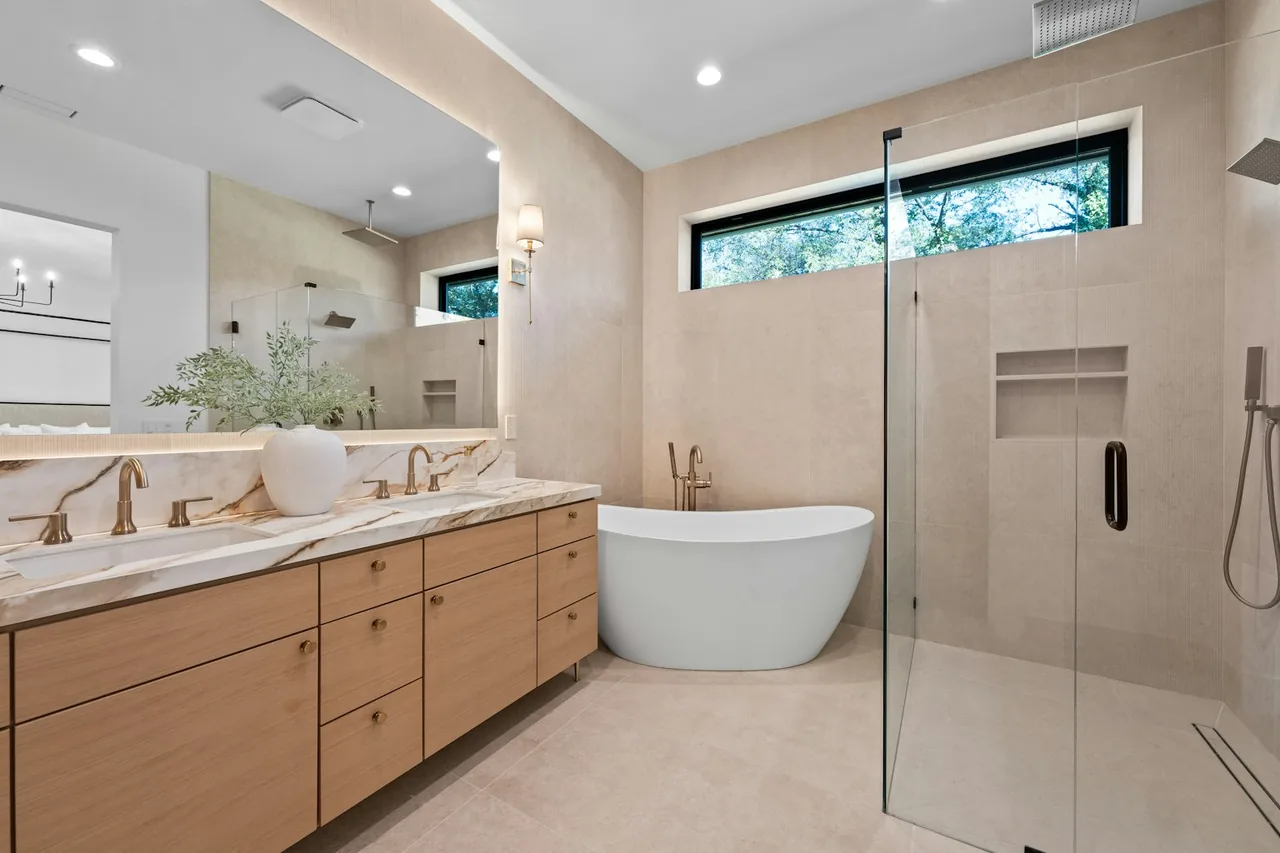
Tile splits into fired clay and natural stone, and within each the right pick is dictated by the room's water, traffic, and slip demands. Pick the type for the constraints first, the look second — and each links to the type page that details it.
Fired Clay: Porcelain, Ceramic, and Wood-Look
Porcelain floor tile is the workhorse — dense, under 0.5% absorption, frost-resistant, available through-body or glazed, and rated PEI IV to V for floors; it is the default for wet rooms, high traffic, and outdoors, at the cost of being harder to cut than ceramic. Ceramic floor tile is glazed clay that is easier and cheaper to cut and install, best for low-to-moderate interior traffic at PEI III, but with higher water absorption that keeps it out of the wettest rooms. Wood-look tile is porcelain printed as wood — waterproof, scratch-resistant, and the one honest way to put a wood look in a bath or laundry.
Natural Stone: Marble, Travertine, and Slate
On the natural-stone side, the trade is beauty for maintenance. Marble is luxurious and veined but soft at Mohs 3, porous, and etch-prone — a honed finish hides etching better than polished, and it needs periodic sealing. Travertine is a naturally pitted limestone sold filled (smooth) or unfilled (textured), porous and requiring sealing, with honed and tumbled finishes adding slip resistance. Slate is the most floor-friendly stone — dense, durable, with a natural cleft surface that gives strong slip resistance, sealed to deepen color.
Mosaics: Where Grout Joints Are the Feature
Mosaic tile — pieces under 2 in. mesh-mounted on sheets — earns its place on shower floors and curbless pans precisely because the extra grout joints raise slip resistance where it matters most. What is a maintenance burden elsewhere (more grout to clean) becomes a safety feature on a wet pan, which is why the same homeowner often runs large tile on the dry bathroom floor and a mosaic on the shower floor.

How Tile Is Installed
Tile is the least forgiving floor to install and the one where the visible work is the smallest part. The substrate and setting bed are most of the job, and the six steps below are the full arc — with the two that prevent every crack and pop, movement joints and waterproofing, called out where they fall.
Substrate and Deflection Assessment
The installer confirms a substrate stiff enough not to deflect, because a floor that bounces cracks rigid tile. Most floors want at least an L/360 deflection limit, and natural stone and large-format tile often want L/720. A bouncy joist system is reinforced first, under subfloor prep.
Backer Board or Uncoupling Membrane
Over a wood floor that often means a layer of cement backer board or an uncoupling membrane that isolates the tile from substrate movement — never tile straight onto a bouncy subfloor. Over concrete it means a flat, sound, clean slab. This layer is what lets a rigid tile survive a substrate that moves at all.
Waterproofing the Wet Areas
In showers and wet areas, a waterproofing membrane goes behind and beneath the tile so water never reaches the substrate. Tile and grout are water-tolerant, not a waterproof barrier on their own — the membrane is, and skipping it is how a beautiful shower rots its substrate from inside.
Setting in Thin-Set With Full Coverage
The tile is set in thin-set mortar with the trowel size the tile and pattern require, and the installer back-butters and checks coverage so the mortar fully contacts the back of every tile — the step that prevents hollow, loose tiles. Large-format tile demands a medium-bed mortar and extra flatness to avoid lippage, the uneven edges you feel and trip on.
Movement Joints at Perimeter and Field
Soft, flexible movement joints go at the perimeter and across large tile fields, per TCNA detail, so the floor can expand and contract without cracking the rigid tile. Cracks that march in a straight line across a floor are the signature of this step being skipped.
Grout, Seal, and Walkthrough
Joints are fully packed with grout at the correct width, stone and cement grout are sealed where specified, and the installer walks the floor with you to confirm coverage, lippage, and slip-rated surfaces in wet areas. Transitions and any stair work finish the edges.
Skip or rush the substrate, the movement joints, or the waterproofing and the failure each prevents — a cracked field, a popping tile, a rotted shower — shows up within a year. That is why a vetted installer treats the setting standards as fixed. The broader sequence lives under flooring installation.
Talk through your project — free.
A free consultation and a written, itemized quote from a vetted installer. No pressure, no obligation.
Is Tile Right for Your Space?
Whether tile belongs in a room — and which tile — is the output of a short chain of facts about the room's water, its traffic, and the substrate's rigidity. Walk the decision in order; each branch narrows the type and the spec.
- Does the room get wet, freeze, or go outdoors? If yes, you need porcelain under 0.5% absorption by ASTM C373, and a wet floor needs a DCOF ≥ 0.42 slip-rated surface. A dry interior room opens ceramic and the softer stones too.
- How hard does the room live? A busy floor wants PEI III to IV; a heavy-traffic entry wants PEI V. Never put a wall-rated PEI I or II tile on a floor — the glaze wears through where people walk.
- Is the substrate rigid enough? Tile demands a deflection-rated substrate — at least L/360, and L/720 for stone and large-format. A bouncy floor must be reinforced first, because a stiffer tile is not the fix for a flexing structure.
- Comfort or hardness first? Tile is cold and hard, which is wrong for a bedroom or living room where comfort underfoot is the priority. If comfort leads, a softer material is the call; if a permanent hard surface leads, tile is.
- Natural stone or porcelain? If you want a stone look but not the sealing and etch-care, a porcelain that imitates the stone gives the appearance without the maintenance. Confirm the survivors under the flooring hub.
Run honestly, this tree returns either a defensible tile spec or a clear signal that comfort points elsewhere — and an installer who quotes the same polished tile for a shower floor and a dry hall is the red flag.
Why Tiles Crack, Pop, and Loosen — and How to Prevent It
Tile does not wear out and does not rot, so when a tile floor fails it shows up as cracked tiles, cracked grout, or hollow, loose, or popping tiles — and almost every one traces to movement and bonding under the tile, not the tile itself. Each is paired below with its cause and prevention.
Cracked Tiles and Grout: the Substrate Moved
A cracked tile or a cracked grout line usually means the substrate moved. Tile is rigid and unforgiving; if the floor beneath it deflects — bounces under load because the joists or subfloor are not stiff enough — the tile or its grout cracks to relieve the stress. The fix is not a harder tile; it is a stiffer, properly prepared substrate meeting the L/360 (or L/720) deflection limit before any tile goes down.
Hollow and Loose Tiles: a Bond Failure
A hollow-sounding or loose tile is a bond failure — the mortar did not fully contact the back of the tile, often from inadequate coverage, the wrong trowel, or setting over dust or a dirty surface, so the tile sits on air and eventually pops free. The prevention is full coverage: the right trowel, back-buttering, and a coverage check on a clean substrate, the unglamorous discipline that keeps tiles bonded.
Straight-Line Cracks: a Missing Movement Joint
Cracks that march in a straight line across the floor point to a missing movement joint: tile and substrate expand and contract, and without soft, flexible joints at the perimeter and across large fields, that movement cracks the rigid tile instead. None of these are product defects — they are deflection, coverage, and movement-joint failures, which is why the substrate and the setting matter more than the tile you pick. When a floor has already cracked or loosened, the repair reaches into the substrate; see flooring repair, and for failed grout or etched stone, floor restoration.
Common Tile Mistakes, Consequences, and Prevention
Most tile failures are the same handful of shortcuts, each with a predictable consequence and a known prevention. Naming them is how you spot a corner being cut before it is buried under your floor.
| Mistake | What it causes | The prevention |
|---|---|---|
| Tile over a bouncy subfloor | Cracked tiles and cracked grout as the floor flexes | Reinforce to L/360 (L/720 for stone) and add backer or membrane |
| No movement joints | Straight-line cracks across the field as the floor expands | Soft, flexible joints at the perimeter and across large fields, per TCNA |
| Inadequate mortar coverage | Hollow, loose tiles that pop free over time | Right trowel, back-butter, and a coverage check on a clean substrate |
| Polished tile on a wet floor | A serious slip hazard in a bath, shower, or entry | Use a textured surface meeting DCOF ≥ 0.42; mosaics on shower pans |
| Ceramic or wall tile in a wet room | Water gets into and behind a too-absorbent tile | Use porcelain under 0.5% absorption by ASTM C373 |
| No waterproofing membrane in a shower | Water reaches and rots the substrate behind sound-looking tile | Install a waterproofing membrane behind and beneath wet-area tile |
| Acidic cleaners on stone or grout | Etched marble, dulled glaze, and damaged grout | Use only pH-neutral, stone-safe cleaners; seal porous stone |
Every row is a documented cause of a cracked, loose, or hazardous floor — which is why "we build the substrate and set to TCNA and ANSI, in writing" is the most valuable sentence in a tile quote.
What Actually Drives the Cost of a Tile Floor
A tile quote is not a flat per-square-foot rate; the headline number a low bid leads with hides the items below, ranked by how much they move the total — and with tile, the substrate and setting are most of the job, not the tile.
The Cost Drivers That Move the Total Most
- Substrate prep and reinforcement. The biggest swing on most jobs. Reinforcing a bouncy structure to the deflection limit, then adding backer board or an uncoupling membrane, is real labor and material a sound, rigid substrate avoids — and it is what keeps the floor from cracking.
- Tile material and format. Porcelain, ceramic, and natural stone differ in price, and large-format tile adds cost in flatter prep, medium-bed mortar, and the skill to avoid lippage.
- Waterproofing in wet areas. A shower or wet floor needs a waterproofing membrane behind and beneath the tile — a real, non-optional line item the lowest bid tends to omit.
- Layout complexity and patterns. Diagonal layouts, herringbone, basketweave, borders, and inlays add cutting, waste, and skilled hours beyond a straight grid.
- Setting labor and movement joints. Full-coverage setting, back-buttering, and detailing soft movement joints to TCNA spec are skilled hours that a fast, thin-bed job skips at the floor's expense.
- Old-floor removal and disposal. Tearing out old tile is heavy, slow labor and haul-away is a fee, and removal often exposes substrate problems that change scope mid-job.
- Natural-stone sealing and care. Porous stone needs sealing on install and a maintenance cadence after — a cost a glazed porcelain avoids.
- Transitions and stairs. Thresholds, Schluter-style edge trim, and tiled stairs with bullnose or stair-edge profiles are exacting work priced separately from field tile.
Because these drivers swing so widely, the only honest number comes from an on-site assessment. Compare what moves the price in our tile flooring cost guide and across the cost guides, and size your own room with the tile calculator so you can read a quote critically.
Get an itemized scope, not a headline rate.
A vetted installer prices the substrate, waterproofing, setting, tile, and transitions as separate lines — so you see the whole job, free and with no obligation.
How to Choose Tile for Your Space
The right tile is the match of water tolerance, traffic rating, and slip safety to the room — settled before color, because the room's demands are constraints and the look is the variable.
- Match water absorption to the room
- Wet rooms, outdoors, and freeze-prone spaces need porcelain under 0.5% absorption. Reserve higher-absorption ceramic for dry, interior, lower-traffic floors where water is not a constant.
- Buy the PEI rating for the traffic
- Floor tile in a busy home wants PEI III to IV, and heavy-traffic entries want PEI V. Never put a wall-rated PEI I or II tile on a floor — the glaze wears through where people walk.
- Demand a slip rating in any wet area
- Baths, entries, and pool surrounds need a textured surface meeting DCOF ≥ 0.42. A polished tile that looks beautiful dry is a hazard wet — and smaller tiles with more grout joints, like mosaics, add grip on shower floors.
- Choose natural stone only with eyes open
- Marble and travertine are stunning but soft, porous, and etch-prone, demanding sealing and immediate spill cleanup. If that upkeep is unwelcome, a porcelain that imitates the stone gives the look without the maintenance.
- Budget for the substrate and setting, not just the tile
- The backer board or membrane, the mortar, the movement joints, and the waterproofing are most of what makes tile last. A premium tile over a skipped substrate still cracks — spend on the setting.
- Confirm the deflection rating before large-format
- Big tiles and natural stone want L/720 rigidity and flatter prep to avoid cracking and lippage. If the floor cannot meet it, reinforce it or choose a smaller, more forgiving tile.
Settle water, traffic, slip, and substrate first and the look becomes a free choice instead of a gamble — which is exactly the order a credible installer walks with you.
Tile Flooring Glossary
The terms below recur in every tile quote, spec sheet, and warranty — each defined as its working meaning on an actual job, so you can read a scope and judge whether it is complete.
- PEI rating
- The Porcelain Enamel Institute scale (I–V) grading a glazed tile's surface resistance to abrasion — floor tile in a busy home wants PEI III–IV.
- Water absorption
- The percentage of water a tile takes on, measured by ASTM C373 — porcelain absorbs under 0.5%; ceramic absorbs more, limiting it to drier rooms.
- DCOF
- Dynamic coefficient of friction — the slip-resistance rating of a tile underfoot. Interior wet floors want ≥ 0.42 per ANSI A137.1.
- Mohs hardness
- A 1–10 scratch-hardness scale for natural stone — marble at ~Mohs 3 is soft and etch-prone; slate is far harder and more durable.
- Porcelain vs. ceramic
- Both are fired clay; porcelain is denser and less absorbent (< 0.5%), so it is frost-resistant and wet-room rated, while ceramic suits drier interiors.
- Thin-set mortar
- The cement-based adhesive that bonds tile to the substrate, troweled to a size set by the tile and pattern; full coverage is what keeps a tile from sounding hollow.
- Backer board
- A rigid cement panel installed over a wood subfloor to give tile a stable, non-flexing bed — an alternative to or paired with an uncoupling membrane.
- Uncoupling membrane
- A layer that isolates the tile from minor substrate movement, letting the substrate shift slightly without cracking the rigid tile above it.
- Movement joint
- A soft, flexible joint at the perimeter and across large tile fields, per TCNA detail, that absorbs expansion so the tile does not crack in a straight line.
- Lippage
- The uneven height between adjacent tile edges that you feel and trip on — controlled by flatter prep, medium-bed mortar, and leveling clips, especially with large-format tile.
- Deflection (L/360, L/720)
- The allowable flex of the floor structure under load — span in inches divided by 360 (or 720 for stone and large tile). Tile cracks over a structure that flexes more.
- TCNA
- The Tile Council of North America, whose handbook (with ANSI) defines the substrate, mortar, coverage, waterproofing, and movement joints a lasting tile floor requires.
Standards, Warranty Conditions, and When a Permit Applies
A tile warranty is a contract with conditions, and most failures are not about the tile — they are about the substrate and setting it was installed over.
Warranty Conditions That Hinge on the Install
The conditions are specific and testable: a deflection-rated substrate; full mortar coverage; movement joints at the perimeter and across large fields; a waterproofing membrane in wet areas; and the correct grout and sealing. A tile maker's warranty covers the tile, not an installer's skipped membrane or thin-bed shortcut — which is why the setting standard, in writing, is what protects the floor. Ask that the install follow the TCNA handbook and ANSI standards explicitly.
The Standards Bodies That Set the Bar
For tile, the TCNA and ANSI govern substrate, mortar, coverage, waterproofing, and movement joints, and ASTM defines the tests behind the specs — C373 for water absorption and the methods behind PEI and DCOF. A floor built to these holds its warranty and its shape.
When a Tile Permit Applies
Replacing a floor like-for-like usually does not require a permit, but repairing or reinforcing structural subflooring or floor joists to carry tile, or work tied to a larger renovation, often does — and the heavier dead load of tile and mortar can matter on a marginal structure. A reputable installer tells you when a permit applies rather than working around it, and structural questions about the deck belong with the subfloor team first. When an old tile floor is failing rather than dated, the path may be full replacement.
A Real Tile Decision
One representative scenario shows how substrate and slip rating override a tile choice: the DCOF and the porosity, not the look, drove every call below.
How to Vet a Tile Installer
Tile failures are almost always install failures, so the installer matters far more than the tile on the sample board. These questions separate a crew that builds a floor to TCNA standards from one that thin-sets tile over whatever is there.
- They assess deflection before they quote
- Ask how they confirm the substrate is rigid enough. A real answer names a deflection limit — L/360, or L/720 for stone — and a plan to reinforce a bouncy floor, not "we'll tile right over it."
- They use backer board or an uncoupling membrane
- Over a wood floor, ask what isolates the tile from substrate movement. A crew tiling straight onto a subfloor with no backer or membrane is building in cracks.
- They waterproof wet areas behind the tile
- For a shower or wet floor, ask how they waterproof. A credible answer describes a membrane behind and beneath the tile — not "the tile and grout keep the water out," which they do not.
- They check mortar coverage and detail movement joints
- Ask how they confirm full coverage and where they put movement joints. Back-buttering, a coverage check, and soft joints at the perimeter and across large fields are the marks of a crew that prevents hollow tiles and field cracks.
- They match the tile spec to the room
- The right installer confirms the PEI, absorption, and slip rating fit your room before ordering, and flags a polished tile headed for a wet floor. A one-tile-everywhere approach is a red flag.
- They put the scope and labor warranty in writing
- Ask for the full scope — substrate, waterproofing, setting, grout — the timeline, and the workmanship warranty before work starts. A crew willing to name a labor guarantee, and to return if a tile cracks or pops, is accountable for the setting, not just the tile.
Two honest answers — how they confirm deflection and how they waterproof a shower — tell you more about a tile crew than any sample board; the rest of the list confirms it.
Why Route Your Tile Project Through Pro Work Home Surface
Pro Work Home Surface is not a contractor and does not lay your floor — we are a national authority on home surfaces that matches homeowners with vetted local installers and holds them to a published bar.
- A free consultation and an itemized written scope
- Every connection starts with a no-obligation consult and a written quote that lines out substrate, waterproofing, setting, tile, and transitions separately — so you read the whole job, not a headline rate.
- Tile spec matched to the room, in writing
- Installers are screened on what decides where a tile belongs: the PEI rating for the traffic, porcelain under 0.5% absorption for wet rooms, and a DCOF ≥ 0.42 slip-rated surface for any wet floor, with the reason explained before you buy.
- Substrate and setting built to TCNA and ANSI
- A deflection-rated, flat substrate with backer board or an uncoupling membrane, full mortar coverage checked behind every tile, movement joints at the perimeter and across large fields, and waterproofing where water reaches it — so the floor does not crack, pop, or rot.
- National coverage, local crews
- We match you with installers in your area nationwide, so the standard is consistent even though the crew is local — whether your project is a single bath or a whole floor.
Tile is one material among many we cover across home surfaces. If your project also touches restoring stained grout and etched stone, fixing a cracked or loose tile, or a full tear-out and replacement, the same standards apply — settle the closest cross-shop in our tile vs. LVP guide, compare the cost in our tile flooring cost guide, and start from the flooring category hub or the full range of home surfaces.
Brands & Material Authority
Quality and construction drive long-term performance more than the label. These are widely respected names in this category:
- Shaw
- Mohawk
- COREtec
- Armstrong
- Pergo
- Mannington
- Bruce
- Karndean