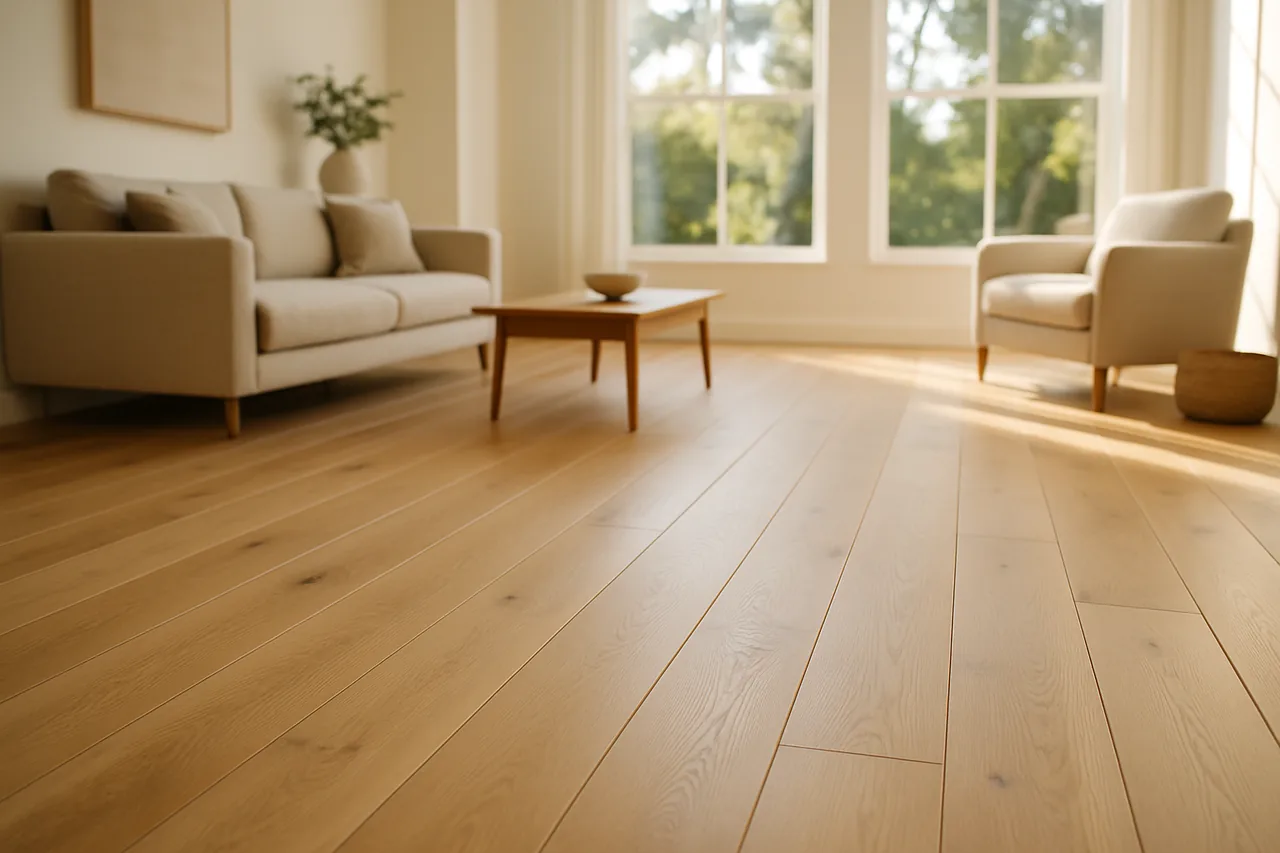
Waterproof laminate is a laminate plank engineered around a sealed, water-resistant HDF core — densified fiberboard with wax-sealed edges and click joints and a topical surface treatment — so it survives the splashes and quick spills that swell a standard HDF plank at the seams. The one fact that decides where it can safely go, and the fact that separates it from every sibling: its warranty is written in hours of surface exposure, not standing water — it is water-resistant, not impervious, and it does not match a true 100% waterproof vinyl core. Choose it over standard laminate for a kitchen or powder room; choose it over high-traffic laminate when moisture, not abrasion, is the room's real threat; and never let a floor rated in hours run into a full bath. Get a free consultation and a written, itemized scope from a vetted installer before you buy, because the moisture rating, the AC class, and the joint-seal quality are settled there, not at the showroom rack.
Waterproof Laminate Is a Sealed Core, Not a Waterproof One
The whole category exists to answer one failure — standard laminate's fiberboard core swelling when water reaches it — and the entire skill of buying it is knowing exactly how far the answer goes and where it stops. It moves laminate's water line; it does not erase it.
The Weakness It Was Built to Fix
Standard laminate's one fatal flaw is its core. High-density fiberboard is compressed wood fiber, and when standing water reaches it through seams or edges, it absorbs, swells, and lifts at the joints permanently — a soaked plank is a replaced plank. Waterproof laminate is the industry's direct response to that exact failure, which is why it is defined by what it changes at the core and joints rather than by any surface property.
Three Fronts of Defense — Core, Joints, Surface
The upgrade attacks the weakness on three fronts a credible spec sheet names separately:
- The HDF core is densified and sealed so it resists absorbing water far longer than an untreated core — the foundational change everything else builds on.
- The edges and click joints are sealed or wax-treated, because standard laminate fails first at the seams, and a splash reaches the core through a gap long before it reaches it through the face.
- A topical surface treatment sheds liquid on top rather than letting it sit in the joint, buying the wipe-up window the warranty is written around.
Together these let the plank shrug off a splash, a quick spill, and routine kitchen humidity that would swell an ordinary plank — a genuine, meaningful upgrade, not a marketing one.
What It Is Not — the Honesty in the Name
The critical honesty is in what the word "waterproof" hides. A waterproof-laminate plank is still built around a wood-fiber core, and a wood-fiber core is not impervious the way the limestone-and-PVC SPC core of a rigid waterproof vinyl floor is. Most waterproof-laminate warranties are written in hours of surface exposure — a stated number of hours before water must be wiped up — which is a water-resistant claim wearing a waterproof label. Standing water, a flood, or a slow persistent leak can still defeat it. Knowing precisely where that line falls is what turns a smart kitchen upgrade into the difference from a swollen, lifted floor in a room that was always wrong for laminate.
Waterproof vs. Standard, High-Traffic, and Waterproof Vinyl
Waterproof laminate is one of two specialized lines within laminate flooring, and it is defined entirely by what it survives — not how it wears. The comparisons that prevent the costliest mistakes are with its abrasion-focused sibling and with the vinyl it is constantly confused for.
The Deciding-Spec Comparison Matrix
The matrix below sets waterproof laminate beside the two floors it is cross-shopped against, each rated by the single spec that decides it — so the "sealed core vs. tough surface vs. impervious core" logic reads at a glance.
| Floor | Deciding spec | What it solves | Standing-water rated? | Best room |
|---|---|---|---|---|
| Waterproof laminate | Warranty hours of exposure + core seal | Splashes & humidity | No — surface exposure only | Kitchen, powder room |
| High-traffic laminate | AC rating AC4–AC5 | Abrasion & scuffing | No — bare HDF core | Entry, hall, stairs |
| Standard laminate | AC rating AC3 | Everyday dry-room wear | No — swells at seams | Dry living room, bedroom |
| Waterproof vinyl (SPC) | Wear-layer mil + rigid core | Standing water | Yes — 100% waterproof | Full bath, laundry, basement |
Waterproof vs. Standard Laminate
Against standard laminate, the difference is the sealed, water-resistant core and joints. Standard laminate's bare HDF core swells the moment standing water reaches a seam; waterproof laminate buys real protection against splashes and quick spills, plus the routine humidity of a kitchen. It is the same affordable, fast-installing, convincingly wood-look floor with the core weakness engineered down — not out. In a genuinely dry room the upgrade earns nothing, which is why the honest recommendation is standard laminate anywhere water is not a factor and the sealed core only where it is.
Waterproof vs. High-Traffic Laminate — Different Problems
Against its sibling high-traffic laminate, the two solve completely different problems and are not interchangeable. High-traffic laminate is about abrasion — an AC4–AC5 wear layer that resists scratching and scuffing in busy halls and entries. Waterproof laminate is about moisture — a sealed core and joints that survive splashes. A high-traffic floor with a standard core will still swell if water sits; a waterproof floor with a low AC rating will still scuff under heavy footfall. A busy kitchen floor is the room that often needs both properties at once — high AC for the traffic and a sealed core for the splashes — which is a spec to confirm on a single product, never assumed from one label.
Waterproof Laminate vs. Waterproof Vinyl — the Line That Matters
The comparison that prevents the most expensive mistakes is with waterproof vinyl, because they sound identical and are not. Waterproof vinyl has a rigid, water-impervious SPC core that can sit in standing water without swelling — genuinely 100% waterproof. Waterproof laminate has a sealed wood-fiber core rated for hours of surface exposure. In a full bathroom, a laundry, or a below-grade basement where standing water is a real risk, waterproof vinyl is the correct floor and waterproof laminate is not, no matter how similar the marketing reads. Our laminate vs. vinyl guide works this line room by room, and the material comparison tool lines them up spec-for-spec.
Want the moisture rating read honestly before you buy?
We match you with a vetted installer who reads the warranty's hours-of-exposure figure, names the AC class for your traffic, and puts the right floor in each room in a written scope — before you commit to a plank or a price.
The Specs That Define Waterproof Laminate
Four things decide whether a "waterproof" laminate actually protects your floor, and the warranty language is the spec that matters most — because the word on the box is not a standard. Read all four and you know what the floor survives; trust the label alone and you may buy a kitchen floor that fails in a bath.
The Four Specs, and Why the Warranty Governs
Each spec below carries a published figure or a tested rating, and where the marketing claim and the warranty disagree, the warranty is the number that governs a swollen-floor claim.
Core Seal — a Densified, Sealed HDF Core
The whole upgrade starts here: a water-resistant HDF core that is densified and treated to resist absorption far longer than bare fiberboard. It is a real improvement, but it remains a wood-fiber core — sealed against water intrusion, not impervious to it the way a rigid SPC vinyl core is. This is the spec that defines both the upgrade and its ceiling.
Sealed Edges and Click Joints
Standard laminate fails first at the seams, so waterproof lines seal or wax-treat the edges and locking joints to keep water from reaching the core through the gaps. The quality of this joint seal is what stands between a splash and a swollen plank — and it is why install quality matters as much as the product here: an unseated joint is an unsealed one.
AC Abrasion Rating — Durability, Separate From Moisture
The AC rating — AC, Abrasion Class — grades surface wear resistance on the EN 13329 Taber-abrasion method and is entirely independent of waterproofing. A floor can be water-resistant and still scuff if its AC rating is too low — AC3 for ordinary rooms, AC4 or higher for a busy kitchen. Confirm the AC rating alongside the moisture rating; both have to be right, and neither implies the other.
Warranty Terms — Hours of Exposure, Not "Waterproof"
This is the spec that tells the truth. Read whether the warranty promises full waterproofing or a stated number of hours of surface exposure before water must be wiped up. Almost all waterproof laminate is the latter — a water-resistant claim measured in a window like 24 to 72 hours of surface contact, not immersion. The hours figure tells you the floor's real limit far better than the name on the box, and it is the line a warranty claim is judged against.
The Moisture-Protection Spec Table
The table below collects the four specs a competent installer verifies on a waterproof-laminate plank, each with what it controls and a representative figure. These are typical values — the product's printed warranty and instructions always govern, and where they are stricter, the stricter number wins.
| Spec | What it controls | Recognized basis | Typical figure |
|---|---|---|---|
| Core seal | How long the fiberboard core resists absorption | Manufacturer core spec | Densified, sealed HDF — sealed, not impervious |
| Warranty exposure window | Where the floor can safely go | Product moisture warranty | Commonly 24–72 hours of surface exposure |
| Joint / edge seal | Whether water reaches the core through a seam | Manufacturer edge treatment | Sealed or wax-treated click joints, fully seated |
| AC rating (abrasion) | Surface wear resistance, separate from moisture | EN 13329 Taber test | AC3 ordinary; AC4+ busy kitchen |
| Expansion gap | Whether the floating floor peaks | Manufacturer install spec | 1/4"–3/8" continuous at the perimeter |
| Slab moisture (over concrete) | Vapor wicking into the core from below | Manufacturer + slab test | Moisture-barrier underlayment, reading within cap |
The rule that emerges is clean: a waterproof laminate is a sealed-core, sealed-joint plank with an AC rating chosen for the traffic and a warranty measured in hours of surface exposure — and that warranty, not the marketing, defines where you can safely put it. Everything else on the box is secondary to those two numbers read together.

Where Waterproof Laminate Belongs — and Where It's the Wrong Floor
Waterproof laminate occupies a precise middle ground: it earns its place in rooms with moisture risk but not standing water, and it is genuinely dangerous to specify where water pools. Getting the room right is most of getting the floor right.
Where It Shines — Splash Zones, Not Wet Rooms
A a kitchen floor is the textbook fit — it handles the splashes at the sink, the quick dishwasher drip wiped up promptly, and the routine humidity that would swell standard laminate, all while delivering the affordable laminate look and a hard, scratch-resistant surface. A powder room with no tub or shower, a half bath, an entry, or a mudroom with tracked-in slush are also reasonable assignments, where moisture is occasional and gets wiped rather than left to stand. In these rooms waterproof laminate is a smart, cost-effective upgrade over standard laminate, and often a near-match in look to the vinyl running in the adjoining wet room.
Where It's the Wrong Floor — Anywhere Water Stands
Any room where standing water is a real risk is out of range. A full bathroom floor with a tub or shower, a laundry-room floor exposed to a supply-line leak, and a below-grade basement floor with slab moisture all exceed what an hours-of-exposure rating covers — and a wood-fiber core, however sealed, will eventually swell if water sits or wicks in. For those rooms the correct floor is a truly impervious vinyl core, full stop. The most common and costly mistake in this category is treating "waterproof laminate" as interchangeable with waterproof vinyl and running it into a full bath — it is not, and the warranty says so. For the broader wet-room decision, see waterproof flooring.
The Placement Rule in One Sentence
Put waterproof laminate where water splashes and gets wiped, and waterproof vinyl where water can stand — the hours-of-exposure warranty is the boundary between those two rooms, and reading it is how you avoid buying the right look for the wrong place.
How Waterproof Laminate Is Installed
Waterproof laminate installs like any laminate — a floating click-lock floor — but its moisture protection depends entirely on the install being done right, because a sealed joint that isn't fully seated isn't sealed. The six steps below are the full arc, with the two moisture-critical steps called out where they fall.
On-Site Subfloor Assessment
The installer inspects the subfloor, checks for squeaks and deflection, measures the room, and identifies transitions and height differences. Because this floor lands in moisture-adjacent rooms, the assessment also flags where the floor meets a wet room so the transition and any perimeter sealant are planned before a plank is ordered.
Flatten the Subfloor to Tolerance
Waterproof laminate telegraphs an out-of-tolerance subfloor as hollow spots and a bouncy, clicky feel just like any laminate, so the substrate is read against the manufacturer's flatness tolerance, high spots ground and low spots filled under subfloor prep. A flat substrate is also what lets the click joints seat fully — the seal the whole floor depends on.
Moisture-Barrier Underlayment Over Concrete
Over a slab, a moisture-barrier underlayment goes down and slab moisture is confirmed within the manufacturer's limit — because even a water-resistant core does not want slab vapor wicking up into it from below. This step is doubly important here: the core is sealed against surface water, not against a continuous supply of vapor from underneath.
Acclimate the Planks to the Room
The planks sit in the conditioned space for the maker's stated window so they reach the room's temperature and humidity before install. Skipping it on a floating floor contributes to gapping or peaking after the room settles, because the planks keep moving after they are locked together.
Seat Every Joint Fully and Set the Expansion Gap
The locking joints must be fully and correctly seated so the edge seals engage — a poorly assembled joint leaves the exact gap the water-resistant treatment was meant to close. At the same time a continuous perimeter expansion gap of roughly 1/4 in. to 3/8 in. is set around the room and every obstruction, hidden under trim, so the floating floor can move without peaking. This step is where the product's rating is either earned or forfeited.
Transitions, Trim, and Walkthrough
Thresholds, T-moldings, and reducers finish the edges and conceal the expansion gap, with a sealed transition detail where the floor meets a wet room. The site is cleaned and the installer walks the floor with you to confirm the joints are tight, review the care rules, and explain the exposure limit in plain terms.
Skip the flatness, the moisture barrier, or — above all — a fully seated joint, and the water-resistant rating the plank was sold on quietly disappears. That is why a vetted installer treats those steps as fixed, and the full method comparison lives under flooring installation.
Talk through your project — free.
A free consultation and a written, itemized quote from a vetted installer. No pressure, no obligation.
Is Waterproof Laminate Right for Your Space?
Whether waterproof laminate is the right floor — or whether the room needs vinyl instead — is the output of a short chain of facts about the room's water exposure, its traffic, and what the warranty actually covers. Walk the decision in order; each branch narrows the answer.
- Does the room ever hold standing water? A full bath with a tub or shower, a laundry with a supply line, or a below-grade basement can pool water — and that exceeds an hours-of-exposure rating, so the answer there is a waterproof rigid-core vinyl core, not laminate. If water only splashes and gets wiped, waterproof laminate is in play.
- What does the warranty actually promise? Read the moisture warranty for a full-waterproof claim versus a stated number of hours of surface exposure. Almost all of these floors are the latter — treat that hours figure, not the word on the box, as the floor's real limit and place it accordingly.
- How hard does the room live? A busy kitchen or entry wants AC4 or higher in addition to the sealed core; an ordinary powder room is fine at AC3. Confirm the AC rating separately — waterproofing does not imply abrasion resistance, and a water-resistant floor with a low AC still scuffs.
- Is the subfloor flat and, over concrete, moisture-controlled? The core is sealed against surface water, not slab vapor, so a slab needs a moisture-barrier underlayment and a verified reading. If the subfloor is uneven, the prep is grinding and filling first — an unflat floor also prevents the joints from seating and sealing.
- Will the installer seat every joint and seal the transitions? The rating assumes a properly seated, sealed install. If the crew cannot describe how they seat the joints and detail the transition to an adjoining wet room, the protection you paid for is at risk — confirm it before work starts.
Run honestly, this tree returns either a defensible waterproof-laminate spec for a splash zone or a clear signal to move to vinyl — and an installer who recommends waterproof laminate for a full bath is the red flag.
Why Waterproof Laminate Still Swells, Peaks, and Scuffs
Waterproof laminate fails for a narrower set of reasons than standard laminate, but it still fails — usually from asking it to do a vinyl's job, or from an install that forfeits the seal. Each failure below is paired with its cause and prevention.
Core Swelling: When It's Asked to Beat Standing Water
The signature failure is the same one the category was built to reduce, and it returns whenever the floor is placed past its rating. A sealed HDF core resists a splash for the warranty's stated hours, but a full bath overflow, a laundry leak, or slab vapor wicking up from below eventually reaches the wood fiber, and it swells and lifts at the joints permanently. The prevention is room selection first — keep it to splash zones, use a moisture barrier over slab — and prompt wipe-up second, because the rating is a window, not immunity.
Forfeited Seal: The Install That Undoes the Product
The second failure is an install that leaves the joints unsealed. A joint that isn't fully seated leaves the exact gap the edge treatment was supposed to close, so water reaches the core through a seam the product would otherwise have held. The prevention is a fully seated, correctly assembled install over a flat subfloor — the same reason a credible crew treats flatness and joint seating as non-negotiable rather than optional.
Peaking and Gapping: The Floating-Floor Failures
Like any floating floor, waterproof laminate expands and contracts with humidity as one connected sheet; without a continuous perimeter expansion gap it grows, hits the walls, and tents at the seams, and without acclimation it gaps as it settles. The prevention is the deliberate 1/4 in. to 3/8 in. gap at every wall and obstruction plus on-site acclimation — the two cheapest steps that prevent the two most common floating-floor complaints.
Surface Scuffing: The AC-Rating Mismatch
Because waterproofing and abrasion are separate specs, a sealed-core plank with too low an AC rating still dulls in a busy entry. The floor stays intact but looks tired in the walking paths, and because laminate cannot be refinished, the worn planks are replaced, not renewed. The prevention is confirming AC4 or higher for a busy kitchen or entry rather than assuming a waterproof floor is also a tough one. When water has already swelled a floor, see flooring repair.
Common Waterproof-Laminate Mistakes, Consequences, and Prevention
Most waterproof-laminate disappointments are the same handful of shortcuts, each with a predictable consequence and a known prevention. Naming them is how you spot a corner being cut before the floor is down or a floor being placed in a room that was always wrong for it.
| Mistake | What it causes | The prevention |
|---|---|---|
| Treating it as waterproof vinyl | Core swells and lifts in a full bath, laundry, or wet basement | Use a rigid SPC vinyl where water stands; reserve laminate for splash zones |
| Trusting the label over the warranty | A floor placed past its real hours-of-exposure limit | Read the warranty's stated hours of surface exposure and place the floor to it |
| Joints not fully seated | Water reaches the core through the gap the seal should have closed | Seat every locking joint completely over a flat subfloor so the edge seals engage |
| Ignoring the AC rating | A water-resistant floor that still scuffs and dulls in a busy room | Confirm AC4+ for a busy kitchen or entry, separate from the moisture rating |
| No moisture barrier over concrete | Slab vapor wicks into and eventually swells even a sealed core | Install a moisture-barrier underlayment and verify slab moisture within limit |
| No perimeter expansion gap | Peaking and buckling at the seams as the floor expands | Leave a continuous 1/4"–3/8" gap at every wall and obstruction, under trim |
| Wet-mopping or steam-mopping | Standing water and forced steam defeat the seal at the joints | Clean damp with a microfiber pad; never steam-mop or flood the floor |
The first two rows are the ones that turn a good floor into a swollen mess — which is why "we read the hours-of-exposure warranty, seat the joints, and keep it out of full baths, in writing" is the most valuable sentence in a waterproof-laminate quote.
Caring for Waterproof Laminate
Waterproof laminate is more forgiving than standard laminate, but the care rule still follows from the wood-fiber core: it buys you time against water, not immunity. Treat it as water-resistant, because that is what it is.
The Damp-Not-Wet Cleaning Cycle
Clean it damp, not wet — sweep or dry-vacuum to lift grit, then use a slightly damp microfiber mop with a laminate-specific cleaner sprayed onto the pad, never poured on the floor. The upgrade means a spill you wipe up promptly is a non-event where it would have threatened standard laminate, and routine kitchen humidity is fine. But the hours-of-exposure rating is a real limit, not a marketing number: do not let water stand, skip steam mops which force heat and moisture into the joints, and wipe spills rather than leaving them to test the seal in a seam.
The Repair Reality — Replace, Don't Refinish
The honest limit on maintenance is the same as all laminate: it cannot be sanded or refinished. When the wear layer dulls in heavy traffic, or if water ever does swell a plank, the affected planks are replaced, not renewed — and a damaged plank in a floating floor can often be swapped individually rather than redoing the room. See flooring repair, and weigh the cost factors against waterproof vinyl in our vinyl flooring cost guide.
What Actually Drives the Cost of a Waterproof-Laminate Floor
A waterproof-laminate quote is not a flat per-square-foot rate; the headline number a low bid leads with hides the items below, ranked by how much they move the total.
The Cost Drivers That Move the Total Most
- Product line — sealed core plus AC rating. The plank sets the baseline, and a sealed water-resistant core with an AC4–AC5 rating costs more than a basic standard plank — it is the spend that decides both where the floor can go and how long its surface lasts.
- Subfloor prep and leveling. The biggest swing on most jobs. Because laminate telegraphs and clicks hollow over an uneven subfloor — and because a flat floor is what lets the joints seat and seal — grinding and filling to tolerance is real material and labor a sound, flat substrate avoids.
- Moisture-barrier underlayment over concrete. A slab needs a moisture-barrier underlayment and a verified reading so vapor cannot wick into even a sealed core — a real line item the lowest bid tends to omit precisely where it matters most.
- Old-floor removal and disposal. Tear-out is labor and haul-away is a fee, and removal often exposes subfloor problems that change scope mid-job — which is why it belongs in the written quote up front.
- Wet-room transitions and sealing. Where the floor meets a bathroom or laundry running vinyl, a sealed transition detail is skilled work — the seam that keeps the laminate's edge protected at the one place water is most likely to reach it.
- Layout complexity. Multiple rooms with continuous runs, diagonal layouts, and intricate transitions add cutting, waste, and skilled hours beyond a straight-lay single room.
- Transitions and trim. Thresholds, T-moldings, reducers, and baseboard or quarter-round at every doorway and material change add up across a whole floor.
- Stairs. If the run continues onto stairs, treads and nosing are slow, exacting work priced separately from field flooring, and not every product is stair-rated.
Because these drivers swing so widely, the only honest number comes from an on-site assessment. Compare what moves the price across the category in our cost guides, weigh it against the vinyl it cross-shops in our vinyl flooring cost guide, and size your own room with the flooring cost calculator so you can read a quote critically.
Get an itemized scope, not a headline rate.
A vetted installer prices the product, prep, moisture barrier, wet-room transitions, and trim as separate lines — so you see the whole job, free and with no obligation.
How to Choose Waterproof Laminate for Your Space
The right waterproof laminate is a match of a sealed core to a room with moisture risk but not standing water, with the AC rating chosen for traffic — settled by reading the warranty, not the label. The six checks below are the buying framework a credible installer walks with you.
- Read the warranty for hours of exposure, not the word "waterproof"
- The warranty's hours-of-surface-exposure figure is the real spec — it tells you the floor is water-resistant, not impervious. Use that number, not the marketing, to decide where the floor can safely go, and treat any "waterproof" claim without a stated exposure window with suspicion.
- Use it for a kitchen or powder room, never a full bath
- Splashes, quick spills, and routine humidity are within its range, so a kitchen, half bath, entry, or mudroom is a smart fit. A full bath, laundry, or wet basement exceeds it — choose a waterproof SPC floor there instead, in a near-matching look if seamlessness matters.
- Confirm the AC rating separately for the traffic
- Waterproofing and abrasion are different specs. A busy kitchen wants AC4 or higher in addition to the sealed core — a water-resistant floor with a low AC rating still scuffs. Both have to be right on the single product you buy.
- Insist on a densified, sealed core with sealed joints
- The upgrade is only real if the core is densified and the edges and click joints are sealed or wax-treated. Ask the installer to name the core type and the joint treatment — the seam seal is what stands between a splash and a swollen plank.
- Require a moisture-barrier underlayment over concrete
- Over a slab, insist on a moisture-barrier underlayment and a verified slab-moisture reading, because a sealed core still does not want continuous vapor from below. On a wood subfloor, confirm the right underlayment for sound and flatness instead.
- Buy the look last, after the specs are settled
- Color, plank width, and embossing are the free variables once the moisture rating, AC class, and core are right. Choosing the look first is how a floor ends up beautiful and in the wrong room — settle the constraints, then pick the finish that best matches the adjoining vinyl.
Settle the moisture rating and AC class first and the look becomes a free choice instead of a gamble — which is exactly the order a credible installer walks with you.
Waterproof Laminate Glossary
The terms below recur in every waterproof-laminate quote, spec sheet, and warranty — each defined as its working meaning on an actual job, so you can read a scope and judge whether it is complete.
- Water-resistant HDF core
- The densified, sealed high-density fiberboard body of a waterproof-laminate plank — treated to resist absorption far longer than bare HDF, but still wood fiber, so sealed against water rather than impervious to it.
- Hours of surface exposure
- The warranty spec that states how many hours water may sit on the floor before it must be wiped up — commonly a window like 24–72 hours. It is a water-resistant claim, not a standing-water one, and it defines where the floor can safely go.
- AC rating
- Abrasion Class — the tested grade (AC1–AC5) of how the wear layer resists abrasion, scuffing, and burns. Entirely separate from moisture: AC3 for ordinary rooms, AC4+ for busy zones.
- SPC core
- The rigid, limestone-and-PVC core of a true waterproof vinyl floor — genuinely impervious to standing water, and the reason vinyl, not laminate, belongs in a full bath. The benchmark waterproof laminate does not meet.
- Sealed joint
- A click-lock edge sealed or wax-treated so water cannot reach the core through the seam — the feature that only works if the joint is fully and correctly seated at install.
- Topical surface treatment
- The coating that sheds liquid on the plank's face rather than letting it sit in a joint, buying the wipe-up window the warranty is written around.
- Expansion gap
- The deliberate 1/4 in. to 3/8 in. space left around the perimeter and at obstructions so the floating floor can expand with humidity without peaking; hidden under trim.
- Moisture-barrier underlayment
- The underlayment type installed over concrete that blocks slab vapor from wicking up into the core — essential under a sealed laminate core, which resists surface water but not a continuous vapor supply.
- Floating floor
- A floor that clicks plank-to-plank and rests on the subfloor over an underlayment rather than fastening to it — fast to install and dependent on a perimeter expansion gap.
- Core swelling
- The permanent, irreversible expansion of the fiberboard core when water defeats the seal — the failure the sealed core delays but cannot prevent past its exposure rating.
- Water-resistant vs. waterproof
- The distinction the whole category turns on: water-resistant means it survives timed surface exposure; waterproof means it survives standing water. Most "waterproof laminate" is the former; a vinyl SPC core is the latter.
- Wet-room transition
- The sealed detail where waterproof laminate meets a bathroom or laundry running vinyl — the seam that protects the laminate's edge at the one point water is most likely to reach it.
Standards, Warranty Conditions, and When a Permit Applies
A waterproof-laminate warranty is a contract with conditions, and many denials are not about the product — they are about how it was installed and, above all, where it was used.
Warranty Conditions That Hinge on the Install
The conditions are specific and testable: a continuous expansion gap at a minimum dimension; the approved underlayment, including a moisture barrier over concrete; fully seated joints so the edge seals engage; the flatness tolerance honored; and the product used only in the rooms its moisture rating allows. An installer who floats a floor tight to the walls, skips the moisture barrier, or puts a sealed-core laminate in a full bath has voided your coverage before you notice. Ask in writing that the install follow the manufacturer's published instructions — that document is what a claim is judged against.
What a Water-Resistant Rating Actually Promises
"Water-resistant" and "waterproof" are different claims, and the warranty draws the line. Most waterproof laminate is rated for a stated number of hours of surface exposure — splashes and quick spills wiped up promptly — not standing water or a flood. Read the moisture warranty for the exposure it actually covers; a label that implies waterproof and a warranty that covers only timed surface exposure are not the same promise, and the warranty is the one that governs whether a swollen floor is your problem or the maker's.
When a Permit Applies
Replacing a floor like-for-like usually does not require a permit, but work tied to a larger renovation, or repairing structural subflooring underneath, can. A reputable installer tells you when one applies rather than working around it — and structural questions about the deck belong with the subfloor team first. When an old floor is failing rather than dated, the path may be full replacement over a fresh install.
A Real Waterproof Laminate Decision
The clearest way to see where waterproof laminate fits — and where it must hand off to vinyl — is to walk through one representative choice that drew the line correctly.
How to Vet a Waterproof-Laminate Installer
Waterproof laminate is fast to install, but its whole value rides on the install being done right — the seal only holds if the joints seat — so the installer still matters. These questions separate a crew that protects the core from one that just clicks planks together fast.
- They read the hours-of-exposure warranty and place the floor to it
- Ask which rooms they would run it in and why. A real answer names the warranty's hours-of-exposure figure and keeps the floor out of full baths — not "it's waterproof, it goes anywhere."
- They confirm the AC rating separately for your traffic
- Ask what AC class they recommend for the room. A credible answer ties the number to your footfall — AC4 for a busy kitchen — and treats it as independent of the moisture rating, not implied by it.
- They seat the joints and can explain how the seal works
- Ask how they make sure the edge seals engage. A professional describes fully seating each locking joint over a flat subfloor — the detail the water-resistant rating assumes and the one a rushed crew skips.
- They use a moisture barrier over concrete and verify the slab
- Ask what underlayment they will use over a slab and whether they read slab moisture. A crew skipping the barrier is exposing even a sealed core to vapor that eventually swells it.
- They detail the transition to any adjoining wet room
- Ask how the laminate meets the vinyl in the bathroom or laundry. A real answer describes a sealed transition that protects the laminate's edge at the one place water is most likely to reach it.
- They put the scope and labor warranty in writing
- Ask for the full scope, the timeline, and the workmanship warranty before work starts. A crew willing to name a labor guarantee — and to return if a seam peaks or a plank swells at a joint — is accountable for the install, not just the product the maker covers.
Two honest answers — which rooms they would refuse to run it in, and how they seat the joints — tell you more about a waterproof-laminate crew than any display; the rest of the list confirms it.
Why Route Your Waterproof Laminate Project Through Pro Work Home Surface
Pro Work Home Surface is not a contractor and does not lay your floor — we are a national authority on home surfaces that matches homeowners with vetted local installers and holds them to a published bar.
- A free consultation and an itemized written scope
- Every connection starts with a no-obligation consult and a written quote that lines out product, prep, moisture barrier, wet-room transitions, and trim separately — so you read the whole job, not a headline rate.
- The moisture rating read honestly, in writing
- The warranty's hours-of-surface-exposure figure is confirmed and the floor placed accordingly — kitchens and powder rooms, not full baths, laundries, or wet basements — with the AC rating matched to traffic at the same time (AC4 or higher for busy kitchens).
- Subfloor flattened, moisture-protected, and joints sealed
- The substrate is read against the manufacturer's flatness tolerance and corrected, a moisture-barrier underlayment is installed over concrete with slab moisture verified, and the locking joints are fully seated so the edge seals engage — because the water-resistant rating only holds when the install is done right.
- National coverage, local crews
- We match you with installers in your area nationwide, so the standard is consistent even though the crew is local — whether your project is a single kitchen or a whole main floor.
Waterproof laminate is one of the specialized laminate lines we cover. For the busiest dry zones see its sibling AC4–AC5 high-traffic line, and for any room with standing water choose a true waterproof vinyl core instead — settle the cross-shop in our laminate vs. vinyl guide, weigh the broader options in how to choose flooring, compare spec-for-spec with our material comparison tool, and start from the laminate hub, the flooring category hub, or the full range of home surfaces.
Brands & Material Authority
Quality and construction drive long-term performance more than the label. These are widely respected names in this category:
- Shaw
- Mohawk
- COREtec
- Armstrong
- Pergo
- Mannington
- Bruce
- Karndean