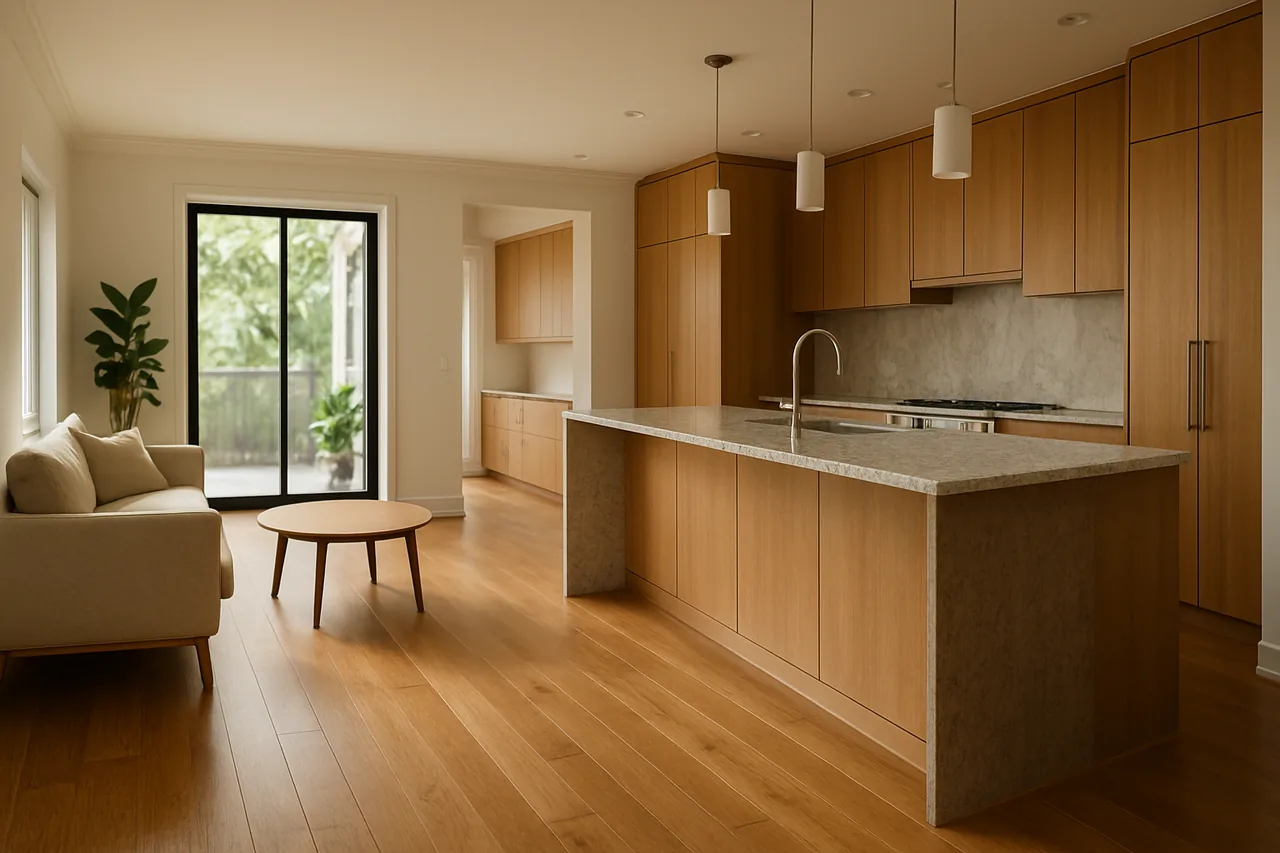
Laminate vs. vinyl flooring is a closer call than it looks, because both are floating click-lock floors that mimic wood — but they part on one decisive property: water. Choose vinyl — rigid-core luxury vinyl plank — for any room that can get wet or sits below grade, because its core is 100% waterproof. Choose laminate for a dry room where you want a harder, more scratch-resistant surface and a more realistic, textured wood look, often at a lower price for a comparable grade. Laminate's HDF core is water-resistant, not water-proof — it swells if soaked — so the room's moisture profile settles most of this decision before finish or feel enter it. Get a free consultation and a written scope from a vetted installer who tests your subfloor first, because flatness and moisture govern both floors and one reading can rule laminate out.
The Verdict First: Which Floor Wins Your Room
These two materials are more alike than any other pair in flooring — both float, both click together, both print a wood look over a fiberboard-or-composite core — so the decision hinges on a few sharp differences rather than a broad gap. The short answer below holds for most homes.
When Vinyl Is the Right Call
Vinyl wins wherever water is a real risk or the subfloor is a below-grade slab. A kitchen, bathroom, laundry room, mudroom, or basement points to rigid-core vinyl, because its SPC or WPC core will not swell when wet. Vinyl is also softer and slightly warmer underfoot, which some households prefer, and thin flexible formats forgive minor subfloor imperfections a rigid laminate plank would telegraph.
When Laminate Is the Right Call
Laminate wins in dry rooms where surface hardness, scratch resistance, and a convincing wood look matter more than water immunity. A living room, bedroom, hallway, or dry home office suits laminate, whose hard melamine wear surface resists scratching and whose embossed texture and high-resolution print often read as more realistic wood than budget vinyl. For a comparable durability grade, laminate frequently costs less — a real advantage in a room that will stay dry.
The One Fact That Settles It Fastest
If the room can get wet or sits below grade, choose vinyl and stop weighing the rest. Standard laminate's HDF core swells irreversibly when it absorbs water — a soaked laminate floor is a replaced laminate floor. Water-resistant laminate lines narrow but do not close that gap; they buy time against spills, not standing water. Everything else in this comparison refines a choice that moisture has usually already made. Size the room with the flooring cost calculator once the material is set.
Laminate vs. Vinyl: The Full Side-by-Side Spec Comparison
The table sets the two floors against each other on the specs that decide performance — core, durability scale, water behavior, feel, and realism — with documented ratings tied to their scales, not marketing.
| Attribute | Laminate | Luxury Vinyl (LVP/LVT) |
|---|---|---|
| What it is | A photographic wood layer over a fiberboard core, sealed under melamine | Printed PVC plank/tile with a clear wear layer over a rigid or flexible core |
| Core | HDF — high-density fiberboard (wood-based) | SPC/WPC rigid composite, or flexible PVC |
| Durability scale | AC rating (Abrasion Class) AC1–AC5 — AC3 residential, AC4–AC5 heavy/commercial | Wear layer in mil — 6 mil light, 12–20 mil heavy traffic |
| Water resistance | Water-resistant only — HDF core swells if soaked | 100% waterproof with a rigid core |
| Below-grade rating | No — not for basements or over damp slabs | Yes — rated below grade and in wet rooms |
| Surface hardness | Harder melamine wear surface — strong scratch resistance | Softer wear layer — dent-forgiving, scratch-resistant by mil |
| Feel underfoot | Harder, firmer; can sound hollow without pad | Softer, slightly warmer; quieter with a rigid core |
| Realism / texture | Deep embossing and high-res print — often very convincing | High-res print; realism rises with price and embossing |
| Typical lifespan | Commonly 15–25 years in a dry room | Commonly 15–25 years; longer in the right room |
| Relative cost | $–$$ — often lower for a comparable grade | $–$$$ by wear layer and core |
| Install | Floating click-lock over a flat subfloor + pad | Floating click-lock; glue-down for some products |
Read across and the split is narrow but clear: vinyl owns water and below-grade; laminate owns surface hardness, texture realism, and often price in a dry room. Both float, both need a flat subfloor, and both live in the same lifespan band — which is why the room, not the category, decides. Compare their documented lifespans in the material lifespan comparison.
Choose Vinyl If…
Six conditions push the decision toward vinyl. If most describe your room and household, rigid-core vinyl is the floor that will frustrate you least — and each is a fact about the space, not a preference.
- The room can get wet
- Kitchens, bathrooms, laundry rooms, and mudrooms see spills and splashes that would swell a laminate core. A 100% waterproof rigid vinyl plank stays flat and stain-free — see waterproof flooring and waterproof vinyl.
- The subfloor is a below-grade slab
- Basements and on-grade concrete carry ground moisture that laminate cannot tolerate. Rigid-core vinyl is rated below grade and installs over a flat, dry slab — the standard answer for basement flooring.
- You want a softer, warmer floor underfoot
- Vinyl's wear layer is more forgiving than laminate's hard melamine, and a WPC core adds warmth. If comfort underfoot matters, vinyl edges laminate — a factor in a a kitchen floor where you stand for long stretches.
- The subfloor has minor imperfections
- Flexible and thinner vinyl formats forgive small substrate variations that a rigid laminate plank would read as a hollow click. Both still want flatness, but vinyl is the more tolerant of a marginal floor — confirm the assessment under subfloor prep.
- Pets and kids are hard on the floor
- A thick wear-layer vinyl resists claws, dropped toys, and accidents, and wipes clean without risk to the core. That water-and-abuse combination is exactly what pet-friendly flooring and kid-friendly flooring call for.
- You want one floor across wet and dry rooms
- Because vinyl works in both, it can run continuously from a dry hallway into a wet kitchen without a material change — a visual and practical win laminate cannot match. Compare formats under luxury vinyl tile and price it in the vinyl flooring cost guide.
Choose Laminate If…
The mirror holds for laminate. If these six describe your dry room and priorities, laminate is the floor that will satisfy you longest — and most are, again, facts about the room.
- The room stays dry
- A living room, bedroom, hallway, or home office away from standing-water risk is laminate's home turf, where its harder surface and lower cost pay off without the moisture caveat ever mattering — see living room flooring.
- Surface hardness and scratch resistance are the priority
- Laminate's melamine wear layer is harder than vinyl's, so it resists surface scratching from furniture and grit well. In a dry room with heavy foot traffic, that hardness is a real edge — quantified by the AC rating you choose.
- You want the most convincing wood texture for the money
- Deep embossing paired with high-resolution print often gives laminate a more realistic wood feel than budget vinyl, with texture that registers to the touch. If authenticity of look matters and the room is dry, laminate competes hard — see laminate flooring.
- Budget is the deciding factor
- For a comparable durability grade, laminate frequently costs less than rigid-core vinyl. If you want the most floor for the money in a dry space, laminate is often the value pick — model it in the cost calculator.
- The room sees heavy foot traffic but no water
- A high-traffic hallway, stair landing, or entry that stays dry is a natural fit for an AC4–AC5 laminate built to take abrasion — see high-traffic laminate. The hard surface handles the grit that scuffs softer floors.
- You accept replace-over-refinish and want low upkeep
- Like vinyl, laminate is never refinished — it is swept and damp-mopped (not wet-mopped), and damaged planks are swapped. If low maintenance in a dry room suits you and you do not need waterproofing, laminate delivers it at a lower price — compare in the hardwood vs. vinyl guide for the wood alternative.

Cost, Lifespan, and Installation Differences Compared
The two floors are close on lifespan and install method, so the meaningful differences are cost-per-grade, water-driven replacement risk, and how forgiving each is of the subfloor — and those often decide the pick.
| Dimension | Laminate | Luxury Vinyl | What it means for you |
|---|---|---|---|
| Relative upfront cost | $–$$ (often lower per grade) | $–$$$ (wear layer + core drive it) | Laminate is often the cheaper floor at a comparable grade |
| Expected lifespan | 15–25 years in a dry room | 15–25 years, longer in the right room | Comparable — the room, not the material, sets it |
| Water-driven replacement risk | High if it gets wet — core swells irreversibly | Low — waterproof core survives spills and leaks | Vinyl removes the biggest early-failure risk in wet rooms |
| Renewability | None — replace worn or swollen planks | None — replace worn planks | Neither refinishes; both are replace-not-renew |
| Install method | Floating click-lock + underlayment | Floating click-lock; glue-down for some products | Both are floating, fast, and relatively low-labor |
| Subfloor tolerance | Needs a flat subfloor; rigid plank telegraphs waves | More forgiving in flexible formats; rigid still wants flat | Vinyl is the safer choice over a marginal substrate |
| Underlayment | Pad required; cuts hollow sound over the hard core | Some products have attached pad; others need one | Underlayment quality shapes sound and feel for both |
| Prep sensitivity | Flatness critical; keep moisture off the core | Flatness matters; moisture tolerated by the core | Both need prep; laminate is stricter on staying dry |
The honest read is that laminate often costs less at a comparable grade and offers a harder surface, while vinyl removes the water risk that ends a laminate floor early in the wrong room. No dollar figure here replaces an on-site quote — compare what moves each price in the cost guides and run your room through the the cost estimator before you read a bid.
Why Both Floors Live or Die on Subfloor Flatness
Neither floor is fastened to the substrate — both float — which makes flatness the shared make-or-break spec. A floating floor over a wavy subfloor telegraphs every dip as a hollow, clicking spot underfoot, whether the plank is laminate or vinyl. Both want the substrate within the NWFA-style tolerance of 3/16" over 10 ft, corrected by grinding high spots and self-leveling low spots. Rigid laminate is the less forgiving of the two, telegraphing imperfections a thin flexible vinyl might absorb, so a marginal subfloor tilts the call toward vinyl even in a dry room.
The One Prep Difference That Matters
Where the two diverge in prep is moisture. Laminate demands a dry substrate and a moisture-barrier underlayment over any slab, because the HDF core cannot tolerate vapor wicking up from below — get that wrong and the core swells from underneath. Rigid-core vinyl tolerates the damp slab that would ruin laminate, which is precisely why it, not laminate, is the below-grade floor. Shared flatness, unshared moisture tolerance — that is the mechanical reason vinyl owns the wet and below-grade rooms while laminate stays upstairs and dry.
Which Floor Fits Your Room? A Decision Tree
The choice is the output of a short chain of facts about the room, the subfloor, and your priorities. Walk it in order; each branch eliminates one floor where it cannot succeed, and what survives is the defensible pick.
- Can the room get wet, or is the subfloor below grade? If it is a kitchen, bath, laundry, mudroom, or basement — or on-grade concrete — choose vinyl. Laminate's core cannot survive that moisture, and this single branch decides most wet-room projects.
- Is the room dry and above grade? If yes, both are viable and the next branches refine it. If no, return to branch one and reconfirm the moisture and grade facts before proceeding.
- Is the subfloor flat and sound, or marginal? A flat, sound subfloor keeps both in play. A marginal or slightly wavy one tilts toward a more forgiving vinyl format, since rigid laminate telegraphs imperfections as hollow spots — confirm under substrate preparation.
- What matters more — surface hardness or softness underfoot? If you want the hardest, most scratch-resistant surface for a dry high-traffic room, choose high-traffic laminate at AC4–AC5. If you want softer, warmer footing, vinyl leads.
- What does the budget allow, and how realistic must the look be? A tight budget with a dry room favors laminate's lower cost-per-grade and deep embossing; a need to run one floor across wet and dry rooms favors vinyl. Confirm the final call against the room under the flooring hub, and if you are weighing real wood too, see the engineered vs. solid hardwood guide.
Run honestly, this tree returns a single floor for most rooms — and a project that puts laminate in a basement or a bathroom is usually ignoring branch one.
Not sure which floating floor your room can carry?
Tell us about the space and we will match you with a vetted installer who tests the subfloor for moisture and flatness, names the floor that fits, and puts it in a written scope — free and with no obligation.
Common Laminate-vs-Vinyl Mistakes, Consequences, and Prevention
Most regret over this pair traces to treating them as interchangeable when the room says otherwise, or to skipping the subfloor work both floating floors demand. Naming the errors is how you avoid them.
| Mistake | What it causes | The prevention |
|---|---|---|
| Putting laminate in a wet or below-grade room | Irreversible core swelling and a floor that must be replaced | Use rigid-core vinyl anywhere water or ground moisture is present |
| Assuming "water-resistant" laminate is waterproof | A soaked floor fails despite the label; only spills are covered | Read the hours-of-exposure warranty; choose vinyl for standing water |
| Wet-mopping laminate | Water works into seams and swells the core over time | Sweep and damp-mop only; wipe spills promptly |
| Floating either floor over a wavy subfloor | Hollow spots, clicking, and a bouncy feel underfoot | Correct flatness to 3/16" over 10 ft before install |
| Choosing a low AC or thin mil for the traffic | Surface wears through in high-use paths within years | Spec AC4+ laminate or 12–20 mil vinyl for busy rooms |
| Skipping the expansion gap on a floating floor | Peaking and buckling when the floor expands with heat | Leave a continuous perimeter gap; hidden under trim |
| Skipping the moisture barrier under laminate on slab | Vapor wicks up and swells the core from beneath | Install a moisture-barrier underlayment matched to the product |
Every row is a decision made before the floor goes down — which is why the most valuable line in a quote confirms the installer tested the subfloor and matched the floor to the room's moisture, in writing.
How Durability Is Rated — AC Rating vs. Wear Layer
The two floors use different durability scales, and comparing them means knowing what each predicts. A floor bought on price alone ignores the number that forecasts how long the surface survives the room.
Laminate: The AC Abrasion Rating
Laminate wear resistance is graded by its AC rating — Abrasion Class — a standardized measure of how the melamine wear surface holds up to traffic and abrasion. It runs from AC1 to AC5, and it is the number that tells you whether a laminate can take the room's foot traffic.
Reading the AC Scale for the Room
AC1 and AC2 suit light residential use only; AC3 is the standard for general residential floors; AC4 handles heavy residential and light commercial traffic; and AC5 is built for heavy commercial use. A busy household wants AC4 or higher, especially in halls, entries, and stair landings — the reasoning behind high-traffic laminate. The rating grades the surface's abrasion resistance, which pairs with laminate's inherent hardness to make it a strong scratch performer in dry, high-traffic rooms.
What the AC Rating Does Not Cover
AC grades abrasion, not water resistance — a high-AC laminate is still only as water-tolerant as its core, and the standard HDF core swells when soaked regardless of the number on the box. It also does not measure impact or the seam integrity that keeps spills out. Read AC as the traffic-durability spec, and treat water separately — the caveat that keeps laminate in dry rooms no matter how high its abrasion class.
Reading AC and Mil Together
When you cross-shop laminate against vinyl, line up the two scales side by side: an AC4 laminate and a 12–20 mil vinyl are both built for a busy household, so the abrasion grades are roughly comparable for traffic. The tiebreaker is not the durability number at all but the water behavior beneath it — the laminate's swelling HDF core versus the vinyl's waterproof SPC one — which is why matching AC to mil settles traffic but never settles the room.
Vinyl: The Wear Layer in Mils
Vinyl durability lives in the wear layer — the clear top film measured in mil that protects the printed pattern. The thicker it is, the longer the image survives, and it is the single spec separating a vinyl floor that lasts from one that scuffs through.
Matching Mil and Core to the Room
A 6 mil wear layer suits light residential use; 12 mil a normal busy household; 20 mil heavy traffic, pets, and light commercial. Beneath it, a rigid SPC or WPC core is what delivers the 100% waterproof performance and dimensional stability that let vinyl go where laminate cannot. Match the mil to the traffic the way you match AC to it — see rigid-core luxury vinyl.
The Water Divide: The Difference That Decides Most Rooms
If one factor overrides all others in this comparison, it is how each core meets water — because that single behavior sorts the two floors into the rooms they own and the rooms they must never see.
How Laminate Responds to Moisture
Laminate's HDF core is wood-based, and wood-based cores absorb water and swell. A spill left to sit, water wicking up from a slab, or standing water in a flooded room drives the core to expand at the seams and edges, and that swelling is irreversible — the plank does not recover when it dries. Water-resistant laminate lines seal the surface and edges to buy time against splashes and brief spills, and they carry an hours-of-exposure warranty, but they are not rated for standing water and are still barred from below grade. In a dry room with prompt cleanup, laminate is entirely reliable; in a wet one, it is on borrowed time.
How Vinyl Responds to Moisture
Rigid-core vinyl is immune. An SPC or WPC core will not swell when wet, the wear layer sheds spills, and sealed click joints keep water off the subfloor. That immunity is why the same plank works in a the kitchen, a bathroom, and a a below-grade basement — rooms that would swell laminate. The remaining caveat is a flatness check and, on glued installs over slab, a moisture reading for the adhesive per the product — but the flooring itself is not at risk from water the way laminate's core is. For the rooms that flood, that is the whole decision.
Laminate vs. Vinyl Glossary
The terms below recur across spec sheets, quotes, and warranties for both floors — each defined as its working meaning on a real job, so you can read a bid and judge whether it matches the room.
- AC rating
- Laminate's Abrasion Class, AC1–AC5, grading how the wear surface holds up to traffic and abrasion. AC3 is standard residential; AC4+ for busy homes and light commercial.
- HDF core
- HDF — the high-density fiberboard core under laminate. Wood-based, dense, and dimensionally stable when dry, but it swells irreversibly when soaked.
- Wear layer
- The clear protective film on top of luxury vinyl, measured in mil, that shields the printed pattern from traffic. 12–20 mil for heavy use.
- Mil
- One thousandth of an inch — the unit for a vinyl wear layer. Not the same as millimeters; a higher mil means a thicker, longer-lasting top layer.
- SPC core
- SPC — a rigid stone-plastic composite core that makes a vinyl plank 100% waterproof, dense, and stable, so it can go below grade and in wet rooms.
- WPC core
- WPC — a rigid wood-plastic composite core, slightly softer and warmer underfoot than SPC, also fully waterproof.
- Water-resistant vs. waterproof
- Water-resistant (laminate) survives spills wiped promptly; waterproof (rigid vinyl) survives standing water. The distinction decides which rooms each floor can enter.
- Floating floor
- A floor that connects plank-to-plank and rests on the substrate over a pad rather than fastening to it. Both laminate and much vinyl install this way.
- Expansion gap
- The deliberate space left around a floating floor's perimeter so it can expand with heat and humidity without peaking; hidden under trim.
- Underlayment
- The thin pad under a floating floor that cushions, quiets, and — for laminate on slab — blocks moisture. Some vinyl has it pre-attached; laminate needs it added.
- Embossing
- The surface texture pressed into a plank to mimic real wood grain. Deep embossing plus high-res print is why laminate often reads as very realistic wood.
- Melamine wear surface
- The hard, clear resin layer that tops laminate and gives it strong scratch and abrasion resistance — harder than a vinyl wear layer, but not waterproof.
A Real Laminate-vs-Vinyl Decision
One representative scenario shows how the room's moisture, not the price tag, drives the call — and how the same home splits correctly between the two floors.
How to Vet an Installer for Either Floor
Both floating floors succeed or fail on subfloor work, so the installer matters as much as the product. These questions separate a crew that preps a floor to last from one that clicks planks over whatever is there.
- They test moisture before recommending laminate
- An installer who puts laminate over a slab without a moisture reading is risking the core. Ask what they check on concrete and whether they would steer you to vinyl if it reads damp — a real answer names a test and a limit and does not force laminate below grade.
- They correct flatness, not just sweep
- Both floors telegraph a wavy subfloor as hollow spots. Ask how they hit 3/16" over 10 ft — grinding high spots and self-leveling low ones, then re-checking with a straightedge, not floating over the existing surface.
- They spec the right AC or mil for the traffic
- Ask why they would put this grade here. A credible answer ties the AC rating or the mil to the room's foot traffic and moisture — AC4+ or 12–20 mil for busy spaces — rather than defaulting to the cheapest grade.
- They set the expansion gap and use the right underlayment
- A floating floor needs a continuous perimeter expansion gap and, for laminate on slab, a moisture-barrier pad. Ask how they handle both — the details that keep the floor flat and, for laminate, dry from beneath.
- They price prep, removal, and transitions separately
- Ask whether old-floor removal, disposal, subfloor leveling, and transitions are itemized. A headline per-square-foot rate that hides those is where a low bid recovers its margin later.
- They stand behind the labor in writing
- Ask for the workmanship warranty and whether they return if a seam lifts, a plank clicks hollow, or a laminate edge swells from a prep miss. A crew that names a labor guarantee is accountable for the install, not just the product.
Get a spec-matched recommendation
Tell us your surface, room, and goals — free, independent guidance and a vetted installer, nationwide.
Beyond the Two: When Neither Floating Floor Is the Answer
Laminate and vinyl cover most budget-conscious wood-look projects, but the honest comparison names the cases where a different material fits better rather than forcing the pair.
When Real Wood Is Worth the Step Up
If you want a genuine wood surface you can refinish for decades in a dry room, neither floating floor replaces hardwood — it is the real material, refinishable 5–7× for solid, with a resale premium look-alikes do not carry. The trade is a higher upfront cost and a stricter, slower install. Weigh it directly in the hardwood vs. vinyl guide and, for the slab case, the engineered vs. solid hardwood guide.
When Tile or Carpet Fits Instead
In a full wet room or a heavy-traffic entry where you want a hard, permanent surface, tile outperforms both — porcelain absorbs less than 0.5% water and carries a PEI IV–V floor rating, compared to vinyl directly in the tile vs. luxury vinyl plank guide. For a bedroom where warmth and quiet outrank everything, carpet beats both floating floors on comfort — see bedroom flooring.
Why Compare Your Flooring Through Pro Work Home Surface
Pro Work Home Surface is not a contractor and does not sell you flooring — we are a national authority on home surfaces that matches homeowners with vetted local installers and holds them to a published bar. On a laminate-versus-vinyl decision, that means an unbiased read on which floating floor your room's moisture can actually carry, from someone with no product to move.
- A free consultation and an itemized written scope
- Every connection starts with a no-obligation consult and a written quote that lines out prep, removal, transitions, and material separately — so you compare the whole job, not a headline rate.
- A subfloor-first standard, applied before we connect you
- Installers are screened on whether they test moisture and flatness and match the floor to the room — the checks that decide whether laminate or vinyl succeeds where it sits.
- An unbiased material recommendation
- Because we sell no flooring, the guidance is which floor fits your room and budget — including the honest cases where hardwood, tile, or carpet beats both.
- National coverage, local crews
- We match you with installers in your area nationwide, so the standard is consistent even though the crew is local — whether the project is one room or a whole home across several materials.
Flooring is one of eight categories we cover across home surfaces. Dig into the how-and-why in our learning center, compare what moves each price in our cost guides, line the materials up spec-for-spec with the material comparison tool, check documented lifespans in our material data, and start from the flooring category hub or the full range of home surfaces.