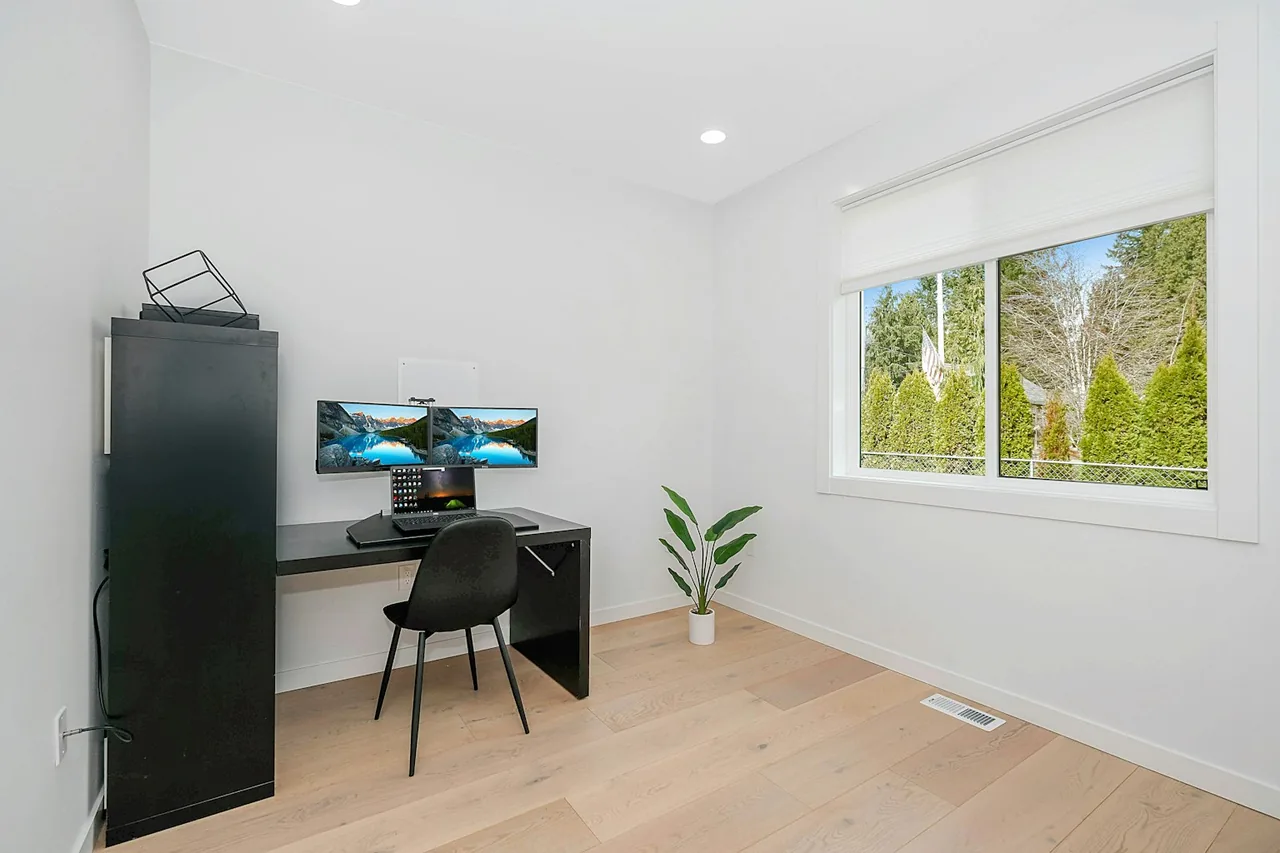
Prefinished vs. unfinished hardwood is the choice between a floor finished at the factory and one sanded and finished on site after install. Prefinished wood arrives with a hard, factory UV-cured aluminum-oxide finish and installs in a day with no dust — but carries micro-beveled edges between boards. Unfinished wood is sanded flat and finished in your home for a seamless surface and a fully custom stain — at the cost of sanding dust, VOC fumes, and several days of cure time before the room is usable. Four things swing on this one decision — finish durability, surface look, color freedom, and downtime — and unlike every other hardwood choice, it has nothing to do with the wood itself. Get a free consultation and a written, itemized scope from a vetted installer before a single board is ordered — which finishing route fits your household is decided in that document, not in the showroom.
The Real Fork — Where the Finish Happens Changes Everything
This is the one hardwood decision that has nothing to do with the wood itself. Whether you choose solid or engineered construction, and whichever species you pick — oak, maple, hickory, or walnut — you still have to decide where the floor gets its finish.
One Variable, Four Consequences
That single variable, the location of the finishing, cascades into four real differences: how durable the finish is, how the floor surface looks, how much color freedom you have, and how disruptive the install is.
What "Prefinished" and "Unfinished" Actually Mean
Prefinished hardwood is sanded, stained, and top-coated at the factory under controlled conditions, then shipped ready to install. The boards go down finished — no sanding, no staining, no coating in your home — so the floor is walkable almost immediately. Unfinished (also called site-finished) hardwood ships as bare, milled wood; the installer fastens it, then sands the entire floor flat, applies stain if you want color, and builds up protective topcoats in your home, with drying and curing between steps.
Optimized for Opposite Priorities
Neither is universally better — they are optimized for opposite priorities. Prefinished optimizes for finish hardness and speed; unfinished optimizes for a flawless, seamless, custom surface. Within hardwood flooring, getting this choice right means being honest about which of those you actually value more, because each comes with a real cost the other avoids.
Why This Choice Comes Last
This is the last fork in a hardwood purchase, decided after construction and species. Those two are dictated by your subfloor and your room; the finish route is dictated by your household's tolerance for downtime and your appetite for a seamless, custom look. The rest of this page is the four trade-offs in detail.
Prefinished vs. Unfinished — the Four Trade-Offs Side by Side
The decision is really four decisions bundled together, and each one points a different direction. Laid out together, they show why neither route wins outright — you weight the two that matter most to you.
The Prefinished-vs-Unfinished Comparison Matrix
The matrix below is the whole decision on one grid — the deciding factor each route is judged by, side by side. These are the widely documented properties of factory versus site finishing; the specifics of your product and finish system always govern.
| Deciding factor | Prefinished | Unfinished (site-finished) | Which wins |
|---|---|---|---|
| Finish hardness | Factory UV-cured aluminum-oxide | Air-cured site finish, softer | Prefinished |
| Surface look | Micro-beveled V-groove at each seam | Sanded flush — seamless plane | Unfinished |
| Color freedom | Fixed manufacturer catalog | Any custom stain, matched on site | Unfinished |
| Downtime | Walkable same day, no dust | Days to a couple of weeks; dust + VOC | Prefinished |
| Dust & fumes | None on site | Sanding dust and finish odor | Prefinished |
| First refinish | Removes factory layer + bevels | Repeats the original process cleanly | Unfinished (long term) |
The split is clean: prefinished wins finish hardness and minimal disruption; unfinished wins the seamless surface and custom color. Two factors favor each, so the honest question is which pair matters more to you — a tough, fast, dust-free floor from a stock palette, or a flawless flush surface in an exact color you can wait for. The rest of this page takes each trade-off in turn.
The Choice Rides on Top of Construction and Species
This fork applies to any hardwood — both solid wood and engineered flooring come prefinished and unfinished, in every species. So settle the subfloor-driven construction question in engineered vs. solid hardwood and the species under the hardwood hub first; the finish route is the last decision, layered on top.
Not sure whether your household can absorb site-finishing downtime?
We match you with a vetted installer who lays out the finish trade-offs against your rooms and schedule, then puts the recommended route in a written scope — before you commit to a board or a price.
Finish Durability — Why Factory Aluminum-Oxide Wins on Hardness
The most decisive difference is finish hardness, and here prefinished has a genuine, measurable edge. Factory finishes are applied and cured in a way no site finish can match.
How the Factory Builds a Harder Finish
Prefinished boards are coated with multiple layers of finish — typically a UV-cured urethane infused with aluminum oxide, one of the hardest abrasives used in coatings — and cured instantly under industrial ultraviolet lamps. The result is a finish meaningfully harder and more abrasion-resistant than what is achievable on site, which is why prefinished floors routinely carry long finish warranties measured in many years against wear-through. The factory environment — dust-free, climate-controlled, with curing equipment a job site cannot replicate — is the whole reason the finish comes out tougher.
Why the Site Finish Trades Hardness for the Seam
Site-applied finishes on unfinished floors are good, but they cure by air and chemistry in a real room, not under UV lamps, so they do not reach the same surface hardness and they take real time to reach full durability. This is the core trade: you give up some finish toughness to gain the seamless, custom surface that only site-finishing delivers. For a high-traffic floor where wear resistance is the priority — busy entries, a wood kitchen floor, active households — the prefinished aluminum-oxide finish is the more durable starting point, and pairing it with a hard species like a hard hickory species compounds the advantage. When either floor's finish eventually wears, both can be renewed under floor refinishing — though, as the next sections cover, the refinish behaves a little differently for each.
Finish Systems Compared — Factory vs. the Site Options
The two routes are not just "factory" versus "site" — each site finish is its own chemistry with its own hardness, cure time, and re-coatability. The table sets the factory finish against the common site systems on the attributes that decide durability and downtime. These are the recognized characteristics of each finish family; the specific product's data sheet always governs.
| Finish system | Where applied | Relative hardness | Cure to full use | Re-coatability |
|---|---|---|---|---|
| Factory UV aluminum-oxide | Prefinished (factory) | Highest — abrasive-loaded, UV-cured | None — walkable same day | Hard to spot-recoat; adheres poorly without abrasion |
| Water-based polyurethane | Site (unfinished) | Hard; clear, low-yellowing | Days to a couple of weeks | Good — screens and recoats cleanly |
| Oil-based polyurethane | Site (unfinished) | Hard; ambers with age | Longer cure; stronger odor | Good — recoats well |
| Penetrating / hardwax oil | Site (unfinished) | Softer surface; repairable in place | Moderate; low VOC options | Excellent — spot-repairable without full sanding |
The pattern is the trade in miniature: the factory finish is the hardest starting point but the least forgiving to touch up, while the site finishes give up some initial hardness for far easier renewal and repair. A busy household weighting raw wear resistance leans factory-prefinished; one weighting long-term repairability and a seamless custom look leans toward a site system on unfinished wood.
The Surface Look — Micro-Bevels vs. a Seamless Floor
The second trade-off is visual and tactile, and here unfinished wins as decisively as prefinished wins on durability. It comes down to what happens at the edges between boards.
Why Prefinished Boards Carry a Micro-Bevel
Because prefinished boards are finished before they are installed, the floor is never sanded flat as a single plane — each board arrives already coated, and tiny height differences between adjacent boards would otherwise show as sharp, finish-chipping edges. To solve that, prefinished boards carry a micro-bevel: a small chamfer milled along each edge that creates a subtle V-groove where boards meet. The micro-bevel is a deliberate, sensible engineering choice — but it means the floor is not perfectly flat across the seams, the grooves are visible and felt underfoot, and they collect dust and grit that has to be cleaned out of the lines over time.
Why Unfinished Delivers a Seamless Plane
Unfinished wood is the opposite: installed bare, then sanded as one continuous surface, so every board is leveled flush with its neighbors before the finish goes on. The result is a perfectly smooth, seamless floor with no grooves between boards — the flat, monolithic look many people associate with high-end and historic floors, and a surface with no bevels to trap dirt. If a seamless, flush floor is what you picture, only unfinished delivers it; prefinished, by its nature, cannot. This is the single most common reason buyers choose site-finishing despite the dust and downtime.
Color Freedom — Stock Finish vs. Any Custom Stain
The third trade-off is color control, and it is the other big reason to choose unfinished. Where the finish happens determines how much say you have over the final shade.
Prefinished Means a Fixed, Guaranteed Catalog
Prefinished hardwood comes in the colors the manufacturer offers — a wide range, but a fixed catalog. You choose from existing stained-and-finished options, and what is in the showroom is what goes on your floor. That is perfectly fine if a stock color matches your vision, and it removes all guesswork: the sample is exactly the result.
Unfinished Means Any Color — and Species Matters
Unfinished hardwood, because it is stained in your home on the actual floor, can be finished in any color — a fully custom stain mixed and tested on your own wood, matched to existing floors in adjoining rooms, or built to a designer's exact target. This is also where species interaction matters: unfinished oak's open grain takes a custom stain evenly and predictably, making it the ideal species for site-finishing, while the custom-color advantage is largely wasted on maple, whose dense grain blotches under stain, or on naturally dark walnut, which is finished clear anyway. So the color logic is clean: if a stock prefinished color works for you, take it — it is faster and the result is guaranteed. If you need a specific custom shade, a match to an existing floor, or a one-of-a-kind tone, unfinished is the only path, and a stain-friendly species like oak is the one to pair it with. Matching new wood to an old floor during a replacement or extension is one of the strongest cases for site-finishing.
How Each Is Installed — and Where the Two Paths Diverge
Both routes share the same universal hardwood prep and split only at the finish. The six steps below are the full arc; the fork opens at steps five and six, where a prefinished floor is essentially done and an unfinished floor's real work begins.
On-Site Subfloor Assessment
Identical for both. The installer identifies the substrate — nailable wood subfloor or concrete slab — checks for deflection and squeaks, and confirms the method against the construction. This is universal hardwood prep, unchanged by which finish route you chose.
Moisture Testing and Acclimation
Also identical. Concrete is read by an in-situ relative-humidity test to ASTM F2170 at 40% of slab depth, wood subfloors are metered, and the boards acclimate in the conditioned space until their moisture content reaches equilibrium — the prep detailed under subfloor prep protects both.
Flatness Correction and Layout
The substrate is corrected to the NWFA flatness tolerance of 3/16 in. over 10 ft and the layout is planned with a continuous 1/4 in. to 3/8 in. expansion gap. Both routes need this — but it matters even more for prefinished, whose micro-bevels forgive small height differences a seamless sanded floor would not.
Fastening the Boards
The floor is fastened by the method the substrate allows — nailed through the tongue every 6 to 8 inches for solid, glued or floated for engineered. Prefinished boards go down finished; unfinished boards go down bare, ready to be sanded as one plane. This is where the two paths visibly diverge.
Prefinished: Done. Unfinished: Sand, Stain, Coat
For a prefinished floor, the field is essentially finished — the floor is walkable almost immediately, with only trim to add. For an unfinished floor, the real work starts: the whole floor is sanded flush (generating fine dust that demands containment), stained if colored, then given multiple protective topcoats with drying time between each. This is the step that buys the seamless surface and custom color, at the cost of dust and time.
Cure, Trim, and Walkthrough
Prefinished needs no cure — trim goes on and the room returns to use. Unfinished must cure: from last coat to light foot traffic is commonly a day or more, and to full cure for rugs and heavy furniture can be a couple of weeks. Stair-nosing, thresholds, and baseboard finish the edges and bridge to any staircase, and the installer walks the floor with you to confirm the result and explain the cure window.
The shared first four steps are why finish route is the last decision, not the first: the wood, subfloor, and method are settled the same way for both, and only the finish changes the timeline. The full method comparison across all materials lives under flooring installation.
Talk through your project — free.
A free consultation and a written, itemized quote from a vetted installer. No pressure, no obligation.
Which Finish Route Is Right for You?
The choice comes down to which two of the four trade-offs you weight most, and one practical constraint. Walk it in order; each branch settles prefinished or unfinished.
- Do you need a specific custom color or a match to an existing floor? If yes, only unfinished delivers it — a stock prefinished catalog cannot hit an exact custom shade or feather into an old floor. Pair it with stain-friendly oak. If a stock color works, continue.
- Is a perfectly seamless, flush surface non-negotiable? If the flat, monolithic look matters more than anything, unfinished is the only route — prefinished's micro-bevels are inherent. If you are fine with subtle V-grooves at the seams, continue.
- Can your household absorb days of downtime, dust, and fumes? Site-finishing takes a room out of use for days to a couple of weeks of cure, with sanding dust and finish odor. If you can't vacate rooms or tolerate that, prefinished's one-day, dust-free install is the realistic choice regardless of the look you'd prefer.
- Is finish hardness the top priority? For a busy entry or a high-traffic home where wear resistance leads, prefinished's factory aluminum-oxide finish is the harder starting point — especially paired with a hard species like hickory flooring.
- Let your species inform the call. The custom-color advantage of unfinished shines on oak, is largely wasted on blotch-prone maple, and is moot on naturally dark walnut — so the species you want can settle a close decision.
Run honestly, this tree returns a clear route — and an installer who pushes one option for every job regardless of your look and schedule is the red flag.
Common Prefinished-vs-Unfinished Mistakes, Consequences, and Prevention
Most finish-route disappointments are the same handful of mismatched expectations, each with a predictable consequence and a known prevention. Naming them is how you spot a corner being cut before it is buried under your floor.
| Mistake | What it causes | The prevention |
|---|---|---|
| Expecting a seamless floor from prefinished | Surprise at the visible, dust-collecting micro-bevels | Choose unfinished if a flush, seamless surface is the goal |
| Planning unfinished around a dark stain on maple | Blotchy color the custom route was meant to control | Site-finish on stain-friendly oak, not blotch-prone maple |
| Underestimating unfinished downtime | A family displaced longer than expected by dust and cure | Confirm walk-on and full-cure timelines before committing |
| Walking on a site finish before it cures | Marred, imprinted finish that needs recoating | Respect the cure window — light traffic in a day, furniture in weeks |
| Site-finishing without dust collection | Fine wood dust through the whole house | Insist on dust-collection equipment during sanding |
| Neglecting the micro-bevel grooves on prefinished | Grit builds in the seams and dulls the look | Vacuum the bevel lines as part of routine care |
| Assuming prefinished can never be refinished | Premature replacement of a renewable floor | Prefinished refinishes too — the first sanding removes the factory layer |
Every row is a mismatch between what a route delivers and what the buyer expected — which is why "we lay out both routes against your look, schedule, and species, in writing" is the most valuable sentence in a hardwood quote.
What Actually Drives the Cost of Each Finish Route
The finish route changes the labor and downtime line items more than the material one; the headline number hides the differences below, ranked by how much they move the total.
The Cost Drivers That Move the Total Most
- Site-finishing labor. The biggest swing between the two. Unfinished adds sanding, staining, and multiple topcoat passes with cure time between — skilled hours a prefinished floor's one-day install avoids entirely.
- Dust containment and downtime. Unfinished requires dust-collection equipment and takes a room out of service for days to weeks — a real cost in disruption even where it is not a line item.
- Species and grade. Common across both routes — a harder, rarer species and a cleaner grade cost more regardless of where the finish happens.
- Custom-stain work. Mixing, testing, and matching a custom stain on unfinished oak is skilled labor; a stock prefinished color carries none of it.
- Subfloor prep and leveling. Shared, but flatness matters more for a seamless unfinished floor — grinding and self-leveling to tolerance is real material and labor.
- Old-floor removal and disposal. Tear-out is labor and haul-away is a fee on either route, and removal often exposes subfloor problems that change scope.
- Stairs and transitions. Treads, risers, and stair-nosing are slow, exacting work priced separately; a run onto stairs raises the total on either route.
Because these drivers swing so widely, the only honest number comes from an on-site assessment. Compare what moves the price in our hardwood flooring cost guide and across the cost guides, and size your own room with the hardwood calculator so you can read a quote critically.
Get an itemized scope, not a headline rate.
A vetted installer prices the finishing labor, dust control, prep, and transitions as separate lines — so you see the whole job on either route, free and with no obligation.
How to Choose Between Prefinished and Unfinished
The decision comes down to which two of the four trade-offs you weight most — durability and speed (prefinished) or seamless look and custom color (unfinished). Use these to settle it.
- Choose prefinished for finish hardness and minimal disruption
- The factory UV-cured aluminum-oxide finish is harder than any site finish, and the floor installs in a day with no dust or cure time. Ideal for busy households, high-traffic rooms, and homes that can't be vacated — if a stock color works for you.
- Choose unfinished for a seamless surface or a custom color
- Only site-finishing gives a perfectly flush, micro-bevel-free floor and lets you stain any custom shade or match an existing floor. The right call when the seamless look or an exact color is non-negotiable — and best paired with stain-friendly oak.
- Be honest about downtime before committing to unfinished
- Site-finishing means sanding dust, finish fumes, and a room out of use for days to a couple of weeks of cure. If your household can't absorb that, prefinished is the realistic choice regardless of the look you'd prefer.
- Match the choice to your species
- Unfinished's custom-color advantage shines on oak, is largely wasted on blotch-prone maple, and is moot on naturally dark walnut — so let the species you want inform whether site-finishing is even worth its cost.
- Weigh the hard species pairing for prefinished
- Prefinished's tough factory finish over a hard species like the hickory species compounds the wear resistance — the most durable starting point for a punishing room.
- Remember the first refinish resets the difference
- A prefinished floor's factory finish and bevels come off in the first full sanding, after which it refinishes like any site-finished floor — so the factory advantage is a one-life benefit, not a permanent one.
Settle the two trade-offs you weight most and the route becomes a clear choice instead of a showroom guess.
Weighing a seamless custom floor against a fast, tough one?
We match you with a vetted installer who lays out both finishing routes against your rooms and schedule, gives realistic cure timelines, and recommends the fit — in a written scope, free and with no obligation.
Prefinished vs. Unfinished Glossary
The terms below recur in every hardwood finish decision, quote, and warranty — each defined as its working meaning on an actual job, so you can read a scope and judge whether it is complete.
- Prefinished hardwood
- Wood sanded, stained, and top-coated at the factory and shipped ready to install — walkable almost immediately, with a hard factory finish and micro-beveled edges.
- Unfinished hardwood
- Bare, milled wood installed then sanded, stained, and coated in your home — delivering a seamless surface and any custom color, at the cost of dust and cure time.
- Site-finished
- Another name for unfinished flooring, emphasizing that the finish is applied on site after installation rather than at the factory.
- Aluminum-oxide finish
- The hard, abrasion-resistant coating on most prefinished hardwood — a UV-cured urethane infused with aluminum oxide, typically harder than any site-applied finish.
- UV-cured finish
- A factory finish hardened instantly under industrial ultraviolet lamps, reaching a surface hardness that air-cured site finishes cannot match.
- Micro-bevel
- The small chamfer milled along each prefinished board's edge, creating a subtle V-groove at the seams — the reason a prefinished floor is not perfectly flush.
- Seamless (flush) surface
- The flat, monolithic plane a site-sanded unfinished floor produces, with no grooves between boards — the look many associate with high-end and historic floors.
- Cure time
- The period a site finish needs to reach full hardness after the last coat — commonly a day to light traffic and up to a couple of weeks for rugs and heavy furniture.
- VOC
- Volatile organic compound — the finish fumes released during and after site-finishing, a factor for occupied homes that prefinished flooring avoids entirely.
- Screen-and-recoat
- Lightly abrading an existing finish and adding a fresh topcoat without a full sanding — a refresh available on either route to extend the life of the finish.
- NWFA
- The National Wood Flooring Association, which sets the recognized practice for subfloor moisture, acclimation, flatness (3/16 in. over 10 ft), and installation that any hardwood floor's warranty is judged against.
- ASTM F2170
- The in-situ relative-humidity test that reads concrete-slab moisture from probes sealed at 40% of slab depth — required before either finishing route over a slab.
Standards, Warranty Conditions, and When a Permit Applies
A manufacturer's warranty is a contract with conditions, and on either finishing route most denials are not about the product — they are about how it was installed and finished.
Warranty Conditions That Hinge on the Finish
The conditions differ by route. A prefinished floor's finish warranty depends on installing to the manufacturer's instructions and not damaging the factory coating. An unfinished floor's finish is only as good as the site work — the finish system followed to spec, dust controlled, and the floor allowed to cure fully before use. In both cases the shared prep conditions apply: substrate moisture below a stated limit, acclimation, the expansion gap, and flatness. An installer who rushes cure time or skips the moisture test has voided your coverage before you notice. Ask in writing that the work follow the manufacturer's published instructions — that document is what a claim is judged against.
The Standards Body That Sets the Bar
For both routes the NWFA governs subfloor moisture, acclimation, flatness, and installation practice, and ASTM F2170 defines the concrete moisture test. A floor built to these holds its warranty and its shape; a floor built around them holds neither.
When a Hardwood Permit Is Required
Permits enter when the work goes beyond the finished surface. Replacing a floor like-for-like usually does not require one, but reinforcing structural subflooring or floor joists, or work tied to a larger renovation, often does — independent of which finish route you choose. A reputable installer tells you when a permit applies rather than working around it, and structural questions belong with the subfloor team first. When only the finish is worn, refinishing renews either route.
A Real Prefinished vs. Unfinished Decision
One representative scenario shows how the four trade-offs resolve when look and downtime pull in opposite directions.
How to Vet a Hardwood Installer on the Finish Route
Most finish-route disappointments are mismatched expectations the installer should have surfaced, so how a crew talks about the choice matters more than the brand on the box. These questions separate a crew that fits the route to your household from one that sells whichever is easier.
- They lay out all four trade-offs honestly
- Ask them to compare prefinished and unfinished for your project. A real answer weighs durability, the micro-bevel look, color freedom, and downtime against your rooms — not a pitch for whichever the shop prefers to install.
- They give realistic cure and downtime timelines for unfinished
- Ask when you can walk on it and when furniture can return. A credible installer names a day or more to light traffic and up to a couple of weeks to full cure — and doesn't pretend site-finishing is a same-day job.
- They use dust collection for site-finishing
- Ask how they contain sanding dust. A professional names dust-collection equipment and containment — the difference between fine wood dust confined to the work and spread through your whole house.
- They match the route to your species
- The right installer knows unfinished's custom color shines on oak and is wasted on blotch-prone maple — and factors that into the recommendation.
- They run the shared prep to spec on either route
- Moisture test, acclimation, flatness, and expansion gap protect any hardwood floor. A crew that skips them because "it's prefinished" is cutting the corner that voids your warranty.
- They put the scope and labor warranty in writing
- Ask for the full scope, the timeline, and the workmanship warranty before work starts. A crew willing to name a labor guarantee — and to return if a seam lifts or a finish flaws — is accountable for the install, not just the product the maker covers.
Two honest answers — a frank comparison of both routes and a realistic cure timeline — tell you more about a hardwood crew than any showroom; the rest of the list confirms it.
Why Route Your Hardwood Project Through Pro Work Home Surface
Pro Work Home Surface is not a contractor and does not lay your floor — we are a national authority on home surfaces that matches homeowners with vetted local installers and holds them to a published bar, whichever finishing route you choose.
- The trade-offs explained before you choose
- Finish durability, the micro-bevel-versus-seamless look, color freedom, and downtime are laid out honestly so the choice fits your priorities and your household — not whichever is easier for the installer to sell.
- Site-finishing done dust-controlled and fully cured
- For unfinished floors, dust-collection equipment is used during sanding, the finish system follows the manufacturer's instructions, and you are given realistic walk-on and full-cure timelines — so the seamless, custom result is delivered without shortcuts on cure time.
- Prep and acclimation before either approach
- Whether prefinished or unfinished, the wood is acclimated on site and the subfloor moisture-tested and leveled to the NWFA 3/16 in. over 10 ft tolerance first — the steps that protect any hardwood floor and the conditions your warranty depends on.
- National coverage, local crews
- We match you with installers in your area nationwide, so the standard is consistent even though the crew is local — whether your project is a single room or a whole home.
Finish is the last fork in a hardwood purchase. Settle the construction question first in engineered vs. solid hardwood and the species under the hardwood hub; if your project also involves refinishing an existing floor, restoring an older one, or a full tear-out and replacement, the same standards apply — weigh the cost in our hardwood flooring cost guide, dig into the how-and-why in our learning center, and start from the hardwood hub to compare a solid-wood floor, an engineered-wood floor, and the species, or zoom out to the flooring hub and the full range of home surfaces.
Brands & Material Authority
Quality and construction drive long-term performance more than the label. These are widely respected names in this category:
- Shaw
- Mohawk
- COREtec
- Armstrong
- Pergo
- Mannington
- Bruce
- Karndean