
Countertop polishing is the mechanical refinishing of a stone surface through an ordered progression of diamond abrasives — climbing from coarse to fine — to remove etch marks, scratches, and dullness and bring back one even sheen. Two facts decide whether a polish succeeds and almost nothing else does: whether the work targets the finish the stone is actually meant to carry, and whether the grit progression is run complete without skipping a step. Chase a high gloss on a stone meant to be matte and you fight its nature; jump from a coarse grit to a fine one and you leave swirl marks the finer pad can never remove. Refinish to the right finish with the right sequence and a tired counter looks new again. Get a free consultation and a written, itemized scope from a vetted polishing specialist before any pad touches the stone — the target finish is where a lasting polish is decided.
Countertop Polishing Is a Finish-Identification Job First, a Grinding Job Second
The dull, etched surface everyone wants gone matters least to whether the polish looks right. What separates a refinish that reads as renewed from one that looks wrong is identifying the finish the stone is supposed to have — read and confirmed before the first diamond pad spins.
The Target Finish Decides What Polishing Can Do
The intended finish dictates what is possible; the grit work only decides how cleanly you reach it, so a credible specialist identifies the finish before quoting:
- A stone meant to be honed matte, taken up to a high gloss, looks unnatural and shows every future etch the gloss would magnify.
- A polished high-gloss top refinished only to the mid grits comes back dull and flat, short of the sheen it carried before.
- An engineered quartz surface put on a polishing wheel at all is ruined — its factory sheen cannot be field-restored, so grinding it leaves a permanent dull patch.
None of those are grinding problems — they are finish-identification problems, the thing that decides whether a polish renews the surface or fights it.
The Order of Operations Never Changes Across Materials
Identify, then refinish. That sequence holds across granite, marble, quartzite, soapstone, and concrete. The refinishing work is always the same: confirm the material can be field-polished at all, identify the target finish, distinguish etch from stain so you do not grind what should be drawn, run the grit progression complete to the right stop point, and seal what is porous afterward. The finish choice happens inside those facts, not before them — and the material gate matters most, because quartz and porcelain cannot be field-polished the way natural stone can, so on them polishing is off the table entirely.
The Countertop Polishing Readiness Gate: Six Checks Before Any Pad Spins
Before a top is polished, a competent specialist runs every surface through the same six-check gate. Each check has a recognized basis, each is a documented reason a polish goes wrong when skipped, and a surface that fails the material check should never be polished at all. Call it the Polishing Readiness Gate: pass all six and the refinish renews the surface; fail one and you have ground in a problem you cannot undo.
- 1. Material is field-polishable
- The slab is identified first, because not every surface can be polished. Natural stone — granite, marble, quartzite, soapstone — and concrete refinish through diamond abrasives; quartz and porcelain cannot be field-polished, and putting them on a wheel ruins the factory finish permanently. This single check decides whether polishing is even the right service.
- 2. Target finish identification
- The finish the stone is meant to carry — polished high-gloss, matte honed, or textured leathered — is confirmed against the existing surface and the stone's nature. The grit progression's stop point is set entirely by this, so refinishing without identifying the finish is aiming a process with no target.
- 3. Etch vs. stain vs. scratch diagnosis
- Each mark is sorted into what polishing fixes and what it does not. An etch (dull spot from acid) and a scratch are surface defects polishing removes; a stain (absorbed discoloration) is below the surface and must be drawn with a poultice, not ground. Grinding a stain only exposes more stained stone — so the diagnosis decides whether polishing is the whole job or just part of it.
- 4. Damage depth — surface vs. through-body
- The surface is checked for damage too deep for polishing. Etch, fine scratches, and dullness are surface-depth and refinish away; a chip is missing material that needs a fill first, and a crack through the body is a structural repair, not a polish. Polishing renews a surface, it does not rebuild one.
- 5. Edge, seam, and cutout transitions
- The plan accounts for edges, seams, and cutout rims, where a flat polishing pad cannot reach and hand or detail work takes over. A field polished bright while the edges and around the sink stay dull reads as half-finished; matching the sheen into the profiled edge and the cutout reveal is what makes the refinish look whole.
- 6. Post-polish seal plan
- Whether the stone needs sealing after is confirmed, because polishing porous stone removes the old sealer along with the wear. Porous granite, marble, and quartzite are resealed after refinishing; non-porous soapstone is oiled instead; quartz and porcelain — which should not be here — would need neither. Matching the seal to the material is what makes the other five checks count.
The first three of these six — material, finish, and the etch-vs-stain call — are the checks a careless polish skips, because identifying them takes knowledge a fast job does not bring, yet every one is verifiable on site. That is why the gate is non-negotiable: the first check alone is the line between a refinish and a ruined quartz top.
Want the right finish identified before the grinding starts?
We match you with a vetted polishing specialist who confirms the stone can be polished, identifies the target finish, and puts the grit plan in a written scope — before any pad touches the surface.
Countertop Polishing Specifications & Standards
The numbers and recognized practices that gate a polish are specific to the stone and the finish — from the finish definitions, through the diamond grit progression and its stop points, to the etch-vs-stain rule and the seal that closes the job.
Finish Type and Sheen Target
The finish is the spec that sets everything downstream, because the grit progression's endpoint is defined by which finish the stone is meant to carry. How it is set depends on whether the surface is reflective, matte, or textured.
The Three Stone Finishes
Natural stone carries one of three recognized finishes, and a polish targets the one the stone was made with.
Polished, Honed, and Leathered
A polished finish is high-gloss and reflective, taken to the finest grits — the most light-reflective surface and the one that shows etch most readily on soft stone. A honed finish is matte and low-sheen, stopped at the mid grits — softer-looking and far better at hiding etch and wear, which is why it is common on marble. A leathered finish is textured and low-gloss, created by brushing the stone, adding grip and hiding fingerprints and water spots. The refinish reproduces whichever the stone already wears.
Why the Finish Sets the Grit Stop Point
The grit progression climbs the same coarse-to-fine ladder regardless of finish; what changes is where it stops. A polish keeps climbing to as fine as 3000+ grit to build gloss; a hone stops earlier around the mid grits to leave a matte surface; a leathered finish substitutes a brushing step for the final polishing pads. Stopping at the wrong grit is how a polish comes back too dull or a hone comes back too shiny — the endpoint, not the climb, defines the result.
Etch and Scratch Depth Limits
Polishing removes surface defects — etch, fine-to-moderate scratches, and dullness — by cutting a thin layer and refinishing it. A defect too deep, or missing material like a chip, is past polishing and needs a fill first; the polish then blends the repair into the finish. Knowing whether a mark is within polishing depth or past it sets whether refinishing alone is the job.
Diamond Abrasive Specifications
The progression uses diamond abrasives in graded grits, run wet, and skipping a grade is the cardinal error.
The Diamond Grit Progression
Refinishing climbs through progressively finer diamond pads — a coarse grit first to cut the etched or scratched layer, then each successive grade removing the scratch pattern the last one left, up to 3000+ grit for a true polish. Each grit must follow the one before it in order: jump from coarse straight to fine and the deeper scratch pattern from the coarse pad stays, because a fine pad only refines the surface, it cannot erase a coarser scratch beneath it. The work is run wet to control heat and dust and to keep the diamonds cutting cleanly. The complete, in-order progression is the entire craft of polishing.
Etch vs. Stain — the Diagnosis That Precedes Polishing
Polishing fixes etch and does nothing for a stain, so the two must be told apart first. An etch is on the surface — acid ate the polish off calcite-bearing stone, dulling the very top layer — and it is removed by polishing it back. A stain is below the surface — liquid soaked into the porosity — and it is drawn out with a poultice, not ground away; polishing a stain only cuts down to more stained stone. Mistaking one for the other wastes the work: grinding a stain chases it deeper, while poulticing an etch accomplishes nothing. This call, central to restoration, governs whether polishing is the whole job.
Post-Polish Sealing Threshold
Polishing porous stone strips the old sealer along with the wear, so resealing is the closing threshold. Porous granite, marble, and quartzite are resealed with a penetrating sealer matched to the stone, detailed under sealing; non-porous soapstone is oiled instead. Leaving porous stone unsealed after a polish means the next spill soaks straight into the fresh finish — undoing the refinish the first time wine sits on it.
Polishing Step, Basis, and What It Reverses, by Defect
The table below collects the recognized polishing approaches a competent specialist verifies. These are representative — the stone, the finish, and the defect depth always govern, and where a mark is a stain or a chip, draw-out or fill replaces a polishing pass.
| Defect | Where it lives | Recognized step | What it reverses |
|---|---|---|---|
| Acid etch | Surface polish loss | Re-polish through the grit progression | Dull spots from acid contact |
| Fine scratches | Surface grooves | Grit progression from a matched start | Abrasion marks in the finish |
| Overall dullness | Cumulative surface wear | Full-face refinish to target sheen | Lost gloss across the top |
| Absorbed stain | Below surface, in porosity | Poultice draw-out — not polishing | Discoloration soaked into the stone |
| Chip (missing material) | Local, surface to shallow | Fill first, then polish in | Lost material at the flaw |
| Wrong sheen vs. original | Whole-surface finish | Re-run to the correct grit stop | A finish that fights the stone |
| Scorch on quartz | Engineered surface | Not polishable — repair or replace | Nothing — quartz is not field-polished |
The lesson is that polishing renews a finish but does not fix a stain, a chip, or a crack — those come first, by draw-out or fill, and the polish blends them in. Size the work against a refinish or replacement first with the countertop cost calculator, and compare what stone finishing costs in our cost guides.
Countertop Polishing Methods Compared
How a top is polished is dictated by the stone and the target finish, because each method builds a different sheen and none suits every stone. There are several recognized approaches, and the right one is set by the finish the stone carries — never by which is fastest.
The Polishing Method Comparison Matrix
The matrix below is the decision the specialist is making — method, the finish it builds, the stone it suits, and where it belongs, side by side.
| Method | Finish it builds | Best for | Materials | Main risk if rushed |
|---|---|---|---|---|
| Diamond grit progression | Polished high-gloss | Restoring a reflective finish | Granite, quartzite | Swirl marks from skipped grits |
| Honing (mid-grit stop) | Matte honed | Hiding etch on soft stone | Marble, soapstone | Accidental gloss vs. matte intent |
| Brushing | Textured leathered | Grip, hiding spots and prints | Granite, quartzite | Uneven texture across the face |
| Powder / compound polish | Touch-up gloss | Light etch on a sound finish | Marble, limestone | Halo if the surface is uneven |
| Hand / detail polishing | Matches field sheen | Edges, seams, cutout rims | All natural stone | Dull edges around a bright field |
| Mineral-oil treatment | Deepened patina | Refreshing soapstone | Soapstone | Blotchy, uneven patina |
Building a Polished or Honed Finish
The two most common refinishes are a polish and a hone, and they share a ladder. To restore a high-gloss polished finish, the specialist runs the diamond grit progression complete, climbing to the finest grits to build reflectivity. To restore a matte honed finish, the same progression is run but stopped earlier at the mid grits, leaving a soft, low-sheen surface. The difference is entirely the stop point, which is why identifying the finish first is non-negotiable — the same climb, ended in the wrong place, gives the wrong stone the wrong face.
Light Etch Touch-Ups vs. Full Refinishing
Not every dull spot needs a full grit progression. A light, isolated etch on an otherwise sound polished surface can sometimes be lifted with a marble polishing powder or compound that re-establishes the gloss in that spot — a touch-up, not a refinish. But the moment etch and dullness are widespread, a spot touch-up leaves a bright halo against the surrounding wear, and the honest fix is refinishing the whole face. Knowing when a touch-up suffices and when it will look worse than the problem is the judgment a specialist brings.
Edges, Seams, and the Quartz Exception
A flat field pad cannot reach a profiled edge, a seam, or a cutout rim, so those are matched by hand and detail polishing into the field sheen — the difference between a refinish that looks whole and one that looks like the middle was done and the edges forgotten. And the exception that overrides every method: quartz and porcelain are never field-polished. Their finish is engineered, not a re-cuttable layer, so a polishing wheel leaves a permanent dull patch — a scorched or scratched quartz top is a repair or replacement question, never a polishing one.
Should Your Countertop Be Polished, Drawn, Repaired, or Replaced?
The right service is not a guess — it is the output of a short chain of facts about the material, the mark, and its depth. Walk the decision in order; each branch eliminates a service the surface does not need, and what survives is the right call.
- Confirm the material can be field-polished. Natural stone and concrete polish; quartz and porcelain cannot be field-polished at all. If the top is quartz or porcelain, polishing is off the table immediately — a damaged surface there is a repair or replacement question, not a refinish.
- Diagnose the mark — etch, scratch, or stain. An etch (dull acid spot) or a scratch is a surface defect that polishing removes. A stain is absorbed discoloration that polishing cannot fix — it is drawn out with a poultice under restoration. Grinding a stain only exposes more stained stone, so this call decides whether polishing is even the right tool.
- Check the depth — surface or through-body. Etch, fine scratches, and dullness are surface-depth and polish away. A chip is missing material that needs a fill before polishing blends it in; a crack through the body is a structural repair, not a polish. Polishing renews a surface, it does not rebuild one.
- Decide touch-up vs. full refinish. An isolated light etch on a sound finish may lift with a polishing compound — a touch-up. Widespread etch and dullness need the whole face refinished, because a spot polish on a worn top reads as a bright halo. Match the scale of the work to the scale of the wear.
- Set the target finish and the seal. Confirm the stone's intended finish — polished, honed, or leathered — so the grit progression stops in the right place, and plan to reseal porous stone afterward. Compare materials and finishes spec-for-spec in the material comparison tool if you are also weighing a change.
Run honestly, this tree returns a clear service — and a specialist who proposes to polish quartz, grind a stain, or spot-polish a uniformly dull top is the red flag.
Not sure if polishing is even the right fix?
Tell us the material and the mark and we will match a vetted specialist who diagnoses etch versus stain, confirms the stone can be polished, and puts the right service in writing — before any work begins.
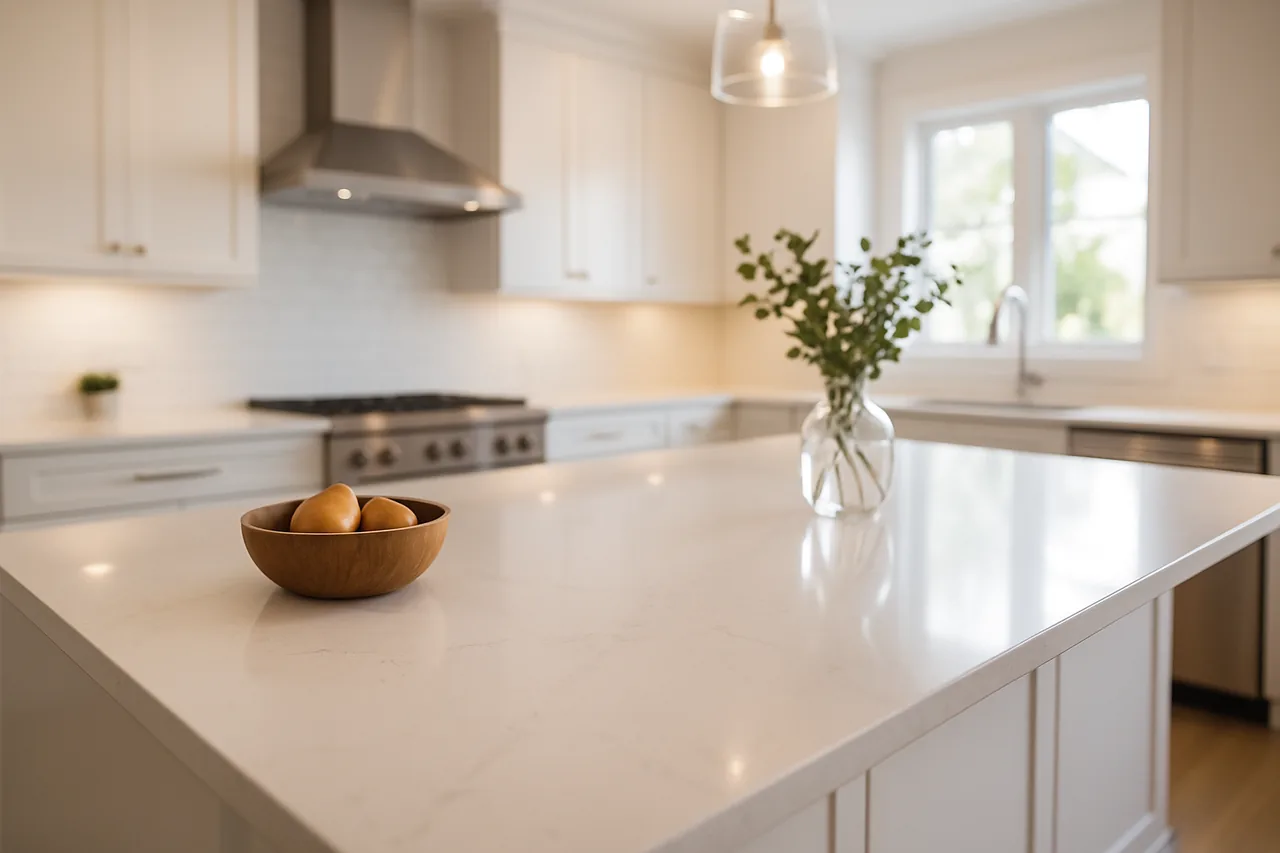
Why Countertops Lose Their Shine — and How Polishing Brings It Back
The conditions that take the sheen off a stone top trace back to acid, abrasion, and wear, and polishing reverses the ones it can by a method matched to the mechanism — paired below with its cause and the named approach that restores the surface.
Etch Marks: An Acid-Contact Failure
Etch is the most common reason a stone top looks dull in spots: acid — citrus, wine, vinegar, harsh cleaners — reacts with the calcium carbonate in marble and other calcite-bearing stone and eats the polish, leaving lighter, duller marks. It is surface polish loss, not a stain and not dirt. Polishing reverses it by re-running the grit progression over the etched area and back into the finish — the only fix, since the shine is simply gone and must be re-cut. A honed finish hides recurring etch better, which is why many marble tops are refinished matte rather than glossy.
Scratches: An Abrasion Failure
Scratches are mechanical: grit dragged across the surface, a heavy object slid over the stone, or daily abrasion cutting fine grooves into the finish. They are surface defects with no missing material, so polishing removes them by starting at a grit that cuts below the deepest scratch and climbing back up to the target finish. The depth of the scratch sets where the progression starts; a fine scratch needs only the upper grits, a deeper one starts coarser — but either way it is the complete climb, not a single pad, that erases it.
Overall Dullness: A Cumulative-Wear Failure
A top that has simply gone flat all over lost its sheen to time — the slow accumulation of fine abrasion, micro-etching, and use that wears the finish down uniformly. There is no single event. Polishing reverses it by refinishing the whole face through the grit progression to the stone's intended sheen, renewing it end to end. Spot-polishing here backfires: a brightened patch against a uniformly dull surface looks worse than the even dullness it replaced, so the whole face is the unit of work.
A Stain That Polishing Can't Touch: A Porosity Failure
The condition polishing cannot fix is a stain — absorbed discoloration where liquid soaked into porous stone below the surface. It looks like it should grind out, but polishing only cuts down to more stained stone. The real fix is drawing it out with a poultice, covered under restoration, before any polishing. And if the dullness hides a chip or a crack rather than just wear, the path is a fill or structural repair first — polishing blends a repair in, it does not stand in for one.
Common Countertop Polishing Mistakes, Consequences, and Prevention
Most botched polishes are the same handful of shortcuts, each with a predictable consequence and a known prevention. Naming them is how you spot a refinish being done wrong before it grinds in a problem you cannot undo.
| Mistake | What it causes | The prevention |
|---|---|---|
| Polishing quartz or porcelain | A permanent dull patch on a non-polishable finish | Identify the material first; never wheel engineered slabs |
| Skipping grits in the progression | Swirl marks the finer pad can never remove | Run every grade in order, coarse to fine |
| Grinding a stain as if it were an etch | The stain deepens; more stained stone is exposed | Draw stains with a poultice before polishing |
| Refinishing to the wrong sheen | A gloss on a stone meant to be honed, or vice versa | Identify the target finish before the final grit |
| Spot-polishing a uniformly dull top | A bright halo against the surrounding wear | Refinish the whole face to one even sheen |
| Leaving edges and cutouts dull | A bright field with a dull, half-finished border | Hand-polish edges and rims into the field sheen |
| Skipping the reseal on porous stone | New spills soak straight into the fresh finish | Re-seal porous stone after polishing |
Every row is a documented callback trigger — which is why "we identify the finish and run the full progression, in writing" is the most valuable sentence in a polishing quote.
Matching the Polish to the Material — and the Spec That Governs It
The right polish for a top is dictated by what the slab is made of, because hardness, finish, and whether it can be field-polished at all decide the approach — which is why the first question is always the material, not the mark.
Polishability by Material
Each material polishes on its own terms — the property that matters is whether the surface can be field-refinished and to which finish, so match the method to the slab.
- Granite is natural stone, Mohs ~6 to 7, and polishes well to a high gloss; its hardness means it holds a polished finish a long time and resurfaces cleanly when it finally dulls. Granite is resealed after polishing because it is porous, and it can also be honed or leathered to taste.
- Marble is the polishing stone with a caveat: soft (Mohs ~3) and acid-sensitive, it etches readily, so much of its polishing is etch removal — and because a polished marble shows every new etch, it is very often refinished honed instead, which hides recurring acid marks far better.
- Quartzite is harder than granite (Mohs ~7), so it resists the scratching and etching that dull softer stone and holds its polish longest; when it does need refinishing, its hardness makes the grit progression slower but the result the most durable of the natural stones.
- Soapstone is the outlier — soft (Mohs ~2.5) and non-porous, it is not polished to a gloss at all; its finish is refreshed by sanding out scratches and re-oiling to deepen the patina, never by a diamond polish or a sealer.
- Quartz, porcelain, and concrete diverge sharply: concrete can be ground and polished like stone, but quartz and porcelain cannot be field-polished — their engineered finish is not a re-cuttable layer, so a damaged surface is a repair or replacement question, full stop.
Matching the Polish to the Room
Room context shapes the polish too. A kitchen countertop dulls from heat, acid, and heavy use, so it sees the most etch and the most frequent refinishing — and is the most common place a marble top is honed to manage recurring etch; a bathroom vanity dulls mostly from cosmetics and water, a lighter touch-up case; an outdoor kitchen adds UV and weather, and any reseal after polishing must be rated for exposure; a kitchen island has long runs and a profiled edge where field-and-edge sheen matching matters most. Match the polish to how the surface actually lives, then compare materials spec-for-spec in the material comparison tool.
What Actually Drives the Cost of a Countertop Polishing
A polishing quote is not a flat per-square-foot rate; the headline number a quick "buff" leads with hides the items below, ranked by how much they move the total.
The Cost Drivers That Move the Total Most
- Touch-up vs. full refinish. The biggest swing. Lifting an isolated etch with a polishing compound is a fraction of running the whole face through the complete grit progression — the extent of the dullness sets the scope.
- Material hardness. Harder stone like quartzite takes more passes and time to refinish than softer marble, so the same area costs more on a harder slab.
- Target finish. A high-gloss polished finish to 3000+ grit takes more grits and passes than a honed matte stop, and a leathered texture is its own brushing process — the finish drives the labor.
- Preceding repair or draw-out. A stain that must be poulticed out, or a chip that must be filled, before polishing is a separate step the polish then blends in — work a clean, sound surface skips, detailed under restoration and repair.
- Edge, seam, and cutout detail. Hand-matching the sheen into profiled edges, seams, and cutout rims is slow, exacting work priced beyond the open field.
- Area and layout. Square footage drives the core labor, and a broken-up layout with many returns and corners adds detail time over a simple run.
- Resealing or oiling. A penetrating seal after polishing porous stone, or oiling for soapstone, is the closing material and labor that protects the fresh finish.
- Access and masking. Polishing wet around a mounted sink, backsplash, and adjoining surfaces means masking and sometimes disconnecting fixtures — labor an open run does not.
Because these drivers swing so widely, the only honest number comes from an on-site look at the stone and the wear. Compare what polishing costs against a refinish or replacement in our cost guides, and size the alternative with the cost estimator so you can read a polishing quote critically.
Get a finish plan and an itemized scope, not a "buff."
A vetted specialist prices the diagnosis, the grit progression, the edge work, and the reseal as separate lines — and tells you when a touch-up or a full refinish is the right call, free and with no obligation.
The Countertop Polishing Process, Step by Step
A professional polish runs the same disciplined sequence every time, and each step exists to reach the right finish cleanly rather than grind in a problem. The six steps below are the full arc from on-site diagnosis to a sealed, refinished surface.
On-Site Diagnosis and Finish Identification
The specialist confirms the material can be field-polished, identifies the target finish — polished, honed, or leathered — and diagnoses each mark as etch, scratch, or stain. Whether polishing is the whole job or part of a larger restoration is decided here against the Readiness Gate, not over the phone.
Stain Draw-Out and Repair First
Anything polishing cannot fix is handled before the pads spin: absorbed stains are drawn out with a poultice and chips are filled and color-matched, so the surface is sound and clean before refinishing unifies it.
Surface Prep and Masking
Adjoining surfaces, cabinets, and fixtures are masked and protected for wet work, and the stone is cleaned so the diamonds cut a bare surface. The starting grit is chosen for the deepest defect — coarser for a scratch, finer for light etch.
The Diamond Grit Progression
The face is worked through the diamond pads in order, run wet, each grade removing the scratch pattern the last one left — climbing to as fine as 3000+ grit for a polish or stopping at the mid grits for a hone. No grade is skipped, because a finer pad cannot erase a coarser scratch beneath it.
Edge, Seam, and Detail Matching
Profiled edges, seams, and cutout rims a flat pad cannot reach are hand and detail polished into the field sheen, so the refinish reads as one whole surface rather than a bright center with a dull border.
Reseal, Clean, and Walkthrough
Porous stone is resealed with a penetrating sealer matched to the material — soapstone is oiled instead — the site is cleaned and unmasked, and the specialist walks the refinished top with you to confirm the sheen, review the care that keeps it, and explain any cure time before heavy use.
Skip or reorder any one of these six steps and the result falls short of renewed — or grinds in damage that cannot be undone — which is why a vetted specialist treats the sequence as fixed, not optional.
Talk through your project — free.
A free consultation and a written, itemized quote from a vetted installer. No pressure, no obligation.
Countertop Polishing Glossary
The terms below recur in every polishing quote and diagnosis — each defined as its working meaning on an actual refinish, so you can read a scope and judge whether it is complete.
- Grit progression
- The ordered climb through coarse-to-fine diamond abrasives — up to 3000+ for a polish — that refinishes stone. Each grade removes the scratch pattern of the one before; skipping a grade leaves marks the finer pad cannot remove.
- Polished
- A high-gloss, reflective finish taken to the finest grits — the most light-reflective surface, and the one that shows etch most readily on soft stone.
- Honed
- A matte, low-sheen finish stopped at the mid grits — softer-looking than polished and far better at hiding etch and wear, common on marble.
- Leathered
- A textured, low-gloss finish created by brushing the stone — it adds grip and hides fingerprints and water spots, an alternative to both polished and honed.
- Etch
- A dull, lightened mark where acid ate the polish off calcite-bearing stone — surface polish loss removed by re-polishing, not a stain and not drawn out.
- Stain
- Absorbed discoloration that soaked below the surface of porous stone — drawn out with a poultice under restoration, never ground away, because polishing only exposes more stained stone.
- Honing
- Refinishing to a matte surface by stopping the grit progression at the mid grits rather than climbing to a gloss — the deliberate creation of a honed finish.
- Diamond pads
- The graded abrasive pads, run wet, that cut and refine stone through the progression — the tool that makes mechanical polishing possible.
- Polishing compound / powder
- A fine abrasive paste or powder used to lift a light, isolated etch on an otherwise sound finish — a touch-up that re-establishes gloss in a spot without a full refinish.
- Field vs. edge
- The open flat surface (field) versus the profiled perimeter (edge) — the field is machine-polished, the edges and cutout rims hand-matched to the same sheen.
- Penetrating sealer
- An impregnating sealer that soaks into porous stone to resist stain absorption — reapplied after polishing strips the old layer, detailed under sealing.
- NSI
- The Natural Stone Institute, successor to the MIA, whose standards govern stone fabrication, finishing, and polishing practice.
Standards, Limits, and When Polishing Isn't the Answer
A polish is only as good as the diagnosis behind it, and most botched refinishes were wrong from the start — a material that should never have been polished, or a mark that should have been drawn or repaired instead.
Why a Polish Renews or Ruins
A clean refinish respects the material and the finish: the stone is confirmed polishable, the target finish identified, the progression run complete to the right stop, and porous stone resealed. A "polish" that wheels a quartz top, skips grits, grinds a stain, or stops at the wrong sheen has built in its own failure — and some of those, like polishing quartz, cannot be undone. Ask in writing that the work confirm the material, name the target finish, and run the full progression — that document is what separates a refinish that renews from one that ruins, and one more reason the cheapest "buff" is rarely the cheapest finish.
The Standards Bodies That Set the Bar
Standards bodies govern the practice. The NSI (formerly MIA) governs stone fabrication, finishing, and the recognized finishes; quartz and porcelain makers publish the hard limit that their surfaces are not field-polishable; sealer manufacturers publish reapplication intervals. A polish done to these renews the surface, and one that ignores them risks permanent damage.
When the Job Is Draw-Out, Repair, or Restoration Instead
Polishing has a narrow lane. A stain is drawn out under restoration, not polished; a chip is filled first and then polished in; a crack through the body is a structural repair; and a top that needs stains drawn, chips fixed, and the whole face renewed at once is a full restoration that contains polishing as one step. Polishing is the right service when the slab is sound and the defect is surface etch, scratches, or dullness — and the right specialist says so honestly, pointing you to the broader service when polishing alone will not deliver.
A Real Countertop Polishing Decision
One representative scenario shows why finish identification decides everything: the finish the stone was meant to carry, not the dullness on its surface, drove every call below.
How to Vet a Countertop Polishing Specialist
Most botched polishes are diagnosis failures, so the specialist matters more than the shine they promise. These questions separate a crew that refinishes to the right finish from one that grinds first and identifies later.
- They confirm the material can be polished before quoting
- A specialist who would put a quartz top on a wheel is one to walk away from. Ask whether your surface can be field-polished at all — a real answer knows quartz and porcelain cannot and says so immediately.
- They identify the target finish first
- Ask which finish they will restore. A credible answer names polished, honed, or leathered to match the stone — not "we'll make it shiny," which ignores stones meant to be matte.
- They tell etch from stain before they grind
- The right specialist diagnoses a stain and draws it out rather than polishing it. A shop that would grind a stain is a shop that drives it deeper, so ask how they handle a discolored spot.
- They run the full grit progression in order
- Ask how they avoid swirl marks. A professional runs every grade coarse to fine without skipping — a vague answer about "a quick buff" usually means skipped grits and marks that come back.
- They match edges and reseal porous stone
- Ask whether edges, seams, and cutouts are hand-matched and whether they reseal afterward. A field polished bright with dull edges and no reseal is a half-finished job.
- They put the finish, scope, and warranty in writing and stand behind the work
- Ask for the target finish, the grit plan, the seal, and the labor warranty in writing before work starts. A crew willing to name a workmanship guarantee — and to return if the sheen is uneven — is accountable for the refinish, not just the visit.
Why Route Your Countertop Polishing Through Pro Work Home Surface
Pro Work Home Surface is not a fabricator and does not polish your top — we are a national authority on home surfaces that matches homeowners with vetted local specialists and holds them to a published bar.
- A free consultation and an itemized written scope
- Every connection starts with a no-obligation diagnosis and a written quote that lines out the finish target, the grit progression, the edge work, and the reseal separately — so you read the whole job, not a headline rate.
- A real vetting standard, applied before we connect you
- Specialists are screened on what decides a polish: whether they confirm the material is polishable, identify the target finish, tell etch from stain, run the full progression, and reseal porous stone.
- Identify the finish, run the full progression, every time
- The material is confirmed field-polishable and the target finish identified before any pad spins, the diamond progression is run complete to the right stop, and porous stone is resealed — the steps that decide whether a refinish renews or ruins.
- National coverage, local crews
- We match you with specialists in your area nationwide, so the standard is consistent even though the crew is local — whether it is a light etch touch-up or a full-face refinish.
Polishing is one of several countertop services we cover across home surfaces. If your project also touches reviving an aged top end to end, fixing a chip or crack, sealing a porous stone, setting a new top, or fabricating a new slab, the same standards apply — and because countertops sit on cabinets, coordinate the base with cabinet work too. Compare what moves the price in our cost guides, dig into the how-and-why in our buying guides, size the job with our spec-comparison tools, and start from the countertops category hub or the full range of home surfaces.
Brands & Material Authority
Quality and construction drive long-term performance more than the label. These are widely respected names in this category:
- Cambria
- Caesarstone
- Silestone
- MSI
- Cosentino
- Corian
- Wilsonart