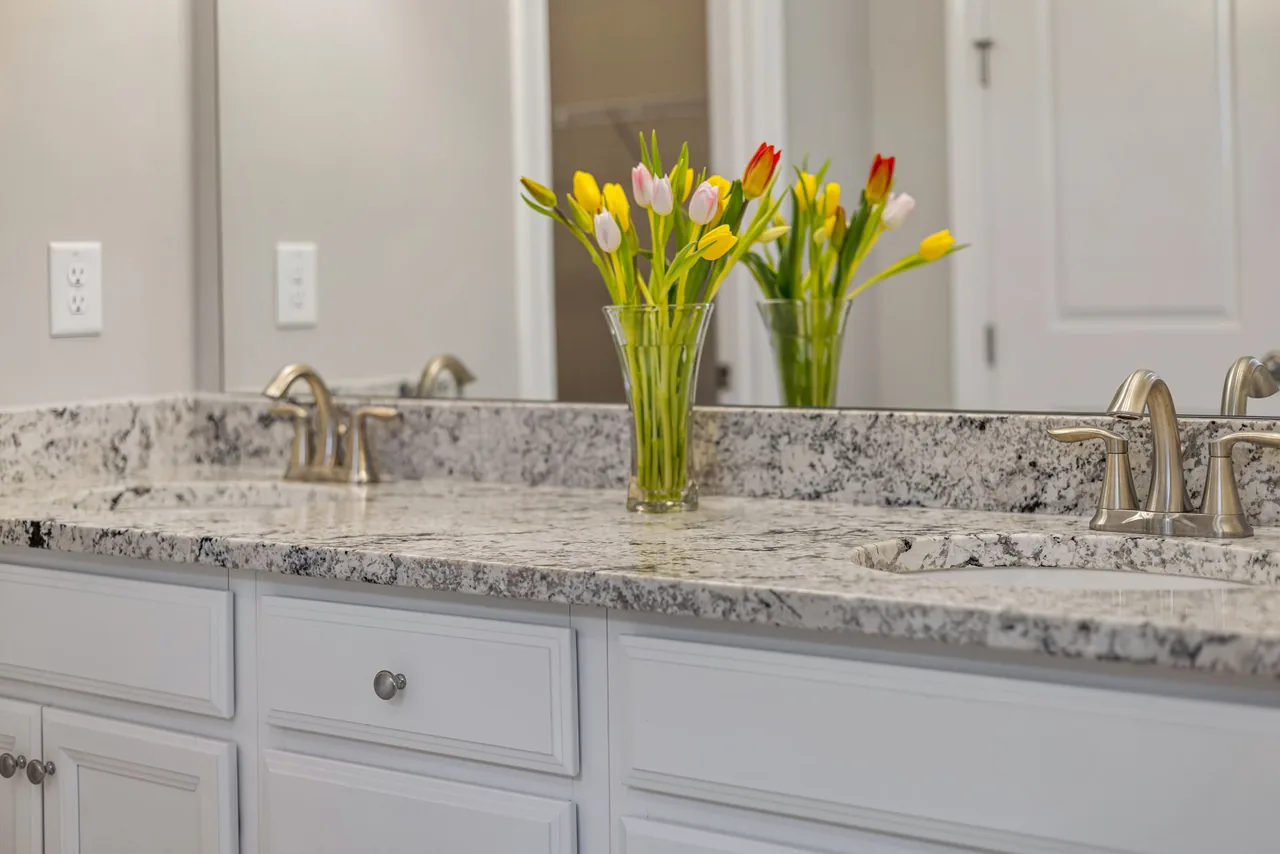
A bathroom countertop lives a gentler life than a kitchen — no knives, no hot pans — but it faces relentless low-grade moisture and a daily parade of cosmetics and cleaning chemicals on a small, up-close surface. The one constraint that decides the material is moisture exposure: standing water around the faucet and basin, plus contact with toothpaste, perfume, hair dye, and acidic cleaners. Because the mechanical abuse is so much lower, the field opens up — even soft marble becomes a sound vanity choice here, where its acid etching would ruin a kitchen. Match a surface that keeps water out and resists the bathroom's specific chemistry — or a porous stone you'll keep sealed — and a vanity stays beautiful for decades. Get a free consultation and a written, itemized scope from a vetted fabricator that names the material's porosity, its sealing cadence, and how the basin cutout and wet joints will be sealed before a single slab is ordered.
A Bathroom Vanity Fails at the Wet Joint, Not the Open Surface
The slab everyone admires in a powder room matters least to whether the vanity lasts. What separates a top still tight and clean in fifteen years from one that mildews in two is whether the material and its seals keep water out at the basin, the faucet, and the backsplash joint — because a bathroom guarantees those spots stay wet.
The Bathroom Flips the Kitchen's Priorities
Move a counter into a bathroom and the whole stress profile changes. The heat and knife abuse that rule a kitchen are simply absent — nobody sears a pan or chops on a vanity. What replaces them is constant, low-grade moisture and chemistry, and a surface judged up close:
- Standing water at the faucet and basin — the faucet base sits wet for hours, the basin reveal is splashed every time the tap runs, and any unsealed pore or open joint there stains, mildews, or feeds water to the cabinet below.
- Cosmetics and chemicals — toothpaste (mildly abrasive), perfume and toner (alcohol and acids), nail-polish remover (acetone), hair dye and self-tanner (staining), and the acidic or abrasive cleaners people reach for in a bathroom.
- Humidity and mildew — a bathroom cycles humid and dry daily, so seams, the backsplash joint, and any gap become a foothold for mildew that a kitchen's drier air doesn't grow as readily.
- A refined, small-scale look — a vanity is a feature surface seen up close in good light, often in a room meant to impress, so finish and veining read louder here than raw durability does.
Because the mechanical abuse is so much lower, the question shifts from "will it survive cooking" to "will it stay beautiful under water and chemistry." That single shift is why a material like marble — a poor primary kitchen counter — earns a real place on a vanity.
Read the Vanity in Priority Order, Not Sample-First
Most people shop a vanity top the same way they'd shop a kitchen — durability first — and miss what the bathroom actually tests. Read the vanity in its real order of failure: moisture resistance first, then chemical resistance, then how it reads at small scale. The look you love has to fit inside the sealing discipline you'll keep and the water tolerance a wet room demands — and because the surface is small, a premium material is far more affordable here than across a whole kitchen. Everything below builds that order into a decision you can hand a fabricator.
The Bathroom Vanity Deciders: Four Specs Before Any Slab Wins
A vanity is bought on properties, not just looks, and four considerations predict how a sample will actually live at a basin. Each has a documented failure attached to ignoring it, and a slab that fails any one is the wrong slab no matter how it photographs. Call it the Vanity Fit Test: pass all six checks and the wet room stays clean and tight; miss one and you're buying a stained, mildewed, or swollen top.
- 1. Porosity and moisture resistance
- The master spec for a wet room. Non-porous surfaces — quartz, porcelain, soapstone — keep water out with zero sealing, exactly where a vanity stays wet. Porous stone — granite, marble, quartzite — needs a maintained penetrating sealer or it stains around the faucet and basin. Ask whether the material is non-porous or needs sealing, and how often.
- 2. Sealing cadence you'll actually keep
- In a humid room a slipping seal invites both staining and mildew, so the honest question is whether you'll reseal on schedule. If a periodic reseal isn't realistic, a non-porous surface that never needs it is the safe ground; if you'll maintain it, porous granite, marble, and quartzite open up. A water-bead test at the faucet — the wettest spot — tells you when the seal is thinning.
- 3. Chemical and acid resistance
- A vanity meets alcohol-based perfumes, acetone remover, hair dye, and acidic cleaners far more than it meets food. Non-porous engineered surfaces shrug them off; soft calcite stone — marble, limestone — etches from acids and abrasives just as it would from a kitchen's lemon. If you choose marble, plan to wipe cosmetics promptly and skip acidic cleaners.
- 4. Finish for a small, up-close surface
- On a surface seen inches away in good light, finish reads strongly. Polished is reflective, wipes cleanest, and resists watermarks; honed (matte) is contemporary and hides etching far better — a real advantage on a marble vanity — but shows fingerprints and watermarks more. The finish changes both the look and the daily upkeep at close range.
- 5. Basin type and cutout support
- The top has to suit your basin — undermount (a cut, polished, sealed reveal), drop-in (a simple cutout with a lip), or vessel (a flat top over a faucet hole). Undermounts on porous stone need the cut reveal sealed so the constantly-wet rim doesn't wick water, and any weak cutout corner is radiused against cracking.
- 6. Overhang and cabinet support
- A vanity top often extends past the cabinet front, and a stone overhang past its safe unsupported span needs a support cleat or bracket — modest compared with a kitchen island, but real, especially on a 2 cm slab or a wall-hung floating vanity where the cabinet gives less backing.
Three of these six — porosity, sealing cadence, and chemical resistance — are exactly the properties a showroom sample can't show you, because they're behavior against water and chemistry over time, not appearance in the moment. That's why the fit test is non-negotiable: every check predicts a specific way a vanity stays clean or fails.
Want porosity and sealing cadence confirmed before you buy?
We match you with a vetted fabricator who names the material's water behavior, sealing schedule, and basin detailing in a written scope — before you commit to a slab or a price.
Bathroom Vanity Specifications That Decide the Room
The specs that gate a vanity top are about moisture and chemistry, not the heat-and-impact numbers a kitchen leans on — from the porosity that separates a clean top from a stained one, through the chemical resistance that decides how it handles cosmetics, to the basin detailing that keeps water out of the cabinet.
Porosity Is the Vanity's Controlling Spec
Water sitting at the faucet and basin is the attack that ruins a vanity, so porosity governs the material choice before looks enter. How a surface answers moisture depends entirely on whether it has pores for water to enter.
Non-Porous Surfaces: Water Stays Out on Its Own
Quartz, porcelain, and soapstone have no open pores, so standing water at the basin never soaks in — the surface stays exactly as it looks, with no sealing for its whole life. In a room that keeps a surface wet for hours a day, that self-defense is the single biggest advantage, which is why the non-porous materials anchor the vanity ranking.
Why a Lapsed Seal Fails Fastest at the Faucet
On a porous stone, the faucet base is where a thinning seal pays off first, because it's the wettest point on the top. Water that would bead and wipe away on a fresh seal instead darkens the stone as the seal wears — a temporary shadow that becomes a permanent stain if a mineral or cosmetic deposits in the open pore. That's why the water-bead test is run at the faucet, not the dry corner, and why the reveal and cut edges get extra sealing there.
The Backsplash Joint and the Basin Reveal
The two spots that decide whether a vanity stays clean are the backsplash joint — where the top meets the wall behind the faucet — and the basin reveal on an undermount. The backsplash joint flexes and stays wet, so it's set with a flexible, mildew-resistant caulk rather than rigid grout that would crack and admit water; the undermount reveal is polished and, on porous stone, sealed so the constantly-wet rim never wicks. A quality seal at these two points is the difference between a clean vanity and a mildew line.
Porous Stone: Beautiful, but the Seal Is the Lifeline
Granite, marble, and quartzite bring natural-stone character a vanity rewards, but each depends on a maintained seal to keep water and colored cosmetics out. The bathroom's lower mechanical abuse actually suits them — there's no knife or hot pan to worry about — so a sealed porous stone vanity performs beautifully as long as the seal holds and spills are wiped promptly.
The Specs That Matter in a Bathroom, and What to Look For
Before the material-by-material verdict, it helps to see each vanity-deciding spec on its own — what it measures, why it matters in this room specifically, and the number or feature to demand.
| Spec | Why it matters in a bathroom | What to look for |
|---|---|---|
| Porosity / sealing cadence | The faucet and basin stay wet for hours, staining any unsealed pore | Non-porous (quartz, porcelain, soapstone) or a maintained sealer |
| Chemical & acid resistance | Cosmetics, acetone, and acidic cleaners etch or stain far more than food | Engineered surfaces resist all; wipe cosmetics fast on marble |
| Finish | A small surface is seen up close, so finish reads loud | Honed to hide etching on marble; polished for the easiest wipe |
| Basin compatibility | Undermount, drop-in, and vessel each need a different cut and seal | Undermount reveal polished and sealed on porous stone |
| Slab thickness & remnants | A small top can use a leftover slab, putting premium stone in reach | 2 cm with a built-up edge is common; ask about a remnant |
| Overhang support | A floating or oversized vanity top can crack at an unsupported edge | A cleat or bracket for any overhang past the safe span |
Bathroom Material Fit, Rated Spec-by-Spec
The table below is the room's ranking made explicit: each candidate material against the vanity deciders and a verdict for this space. These are recognized properties — the printed spec for your product always governs, and where it is stricter, the stricter guidance wins.
| Material | Moisture behavior | Chemical resistance | Look at small scale | Verdict for a vanity |
|---|---|---|---|---|
| Quartz | Non-porous, never sealed | Resists cosmetics & cleaners | Uniform, many colors | Safest all-round — the worry-free default |
| Marble | Porous; needs sealing | Etches from acids & cosmetics | Unmatched veining | Finally viable here — honed, for a showpiece |
| Granite | Porous; periodic sealing | Sealed, resists most | Unique natural slab | Durable character when you'll seal |
| Quartzite | Porous; needs sealing | Sealed, resists most | Marble look, tougher | Veining without marble's softness |
| Porcelain | Non-porous, stain-proof | Resists all; UV-stable | Slim, large-format | Ultra-thin & low-upkeep; sun-flooded baths |
| Soapstone | Non-porous; oiled not sealed | Chemically inert | Soft matte, deep patina | Works well; its heat-proofing goes unused |
| Butcher block | Porous; warps near water | Absorbs, stains | Warm, characterful | Dry-area only — poor beside a basin |
The pattern is the mirror image of a kitchen's: the bathroom rewards moisture and chemical resistance and forgives the softness that a knife-and-heat room punishes — which is exactly why marble climbs from cautioned to viable. Pick the look you love inside the water constraint, and to weigh the most cross-shopped vanity pair, see our marble vs. quartz guide, then size the top with the countertop cost calculator.
The Best Bathroom Vanity Materials, Ranked — and Why
Because the bathroom punishes a surface less than the kitchen, the ranking weighs water resistance, chemical resistance, and looks-at-small-scale more than brute durability. Every option below is matched to how a vanity actually lives.
Quartz: The Worry-Free Default
Quartz is the safest all-round vanity surface. Non-porous, it shrugs off standing water, toothpaste, cosmetics, and most cleaners, and it never needs sealing — a real advantage in a humid room where a slipping seal invites mildew. With no hot pans in a bathroom, quartz's one weakness barely applies, which is why it's the default for a worry-free vanity, backed by long warranties from lines like Cambria, Caesarstone, and Silestone.
Marble: The Look You Couldn't Have in a Kitchen
Marble finally earns a top spot here. The acid etching that rules it out of a kitchen is far less of a daily threat on a vanity, where there's no citrus or wine — just the occasional splash of cleaner or perfume — and a small vanity makes a luxury slab affordable. It's soft and porous, so it needs sealing and prompt wiping of cosmetics, and a honed finish hides the inevitable light etching beautifully. For a powder-room showpiece seen up close, nothing matches its veining, and the low-abuse room is precisely where it can live.
Granite and Quartzite: Natural Stone That Holds Up
Granite brings unique-slab character and excellent durability, and the bathroom's lower abuse suits it well; it's porous, so it needs sealing, but a sealed granite vanity is highly stain-resistant. Quartzite gives the marble look with far more toughness — a natural stone near Mohs 7, harder than granite and scratch-resistant, though still porous and needing a seal. Choose granite for a real, one-of-a-kind slab you'll maintain, and quartzite for veined stone without marble's softness.
Porcelain and Soapstone: Non-Porous Alternatives
Porcelain is the engineered alternative for ultra-thin, large-format vanity tops: non-porous, stain-proof, available in slim profiles, and UV-stable — a bonus in a sun-flooded bath. Soapstone is non-porous and chemically inert, so it never stains or needs sealing and ages to a deep matte patina; its main virtue — heat-proofing — simply goes unused on a vanity, but its water and chemical resistance make it a quietly excellent choice.
What to Avoid on a Bathroom Vanity
The bathroom's forgiving abuse profile means fewer outright mistakes, but a few choices still cause regret because they ignore the room's real stressor: water. Butcher block beside a basin is the most common misstep — solid wood is gorgeous, but a bathroom keeps it damp around the faucet and basin exactly where wood fails, so it warps, the finish breaks down, and unsealed wood absorbs water and stains; it can work as a dry-area vanity well away from the basin with diligent sealing, but next to standing water it's fighting the room. Unsealed or under-sealed porous stone is the second trap: a granite or travertine vanity left without a maintained seal wicks water and colored cosmetics and stains at the very spots that stay wet — the fix is simple sealing, but skipping it defeats the stone. Laminate in a full, daily bath is the budget over-reach: water at the seams and edges swells the particleboard core over time, so while it's fine for a low-use powder room, it struggles in a wet, heavily used bath. The thread is water, not force — anything that can't keep moisture out is the wrong call, and materials that resist water natively (or porous stone you'll keep sealed) are the safe ground.
How a Bathroom Vanity Top Is Fabricated & Installed — the Room-Specific Sequence
A vanity install is smaller and simpler than a kitchen, but it has its own particulars — most about the basin and keeping water out of the cabinet below. The six steps below are the full arc, each aimed at the room's moisture points.
Template After the Vanity Cabinet Is Set and Level
A template is taken only after the vanity cabinet is installed and leveled, because the top is cut to exact dimensions in the shop. On a small top this is also where a stone remnant — a leftover piece from a larger job — is matched to the space, often putting a premium material within reach.
Cut the Basin to Suit the Fixture
The basin cutout is made in the shop for your fixture type: an undermount is carried on brackets or a rail with its cut reveal polished; a drop-in gets a clean cutout with the right lip support; a vessel sits on a flat top over a single faucet hole. Any weak inside corner is radiused so it can't crack under stress.
Drill Faucet and Accessory Holes
Faucet, handle, and soap-dispenser holes are drilled to the fixture's exact spec, positioned so the deck plate and handles land clean. Getting the drilling right in the shop avoids chipping a hole on site and ensures the fixtures seat without gaps that would hold water.
Seal the Basin Reveal and Cut Edges
On porous stone, the constantly-wet undermount reveal and every cut edge are sealed so water at the rim never wicks into the slab. This is the detail that keeps a porous-stone vanity from staining and shadowing at the one spot that stays wettest.
Set the Top and Support Any Overhang
The top is set level on the cabinet, and any overhang past the safe unsupported span — common on a floating wall-hung vanity — gets a support cleat or bracket first, so the edge can't crack under weight. A 2 cm top may get a built-up edge here for a substantial look.
Seal the Wet Joints and Walk It
The backsplash and wall joints are set with a flexible, mildew-resistant caulk rather than rigid grout, the whole top on porous stone gets its first seal, and the fabricator walks the vanity with you to review the sealing cadence and the re-caulk-at-first-gap habit that keeps mildew out.
Skip or rush any one of these six and the failure it was meant to prevent shows up later as a mildew line or a stain at the basin — which is why a vetted fabricator treats the sequence as fixed, not optional.

Common Bathroom Vanity Mistakes, Consequences, and Prevention
Most vanity failures are the same handful of moisture mismatches, each with a predictable consequence and a known prevention. Naming them is how you spot a corner being cut before the top is set.
| Mistake | What it causes | The prevention |
|---|---|---|
| Butcher block beside the basin | Wood warps, finish breaks down, and it absorbs water and stains | Keep wood to a dry-area vanity, or choose a non-porous surface |
| Porous stone left unsealed | Water and colored cosmetics stain the faucet and basin area | Seal on install and reseal on a cadence via a water-bead test |
| Rigid grout at the backsplash joint | The flexing wet joint cracks and admits water behind the top | Set the joint with flexible, mildew-resistant caulk, not grout |
| Acidic cleaners on marble or limestone | Etch marks dull the polish just as a kitchen acid would | Use stone-safe pH-neutral cleaner; choose a honed finish |
| Unsealed undermount reveal | The constantly-wet rim wicks water and shadows the stone | Polish and seal the reveal and cut edges on porous stone |
| Polished marble that shows every etch | Cosmetic and cleaner splashes leave visible dull spots | Choose honed marble, which hides light etching beautifully |
| Unsupported floating-vanity overhang | The edge cracks on a wall-hung top with little cabinet backing | Add a support cleat or bracket for any overhang past the span |
Every row is a documented way a vanity stains, mildews, or cracks early — which is why "we seal the reveal, caulk the wet joints, and match the material to the room's moisture, in writing" is the most valuable sentence in a vanity quote.
Which Countertop Is Right for Your Bathroom?
The right vanity surface is the output of a short chain of honest answers about the room's use, your sealing habits, and how much the look matters. Walk it in order; each branch eliminates options the room rules out.
- Is this a busy primary bath or a low-use powder room? A powder room used lightly by guests is the safest place to indulge soft, dramatic marble for its veining; a primary bath shared by a family, wet and used daily, leans toward tougher, lower-maintenance surfaces.
- Will you reseal a porous stone on schedule? If a periodic reseal in a humid room isn't realistic, choose a non-porous surface — quartz, porcelain, or soapstone — that never needs it. If you'll maintain the seal, porous granite, quartzite, and marble open up.
- How much does the up-close look matter versus upkeep? If a statement surface seen inches away is the point, marble or a dramatic quartzite earns its place; if easy daily wipe-down and zero fuss win, quartz or porcelain is the answer.
- What's your basin type? An undermount (the clean-wipe standard) needs a polished, sealed reveal on porous stone; a vessel wants a flat, simple top; a drop-in is the most forgiving of any material. Settle the basin before templating so the cut and seals are planned.
- What does the budget read, honestly? Because a vanity is small, ask about a remnant — a leftover from a larger slab — which can put quartzite or marble within reach for a fraction of a full slab. Compare the field in our cost guides and the material comparison tool.
Run honestly, this tree almost always returns a single defensible top — and a fabricator who recommends the same material for a powder room and a busy family bath regardless of the answers is the red flag.
Not sure which surface your bathroom actually needs?
Tell us whether it's a powder room or a busy bath and we'll match a vetted fabricator who names the right material, seals the wet joints, and puts it in writing.
Why a Vanity Is the Place to Splurge on Stone
The bathroom's small footprint changes the money math entirely, and understanding it is how a premium material becomes affordable. Two facts make a vanity the right place to reach higher than you would in a kitchen.
Remnants Put Premium Stone in Reach
A vanity is small enough to be cut from a remnant — the leftover piece from a larger kitchen or commercial job — which fabricators sell at a fraction of a full slab. That means a marble or exotic quartzite that would be extravagant across a whole kitchen becomes attainable on a single vanity, and it's why the powder-room showpiece is often the one place in a house to own a truly dramatic stone. Ask your fabricator what remnants they have in the material you love before pricing a full slab.
Low Abuse Extends a Soft Stone's Life
Beyond cost, the bathroom's gentleness itself favors splurging. A soft stone that would etch and scratch within months in a kitchen can last beautifully for years on a vanity, because the daily acids and knives simply aren't there. Match a high-maintenance luxury stone to a low-abuse room and modest care carries it a long way — the whole reason marble belongs here and not on a prep run.
What Actually Drives the Cost of a Bathroom Vanity Top
A vanity quote is smaller than a kitchen's but still not a flat rate; the items below drive the total, ranked by how much they move it in this specific room.
- Material grade and slab vs. remnant. The stone or engineered product sets the baseline, and whether it's cut from a full slab or an affordable remnant is often the single biggest swing on a small top — a remnant can put a premium material within reach for a fraction of the cost.
- Basin type and cutout. An undermount's bracket-and-seal reveal is more shop work than a simple drop-in cutout, and a vessel top is different again — the basin choice moves the fabrication labor.
- Edge profile and thickness. A 2 cm top with a built-up edge to look substantial, or a decorative profile, adds shaping and polishing hours over a plain 3 cm eased edge.
- Faucet and accessory drilling. Each faucet, handle, and dispenser hole is drilled to spec, and a widespread faucet or extra accessories add holes and labor over a single-hole setup.
- Sealing and wet-joint detailing. A porous stone's first seal, the sealed reveal, and the flexible mildew-resistant caulk at the backsplash are small line items the lowest bid tends to omit — and exactly the ones that keep the vanity clean.
- Overhang or floating-vanity support. A wall-hung floating vanity or an oversized top needs a support cleat or bracket a standard cabinet-backed top doesn't.
- Old-top removal and disposal. Tear-out is labor and haul-away a fee, and removal can reveal water damage to the cabinet that changes scope — which is why it belongs in the written quote.
Because these swing widely and a remnant can change the math entirely, the only honest number comes from an on-site look. Compare what moves the price across the category in our cost guides — the quartz and granite countertop cost guides both apply to a vanity — and size your own top first with the countertop cost calculator.

Keeping a Bathroom Vanity Looking New
A vanity's lifespan turns on keeping moisture and cosmetics from staining it, and the routine splits cleanly between non-porous and porous surfaces — each habit targeting a failure the room creates.
For non-porous surfaces — quartz, porcelain, soapstone — daily care is just a wipe with warm water and mild soap; there's no sealing, and standing water, toothpaste, and cosmetics never threaten the surface, though you should avoid abrasive or high-pH cleaners that can dull the finish. For porous stone — granite, quartzite, marble — the surface and its cut edges must be sealed and then resealed periodically, with a water-bead test at the faucet telling you when the seal is thinning; wipe cosmetics, perfume, and hair products promptly, never use acidic or abrasive bathroom cleaners, and re-caulk the backsplash joint at the first sign of a gap to keep mildew out. Marble asks the most attention: wipe alcohol-based and acidic products fast, expect a honed finish to develop a gentle patina, and have it re-honed if etching ever bothers you. The bathroom's low abuse means even a high-maintenance stone like marble can last beautifully here with modest care — the reason the fit test pointed to moisture, not durability, as the deciding factor. If a vanity does stain, etch, or chip, countertop restoration, repair, and polishing can usually bring it back.
Talk through your project — free.
A free consultation and a written, itemized quote from a vetted installer. No pressure, no obligation.
Bathroom Vanity Glossary
The terms below recur in every vanity quote, spec sheet, and warranty — each defined as its working meaning on an actual bathroom job, so you can read a scope and judge whether it is complete.
- Porosity
- Whether a surface has pores that absorb liquid. Non-porous materials (quartz, porcelain, soapstone) keep water out with no sealing; porous stone (granite, marble, quartzite) needs a maintained sealer, which matters most in a wet room.
- Sealer
- A penetrating treatment that fills a stone's pores so water and cosmetics can't wick in and stain. It prevents staining but never acid etching, and it wears — so a porous vanity is resealed on a cadence.
- Etching
- A chemical reaction where acid — from cleaners, cosmetics, or the odd citrus — dissolves calcite into a dull spot. It threatens soft marble and limestone; a sealer does not prevent it, but a honed finish hides it.
- Undermount basin
- A basin mounted below the top so the counter wipes straight into it, carried on brackets or a rail. Its cut reveal is polished and, on porous stone, sealed against the constantly-wet rim.
- Vessel basin
- A basin that sits on top of a flat vanity like a bowl, needing only a faucet hole drilled. It suits almost any material because there's no cut reveal to seal.
- Drop-in basin
- A basin with a rim that rests in a simple cutout, the most forgiving mount for any material because the rim covers and protects the cut edge.
- Backsplash joint
- Where the vanity top meets the wall behind the faucet — a flexing, wet joint set with flexible mildew-resistant caulk rather than rigid grout, the detail that prevents a mildew line.
- Remnant
- A leftover piece of stone from a larger job, sold at a fraction of a full slab. Because a vanity is small, a remnant often puts premium marble or quartzite within reach.
- Honed finish
- A matte surface (versus polished) that hides etching and watermarks far better — the finish that makes soft marble tolerable and elegant on a vanity, at the cost of showing fingerprints more.
- Slab thickness (2 cm vs. 3 cm)
- Standard stone thicknesses. Vanities often use 2 cm with a built-up edge to save weight and cost; 3 cm runs a single-thickness edge and is more robust.
- Water-bead test
- Dripping water at the faucet to check a porous stone's seal — if it beads, the seal holds; if it darkens the stone, it's time to reseal.
- Patina
- The soft, aged surface a stone like soapstone or honed marble develops over time — a deepening the material's fans embrace rather than fight, distinct from a stain or etch.
Standards, Warranty Conditions, and What a Vanity Must Meet
A manufacturer's warranty is a contract with conditions, and on a vanity most issues aren't about the product — they're about moisture and how the wet joints were detailed.
Warranty Conditions That Hinge on the Bathroom
The conditions are specific: natural-stone coverage assumes the sealing cadence is maintained — a stained, never-sealed vanity is outside its terms — and every material assumes the reveal and wet joints were sealed on install. Engineered-quartz and porcelain warranties assume ordinary care and pH-appropriate cleaners; abrasive or acidic cleaners that dull a finish fall outside them. An installer who skips the reveal seal or a homeowner who never reseals has weakened coverage before a problem appears. Ask in writing that fabrication follow the manufacturer's published instructions, because that document is what a claim is judged against.
What Sets the Bar for Vanity Surfaces
Recognized guidance governs the rest. Stone-care practice sets sealing and finish standards; engineered-surface makers publish chemical and care limits per line; and a wet-room joint is expected to be a flexible, mildew-resistant seal, not rigid grout. A vanity fabricated and cared for to these keeps its warranty and its looks. When light wear or etching is the issue, the better path is often polishing or re-honing rather than replacement — and a new top is usually templated alongside a new vanity cabinet so both land level.
A Real Bathroom Vanity Decision
One representative vanity shows why the room's low abuse changes the calculus: the same stone ruled out everywhere else became the right call in a powder room.
How to Vet a Fabricator for a Bathroom Vanity
Most vanity failures are moisture-detailing failures, so the pro matters more than the brand on the slab. These questions separate a fabricator who builds a vanity to stay clean and tight from one who cuts stone fast.
- They match the material to the room's use and moisture
- Ask what they'd recommend for a busy primary bath versus a low-use powder room. A real answer weighs the room's water exposure and your sealing tolerance — and knows a soft stone like marble belongs only where the room won't punish it.
- They seal the undermount reveal and cut edges
- Ask specifically how they'll protect the constantly-wet basin rim on porous stone. A credible answer describes polishing and sealing the reveal and every cut edge, because that's where a vanity stains first.
- They caulk the wet joints, not grout them
- Ask how the backsplash and wall joints are finished. The answer should name a flexible, mildew-resistant caulk — not rigid grout that cracks and admits water at a joint that flexes and stays wet.
- They know how to source and use a remnant
- Ask whether a remnant could put a premium stone in reach. A fabricator who works with remnants can often deliver a dramatic material on a small top for a fraction of a full slab.
- They cut the basin and drilling to the fixture
- Ask how they'll handle your basin type and faucet holes. The answer should tie the cutout and drilling to your exact fixture, so the basin and handles seat clean with no water-holding gaps.
- They put the scope, seal plan, and warranty in writing
- Ask for the full scope, the sealing cadence, and a labor warranty in writing before work starts. A crew willing to name a workmanship guarantee — and return if a joint opens or the reveal shadows — is accountable for the fabrication.
Why Route Your Bathroom Vanity Through Pro Work Home Surface
Pro Work Home Surface is not a fabricator and does not cut or set your slab — we are a national authority on home surfaces that matches homeowners with vetted local countertop pros and holds them to a published bar.
- Material matched to moisture and use, not just looks
- The recommendation weighs the room's water exposure, your sealing tolerance, and whether it's a busy primary bath or a low-use powder room — so a soft stone like marble lands only where the room won't punish it.
- Basin cut, sealed, and supported correctly
- The basin cutout suits your fixture, undermount reveals are polished and sealed on porous stone, and the constantly-wet rim is protected so water never wicks into the slab or the cabinet below.
- Wet joints sealed against mildew
- The backsplash and wall joints are set with flexible, mildew-resistant caulk rather than rigid grout, and on porous stone the whole top and every cut edge are sealed on install.
- National coverage, local crews
- We match you with fabricators in your area nationwide, so the standard is consistent even though the crew is local — whether it's a single powder-room vanity or a whole primary bath.
Countertops are one of eight categories we cover across home surfaces. If your bathroom project also connects to your kitchen counters, an island, or an outdoor kitchen with a very different material logic, the same standards apply — compare what moves the price in our cost guides, weigh the options in our learning center, size the job with our material comparison tool, and start from the countertops category hub or the full range of home surfaces. If you're planning a new vanity cabinet, template both together so the top lands level.
Brands & Material Authority
Quality and construction drive long-term performance more than the label. These are widely respected names in this category:
- Cambria
- Caesarstone
- Silestone
- MSI
- Cosentino
- Corian
- Wilsonart