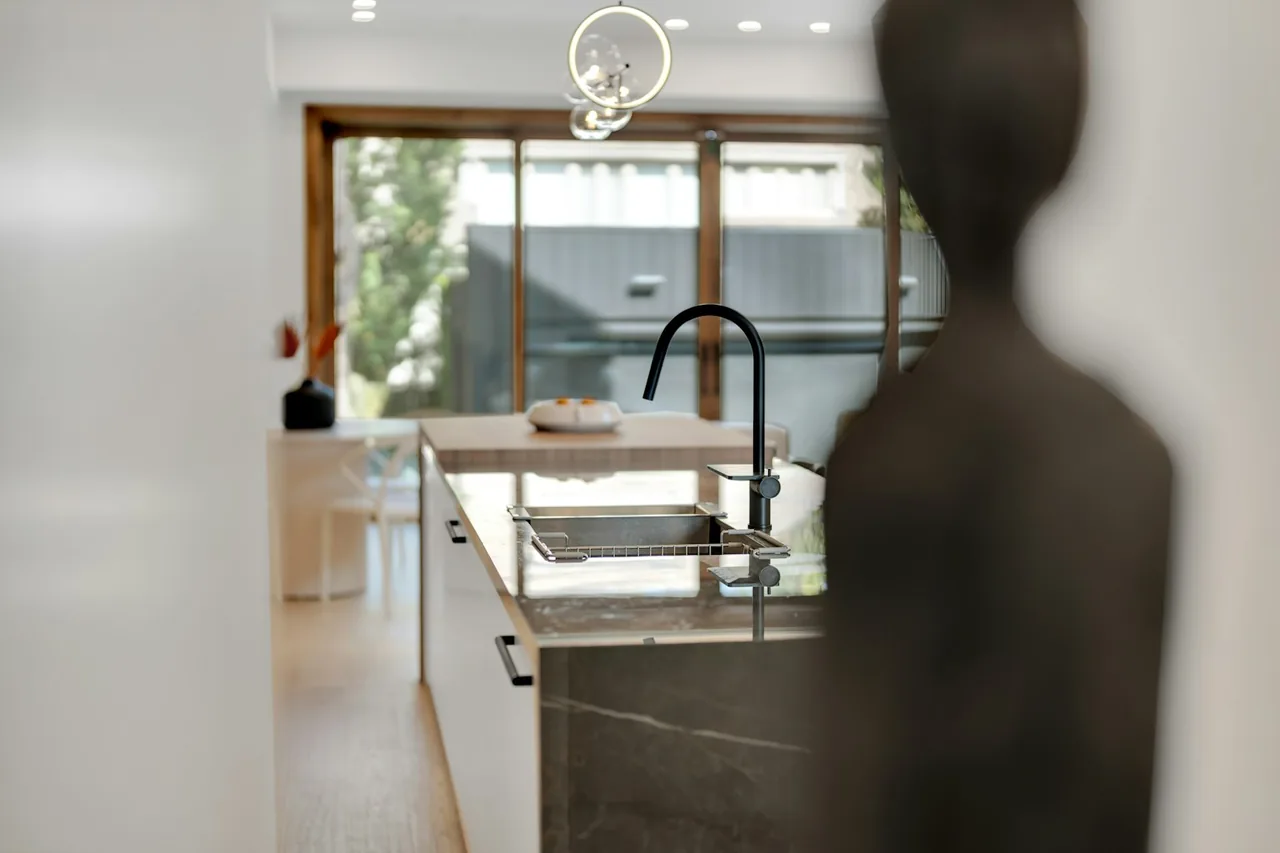
Porcelain countertops are large-format sintered slabs — refined clay and minerals fired and compacted at extreme heat into a dense, glass-hard sheet, usually thin and surface-decorated. One detail decides whether it's right for your space: the edge. Porcelain is non-porous, heat-proof, scratch-resistant, and the only common counter that's truly UV-stable for the outdoors, but a thin sintered slab is brittle at unsupported edges and most is surface-decorated, so a cut edge can reveal a different-colored core. Get the edges, support, and printed-vs-full-body decision right and porcelain does things stone can't. Because a thin, brittle slab demands a fabricator who specializes in it, get a free, itemized scope from a vetted porcelain pro before a slab is cut.
Porcelain Is a Sintered Slab, Not Tile and Not Stone
The single fact that explains every strength and limit of porcelain is how it's made: it's sintered — fired and fused at extreme heat — rather than quarried like stone or cast in resin like quartz. That process is what makes it heat-proof, non-porous, and UV-stable, and also what makes it thin and brittle.
How Sintering Makes the Slab
Porcelain countertops aren't tile — they're full slabs, the same family as porcelain floor tile but made in large dimensions and often thinner than stone. The process is sintering: clay, feldspar, silica, and mineral pigments are pressed and fired at very high temperature until they fuse into a single dense body with near-zero porosity. The result is a surface that's exceptionally hard, completely non-porous, fully heat-resistant, and — crucially — colorfast under sunlight, because mineral pigments fired into ceramic don't fade the way a resin binder does.
The Two Places Porcelain Wins Outright
Porcelain wins in two places no other mainstream counter fully covers. First, the outdoor kitchen: porcelain's UV stability means it won't yellow or fade in full sun, where quartz discolors and where most surfaces struggle, making it the engineered choice for grilling stations and covered patios. Second, the ultra-modern, ultra-thin look: porcelain slabs can be made remarkably slim for a sleek waterfall edge or a minimalist profile that thick stone can't match. Indoors it's also a strong performer in a hard-working kitchen countertop — heat-proof for pans straight off the burner, scratch- and stain-resistant, easy to clean — on a dramatic island where a thin waterfall edge reads modern, and on a bathroom vanity where its non-porous body shrugs off cosmetics and water; it can even run as a continuous surface up the wall as a backsplash for a seamless look.
The Trades You Accept
The trades are real. Most porcelain is surface-decorated — the pattern is printed on the top face — so unless you buy a full-body (through-color) slab, a cut or mitered edge can reveal a different-colored core that has to be designed around. And the thin, sintered body, while hard, is brittle: it resists scratching beautifully but can chip or crack under a sharp point impact or at an unsupported span. If you want the depth and through-body character of natural stone, that's an argument for quartzite or granite; if you want a heat-proof, UV-proof, ultra-thin, non-porous surface, porcelain is built for it. The learning center walks the broader decision.
Where Porcelain Fails — Brittle Edges and the Printed Surface
Porcelain's weaknesses come straight from what makes it special: it's thin, sintered, and usually surface-printed. Understanding both keeps you from the two ways porcelain disappoints.
Brittleness and Chipping
A thin sintered slab is extremely hard on its face but has less mass to absorb a blow, so a sharp impact — a dropped heavy pan hitting an edge, or pressure on an unsupported overhang — can chip or crack it, and chips at an edge are harder to repair invisibly than on solid stone. The mechanism is leverage and point load, not wear; the surface won't scratch from knives, but it can fracture from impact.
Why Full Support and Reinforced Edges Matter
The defenses follow directly from the mechanism: full, continuous support under the entire slab so there's no unbacked span to flex, mitered or reinforced edges that add mass where impact lands, and never cantilevering an overhang without a substructure. Unlike thick stone, thin porcelain can't bridge an uneven base or carry its own leverage, so the support is the slab's strength — and it's a fabrication decision, not an optional upgrade.
The Overhang Is the Highest-Risk Span
Of every span on the counter, the overhang carries the most risk, because it's the one place the slab projects past its support and must resist both downward load and the leverage of anything that leans or sits on it. A thin porcelain overhang past roughly 10 inches without a substructure is a fracture waiting for the first real load, which is why the substructure under a breakfast bar or seating overhang is non-negotiable rather than a finish detail.
Substructure Beats Slab Thickness Outdoors
The instinct to fix a weak span by ordering a thicker slab is the wrong lever, especially outdoors where the sleek thin profile is half the reason to choose porcelain. A proper substructure — a backing frame or panel that carries the overhang — lets a thin slab keep its minimalist look while gaining the support it needs, so the design intent and the structural reality both survive. Thickness adds weight and cost; the substructure adds the actual strength.
The Printed Surface
Because most porcelain's color and veining are printed on the top layer rather than running through the body, two things follow. A deep chip or scratch can expose the lighter core beneath the print, which shows; and any cut edge — at a sink, a seam, or a mitered waterfall — needs to be handled so the exposed core doesn't read as a stripe of off-color.
Full-Body Porcelain Solves It, at a Cost
Full-body porcelain carries color through the entire slab, so chips and cut edges blend instead of revealing a pale core. It solves the printed-surface limitation outright — at a higher price and with fewer pattern options. This is the opposite limitation of marble or quartzite, whose veining is geological and runs all the way through, and it's why the printed-vs-full-body choice is driven by where your edges are exposed.
The Lesser Limit: Hard on Knives
Beyond brittleness and the printed surface, porcelain's only other note is that its very hardness can dull knives quickly, so a cutting board protects your blades even though it doesn't protect the counter. It's a minor, manageable trade — the inverse of soft marble, where the board protects the stone rather than the knife.
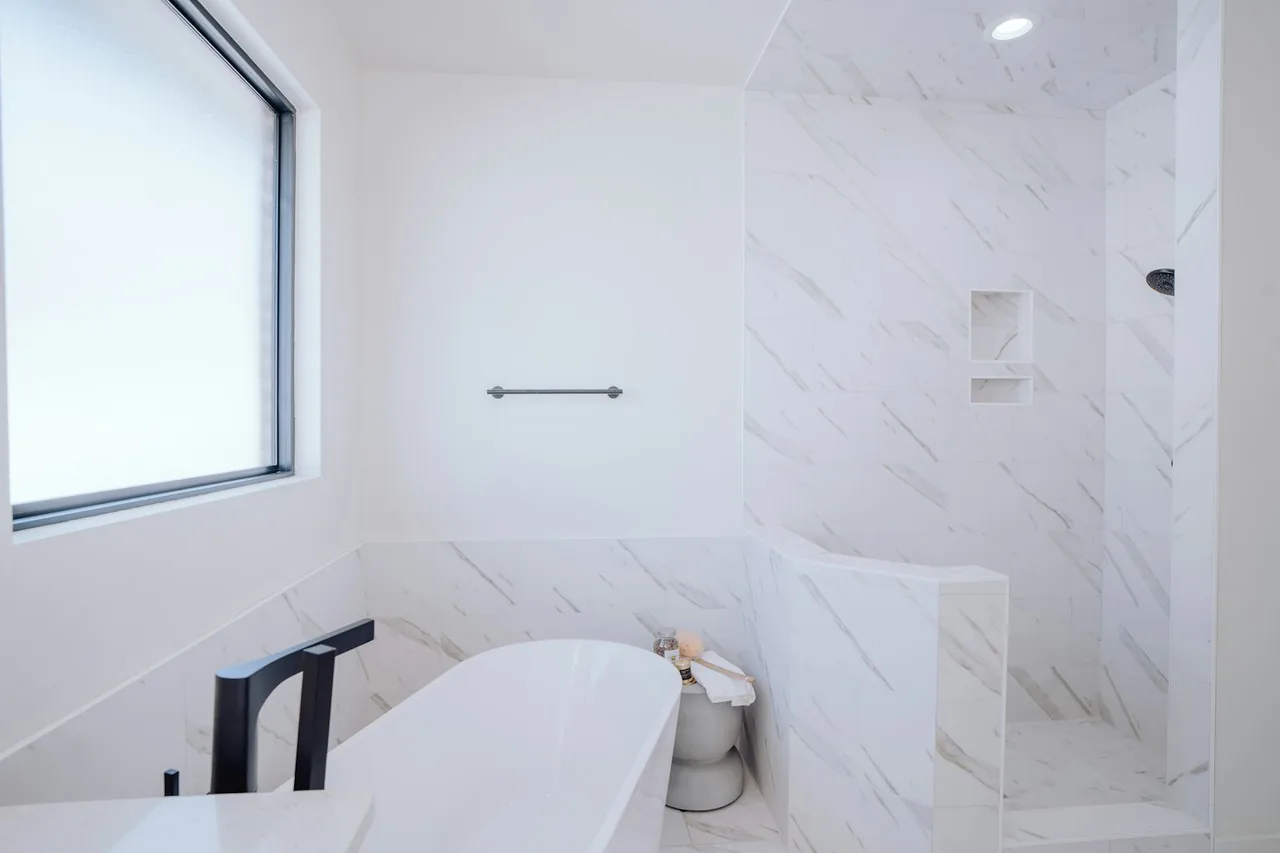
Porcelain vs Quartz, Granite, Marble, and Quartzite
Porcelain is the engineered surface for heat, sun, and slim profiles. The cleanest way to place it is against the four materials it's cross-shopped with, rated on the specs that actually decide a kitchen — or a patio.
The Countertop Material Comparison Matrix
The table below is the decision a buyer is really making — type, porosity, UV behavior, edge character, and where each belongs, side by side. Porcelain's profile is the non-porous, never-sealed, UV-proof, printed-surface column.
| Material | Type | Porosity / sealing | UV / outdoor | Edge character | Best fit |
|---|---|---|---|---|---|
| Porcelain | Engineered sintered | Non-porous, never sealed | UV-stable — true outdoor surface | Printed (or full-body), brittle | Outdoors, full sun, ultra-thin |
| Quartz | Engineered | Non-porous, never sealed | Yellows in sun — indoor only | Through-body color, thicker | Hands-off indoor kitchens |
| Granite | Natural igneous | Porous, periodic seal | UV-safe but porous | Through-body, thick edge | Heavy cooking, natural character |
| Marble | Natural metamorphic | Porous, frequent seal | Etches and stains outdoors | Through-body veining, soft | Baths, baking, statement pieces |
| Quartzite | Natural metamorphic | Porous, periodic seal | UV-safe but porous | Through-body veining, thick | Marble look with real durability |
Porcelain vs Quartz and Granite
Porcelain vs quartz pits two engineered, non-porous surfaces that win in different rooms. Quartz offers more depth, a wider resin-rich palette, and a substantial look, but it scorches under heat and yellows in sun. Porcelain is fully heat- and UV-proof and far thinner, making it the choice for outdoors and minimalist profiles — at the cost of the printed-surface limitation. Choose quartz for indoor depth and color; choose porcelain for heat, sun, and slimness. Porcelain vs granite sets a sintered slab against natural stone: granite is genuine, heat-tolerant, and through-body but porous, thick, and heavy; porcelain is non-porous (never sealed), lighter, thinner, and UV-stable, but printed. Granite for natural depth and a hot-pan-proof slab; porcelain for low weight, no sealing, and outdoor durability.
Porcelain vs Marble and Quartzite
Porcelain vs marble is the toughest route to marble style. Porcelain can print a convincing marble look on a body that's heat-proof, UV-proof, scratch-resistant, and non-porous — everything soft, etch-prone marble is not — trading natural depth for durability, especially outdoors. Porcelain vs quartzite sets printed against genuine: quartzite gives you through-body stone with elite hardness but needs sealing and runs thick; porcelain is non-porous, thinner, and UV-proof, but printed. For full sun, porcelain wins; for natural-stone authenticity, quartzite does. Line them all up spec-for-spec with our material comparison tool.
The Specs and Properties That Actually Matter for Porcelain
Porcelain is judged on the handful of properties that flow from its sintered, fired nature — the numbers and traits that predict how it performs. Each is a question a credible fabricator can answer about the slab you're choosing.
Porosity, Hardness, and Heat
Sintered porcelain has near-zero water absorption — among the lowest of any counter — which is the spec behind non-porous, never-sealed, stain-proof, and bacteria-resistant; nothing soaks in. Fired porcelain is also glass-hard and highly scratch-resistant, standing up to knives and abrasion better than most surfaces, though that same hardness makes it brittle to impact and tough on knife edges. And because it's fired at extreme temperature, finished porcelain is essentially heat-proof, taking hot cookware straight off the burner without scorching, discoloring, or thermal-shock damage — superior to resin-bound quartz.
UV Stability, Thickness, and Decoration
The defining outdoor spec is UV stability: mineral pigments sintered into ceramic are colorfast in sunlight, so porcelain doesn't yellow or fade outdoors the way resin surfaces do — which is why it's the engineered pick for an outdoor kitchen. Slabs run notably thin — often around 1 cm for a sleek profile, up to thicker formats — and most are surface-decorated rather than full-body, so confirm whether the pattern runs through the slab if exposed edges matter to your design.
The Porcelain Spec Sheet at a Glance
The table below collects the properties a credible fabricator can speak to, with the practical meaning of each. None is a marketing grade; every one predicts how the slab lives.
| Spec | Typical value | What it predicts |
|---|---|---|
| Water absorption | Near zero | Non-porous: never sealed, stain- and bacteria-resistant |
| Hardness / scratch resistance | Glass-hard | Resists knives and abrasion; brittle to impact |
| Heat resistance | Essentially heat-proof | Takes hot pans straight off the burner |
| UV stability | Colorfast in sun | The one common surface that truly belongs outdoors |
| Thickness | Often 1 cm, up to thicker | Sleek and light, but demands full support and edge work |
| Decoration | Surface-printed or full-body | Printed shows core at cut edges; full-body blends |
Planning an outdoor or ultra-thin porcelain counter?
We match you with a vetted porcelain specialist who handles the edges, support, and outdoor rating — with a free, written quote.
Types, Thicknesses, and What to Buy
With porcelain, "what to buy" centers on thickness, whether the color is printed or full-body, and matching the slab to indoor or outdoor use.
Thickness and Printed vs Full-Body
Thin formats around 1 cm deliver the sleek, minimalist look porcelain is known for and keep weight low, but they demand full support and careful edge work; thicker slabs are more forgiving of impact and easier to run as a single-thickness edge, and many sleek installs use a thin slab with a mitered build-up to look substantial while staying light. The key buying decision is printed vs full-body: standard surface-printed porcelain offers the widest range of marble-, concrete-, and stone-look patterns at lower cost, but cut edges may show a different core, while full-body porcelain carries color through the slab so chips and cut edges blend — choose it where edges are exposed or impact risk is higher, accepting fewer patterns and higher cost.
Finish and Indoor vs Outdoor
Matte, polished, and textured finishes are available; textured and matte hide smudges and add grip, while polished maximizes the look but shows fingerprints. Porcelain's UV stability makes it the standout for outdoor use, so confirm the slab and any seam/adhesive system are rated for the application — and lean on porcelain specifically when sun would fade other surfaces, the one place it has no real competition among common counters.
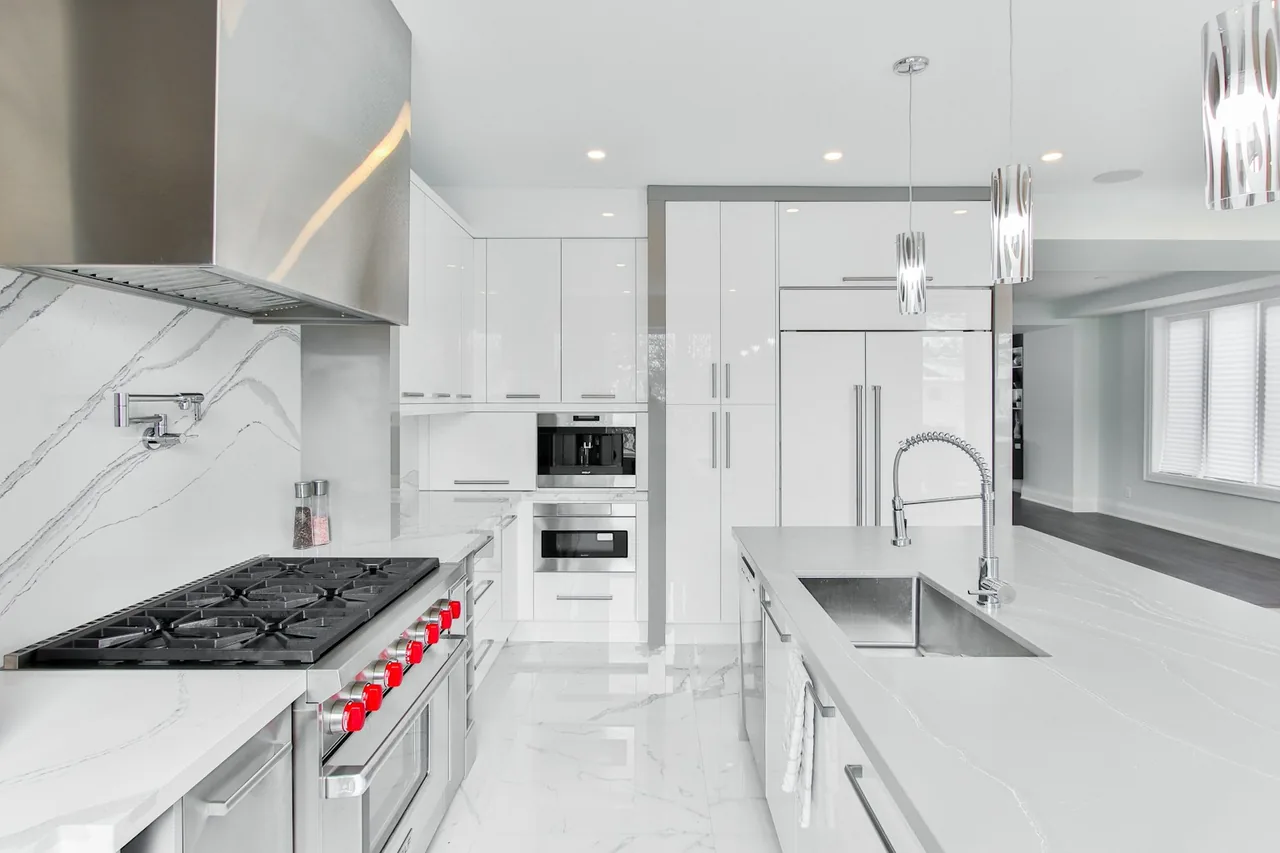
How Porcelain Is Fabricated and Installed
Porcelain is the most specialized counter to fabricate, because a thin, brittle, sintered slab behaves nothing like stone — and several realities are unique to it. The six steps below are the full arc from a porcelain-specialist's measure to the finished counter.
Confirm a Porcelain Specialist and Template
A precise template is taken from installed, level cabinets by a fabricator trained and equipped specifically for porcelain — not every stone shop is, because handling a large, thin sheet risks cracking. The template also confirms full, level support, since thin porcelain can't bridge an uneven base the way thick stone can.
Choose Printed vs Full-Body for the Edges
Before cutting, the printed-vs-full-body decision is locked to the design: full-body where a mitered waterfall, exposed cut edge, or higher impact risk means a pale core can't show; printed where edges are protected and pattern range matters. This choice drives everything downstream.
Specialized Diamond-Tool Cutting
The slab is cut with specialized diamond tooling and techniques, because porcelain is unforgiving during fabrication — a wrong move cracks a large, thin sheet. Sink and cooktop cutouts get radiused corners and are often reinforced, since a thin sintered slab is most vulnerable at openings, where a square corner is a stress riser.
Mitered Edges and Profiles
Mitered edges are the signature porcelain detail — two pieces joined at 45 degrees to build a thick-looking edge from a thin slab — and they require precision so the printed faces meet cleanly and the seam disappears. Profiles are typically eased or mitered rather than ornate, since intricate profiles suit thicker material.
Setting on Full Support, Seaming Overhangs
The slab is set on full, continuous, perfectly level support beneath the entire piece, and seams are bonded with color-matched adhesive, aligning printed patterns across the joint. A thin porcelain overhang past roughly 10 inches needs a substructure or backing — because the slab is brittle, generous support is wise and the slab is never relied on to cantilever on its own.
Sink Mounting and Walkthrough
Undermount sinks are carried on a bracket or rail system and the cut reveal is finished so the core doesn't show. Porcelain never needs sealing, so install simply ends with cleanup and a walkthrough to confirm edges, seams, and support. The full sequence is in countertop installation.
Skip or rush any one of these six — above all hiring a non-specialist or under-supporting a thin slab — and the failure it was meant to prevent shows up later, which is why a vetted porcelain fabricator treats the sequence as fixed.
Talk through your project — free.
A free consultation and a written, itemized quote from a vetted installer. No pressure, no obligation.
Is Porcelain Right for Your Space?
Whether porcelain fits is the output of a short chain of facts about where the counter goes, how its edges are designed, and whether you can hire a specialist. Walk the decision in order; each branch either confirms porcelain or points you elsewhere.
- Is the counter outdoors or in full sun? If yes, porcelain is the standout — its UV stability means it won't fade where quartz yellows and where stone needs sealing against weather. This is porcelain's home turf and often the deciding question on its own.
- Do you want an ultra-thin, minimalist profile? Porcelain's thin slabs deliver a sleek waterfall or slim edge thick stone can't. If you want substantial through-body depth instead, granite or quartzite fits better.
- Are cut edges or a mitered waterfall exposed? If yes, plan for full-body porcelain so a pale printed core won't show; if edges are protected, surface-printed gives more patterns for less. The edge design drives the slab choice.
- Can you hire a true porcelain specialist? Thin, brittle slabs take specific tooling and training, and a general stone shop may crack the material. If a verified specialist isn't available, a more forgiving material may be the safer call.
- Plan thickness, support, and budget. Match thickness to look-vs-forgiveness, design out unsupported spans, and weigh the slab against our cost guides and the countertop cost calculator.
Run honestly, this tree returns a clear answer — and the most common reasons porcelain disappoints are an under-supported thin slab and a printed core showing at an edge that should have been full-body.
Common Porcelain Mistakes, Consequences, and Prevention
Most porcelain disappointments are the same handful of avoidable choices, each with a predictable consequence and a known prevention. Naming them is how you spot a problem before the slab is cut.
| Mistake | What it causes | The prevention |
|---|---|---|
| Hiring a non-specialist fabricator | Cracked slabs and poor miters from wrong tooling and technique | Confirm the shop regularly fabricates porcelain slabs specifically |
| Printed slab at exposed cut edges | A pale off-color core shows as a stripe at the miter or sink | Choose full-body porcelain where edges are exposed |
| Under-supported thin slab | The brittle slab flexes and cracks over an unbacked span | Set on full, continuous, level support under the entire slab |
| Unsupported overhang past 10 inches | The cantilever chips or fractures under load | Back any overhang with a substructure before setting |
| Square inside corners on cutouts | Stress risers crack the thin slab at sink and cooktop openings | Radius and often reinforce every inside cutout corner |
| Sharp impact on an edge | A chip that's hard to repair invisibly on a thin slab | Respect the edges; design out exposed sharp corners |
| Cutting directly on the slab | Knives dull fast on the glass-hard surface | Use a cutting board to protect blades, not the counter |
Every row is either a fabrication failure or an edge problem — which is why "a specialist, fully supported, full-body where edges show, and respected at the corners" is the entire discipline of living well with porcelain.
Caring for Porcelain
Porcelain is among the most carefree counters once installed — the routine is minimal because the slab is non-porous and inert — and the few cautions are about impact, not cleaning.
The Daily Routine
Clean day to day with warm water, a soft cloth, and mild soap or a standard non-abrasive cleaner; because porcelain is non-porous it resists stains and bacteria and never needs sealing. It tolerates a wider range of cleaners than natural stone since there's no calcite to etch and no sealer to degrade, though gentle is always best to protect any polished finish. Take hot pans straight to the surface freely — heat is no concern — and outdoors, enjoy that it won't fade in the sun.
The Cautions Are Mechanical, Not Chemical
The real care is mechanical: avoid sharp impacts, especially at edges and corners, since a brittle sintered slab can chip; use a cutting board to spare your knives — the hard surface dulls blades fast — even though the counter resists scratching; and don't stand or put heavy point loads on an unsupported overhang. Compared with a porous, etch-prone stone like marble, porcelain's upkeep is essentially nothing beyond treating its edges with respect.
What Actually Drives the Cost of a Porcelain Countertop
A porcelain quote is not a flat per-square-foot rate; the headline number hides the items below, ranked by how much they move the total. We don't publish dollar figures here — compare across materials in our cost guides hub and weigh the trade-offs in the learning center.
- Printed vs full-body. A big swing. Full-body porcelain costs more than surface-printed for the same look, and the choice is driven by where your edges are exposed — so the edge design sets this cost.
- Specialist fabrication. Porcelain demands a trained specialist with specific diamond tooling, and that expertise carries a labor premium over a general stone shop — one you want to pay, since a non-specialist risks the slab.
- Mitered edges and detailing. The signature thin-slab mitered edge is precise, skilled work that builds a thick look from a thin sheet, adding labor beyond a simple eased edge.
- Total square footage and slab count. More area means more slabs, and a layout past one slab adds material, a seam, and labor — with pattern alignment across the seam on printed slabs.
- Support and overhang substructure. Thin porcelain needs full support and a substructure for any overhang past 10 inches — real material and labor a thick stone slab wouldn't require.
- Cutouts and complexity. Each reinforced sink or cooktop cutout and faucet hole is exacting shop labor on a brittle slab.
- Removal and disposal. Tearing out and hauling away an old counter is labor and a fee, and it belongs in the written quote up front.
Because these drivers swing so widely, the only honest number comes from an on-site assessment. Size your own counter first with the countertop cost calculator so you can read a quote critically.
Want a porcelain specialist's itemized quote?
We match you with a vetted porcelain pro who prices the slab, full-body upgrade, miters, support, and substructure as separate lines — free and with no obligation.
The Porcelain Fit Test: Six Checks Before You Buy
Before you commit to a slab, run your space through the same six-check test a good fabricator would. Each check matches porcelain's unique strengths and edge realities to how the room lives, and a slab that passes all six is a porcelain that does what stone can't. Call it the Porcelain Fit Test.
- 1. Lean on it where sun or heat rules out others
- Porcelain is the standout for an outdoor kitchen and full-sun spots because it's UV-stable where quartz yellows, and it's heat-proof for serious cooking indoors. If sun or constant hot pans are your reality, this is porcelain's home turf.
- 2. Decide printed vs full-body by your edges
- If cut edges, a mitered waterfall, or higher impact risk are part of your design, spend up for full-body (through-color) porcelain so chips and cut edges blend; if edges are protected, surface-printed gives more patterns for less.
- 3. Choose a true porcelain specialist
- Fabricating thin, brittle slabs takes specific tooling and training, and a general stone shop may crack the material. Ask directly whether the fabricator regularly does porcelain slabs and how they handle miters and cutouts.
- 4. Plan full support and respect the edges
- Porcelain needs continuous, level support and engineered backing for any overhang past 10 inches; it resists scratches but chips on impact, so design out unsupported spans and exposed sharp corners.
- 5. Pick thickness for look vs forgiveness
- Ultra-thin (around 1 cm) gives the sleek minimalist profile but is least forgiving of impact; thicker or mitered-build-up edges look substantial and absorb knocks better. Match the choice to how the surface will be used.
- 6. Weigh the slab and upgrades against the budget
- Full-body, miters, and specialist labor move the price, so weigh your design against our cost guides and size the job with the cost calculator before you commit.
Pass all six and porcelain is almost certainly the right call for that surface; fail one or two and the test has just saved you from an under-supported slab or a core showing at an edge.
Porcelain Countertop Glossary
The terms below recur in every porcelain quote, spec sheet, and warranty — each defined as its working meaning on an actual job, so you can read a scope and judge whether it is complete.
- Sintered slab
- A countertop made by firing and compacting clay, feldspar, silica, and pigments at extreme heat until they fuse into one dense body. The process that makes porcelain heat-proof, non-porous, and UV-stable.
- Sintering
- The high-temperature firing that fuses porcelain's raw minerals into a glass-hard sheet without fully melting them — distinct from casting quartz in resin or quarrying stone.
- Surface-decorated
- Porcelain whose color and veining are printed on the top face rather than running through the body. The most common and lowest-cost type, but its cut edges can reveal a paler core.
- Full-body
- Porcelain with color carried through the entire slab, so chips and cut edges blend instead of showing a core. Costs more and offers fewer patterns; the choice where edges are exposed.
- UV stability
- Resistance to fading and yellowing in sunlight. Porcelain's mineral pigments are colorfast in UV, which is why it's the one common counter that truly belongs outdoors.
- Non-porous
- Having near-zero water absorption, so liquids can't soak in. The spec behind porcelain's stain and bacteria resistance and its "never needs sealing" property.
- Brittleness
- A thin sintered slab's vulnerability to chipping or cracking under sharp impact or unsupported leverage — the inverse of its scratch resistance, and the reason support and edge care matter.
- Mitered edge
- Two pieces joined at 45 degrees to build a thick-looking edge from a thin porcelain slab. The signature detail, requiring precision so the printed faces meet cleanly.
- Stress riser
- A point — like a square inside corner on a cutout — where load concentrates and a crack can start. On thin porcelain, corners are radiused and often reinforced to remove it.
- Substructure
- The backing or support frame under an overhang or unbacked span. Thin porcelain can't cantilever on its own, so a substructure carries any overhang past roughly 10 inches.
- Heat resistance
- Porcelain's ability to take hot cookware straight off the burner without scorching or thermal-shock damage, a result of being fired at extreme temperature.
- Backsplash run
- Continuing the porcelain slab up the wall behind the counter for a seamless look, made practical by the slab's thinness and large format.
Specialist Fabrication, Outdoor Rating, and Warranty
A porcelain warranty is a contract with conditions, and the protections that matter most are specialist fabrication, the right outdoor rating, and honest edge handling.
Why a Specialist Is the Real Assurance
Porcelain warranties cover manufacturing defects, but the most common porcelain failures — a cracked slab, a chipped edge, a core showing at a miter — trace to fabrication, not the material. The real assurance is a fabricator trained and equipped specifically for porcelain, with the diamond tooling and technique a thin, brittle sheet demands. A specialist's workmanship guarantee covers the install the maker can't: full support, clean miters, reinforced cutouts, and a backed overhang.
Outdoor Rating and Edge Handling
For an outdoor project, confirm the slab and the seam and adhesive system are rated for the application — porcelain's UV stability is its outdoor advantage, but the assembly has to match. And because most porcelain is printed, the fabricator should handle every cut edge so the core doesn't show, recommending full-body where a mitered waterfall or exposed edge demands it. Ask in writing for the scope, the outdoor rating where it applies, and a workmanship guarantee.
A Real Porcelain Decision
The clearest way to see where porcelain fits is to follow one realistic choice where UV stability, not just looks, decided the material.
How to Vet a Porcelain Fabricator
With porcelain, the fabricator's specialization is the whole game — a thin, brittle slab punishes a general stone shop. These questions separate a true porcelain pro from one who'll treat it like granite and crack it.
- They regularly fabricate porcelain slabs specifically
- This is the non-negotiable first question. Ask directly how often they cut porcelain and what tooling they use. A shop that mostly does stone and "can try porcelain" is the fastest way to a cracked slab.
- They recommend printed vs full-body by your edges
- A real pro asks where your edges are exposed and steers you to full-body for a mitered waterfall or exposed cut, printed where edges are protected. Vagueness about the core showing is a red flag.
- They plan full, continuous support
- Thin porcelain can't bridge an uneven base. Confirm they set on full level support under the entire slab and back any overhang past 10 inches with a substructure.
- They radius and reinforce cutout corners
- Openings are where a thin slab is most vulnerable. Ask how they handle sink and cooktop cutouts — radiused, often reinforced corners are the right answer.
- They miter and align patterns cleanly
- The mitered edge and seam are where porcelain craft shows. Ask to see how they join printed faces and align patterns across a seam so the joint disappears.
- They put scope, schedule, and a labor guarantee in writing
- Ask for the full scope, the timeline, the outdoor rating where it applies, and a workmanship warranty before work starts. A shop willing to name a labor guarantee — and return if an edge chips or a seam shows — stands behind the install itself.
Want a verified porcelain specialist?
Tell us about your project and we'll match you with a vetted pro who fabricates porcelain specifically, supports the thin slab fully, and handles every edge — in a written scope, free.
Why Route Your Porcelain Countertop Through Pro Work Home Surface
Pro Work Home Surface is not a fabricator and does not cut or set your slab — we are a national authority on home surfaces that matches homeowners with vetted local countertop pros and holds them to a published bar.
- A free consultation and an itemized written scope
- Every connection starts with a no-obligation consult and a written quote that lines out the slab, full-body upgrade, miters, support, and substructure separately — so you read the whole job, not a headline rate.
- Fabricated by a porcelain specialist
- Thin, brittle sintered slabs are cut and handled with the specific diamond tooling and training porcelain requires, from installed, leveled cabinets, with cutout corners radiused and reinforced so the slab doesn't crack at openings.
- Full support and clean mitered edges
- The entire slab rests on continuous, level support, any overhang past 10 inches is backed by a substructure, and mitered edges are joined precisely so printed faces meet cleanly and the seam disappears.
- Right slab for the use, edges handled
- The slab matches your application — UV-rated for outdoors, full-body where exposed edges demand it — seams are color-matched and pattern-aligned, and because porcelain is non-porous no sealing is needed or sold.
Countertops are one of eight categories we cover across home surfaces. Compare porcelain against the rest of the field at the countertops hub, weigh material trade-offs in our learning center, check budget factors in our cost guides, and line surfaces up spec-for-spec with the material comparison tool. Explore the full range of home surfaces — and if new cabinets are part of the project, template both together so even a thin porcelain slab lands on a level, fully supported base.
Brands & Material Authority
Quality and construction drive long-term performance more than the label. These are widely respected names in this category:
- Cambria
- Caesarstone
- Silestone
- MSI
- Cosentino
- Corian
- Wilsonart