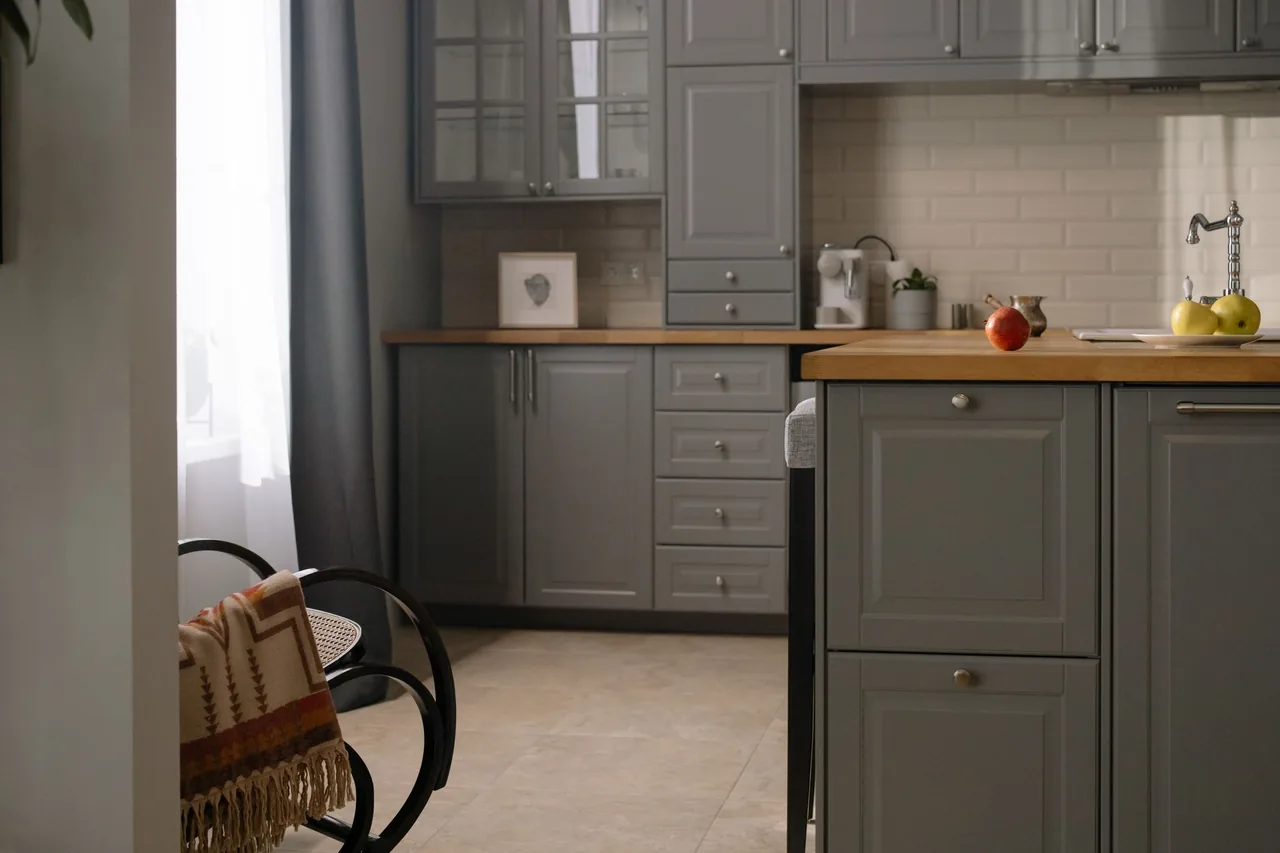
The best kitchen countertop takes a pan straight off the burner, a splash of red wine that sits till morning, and a knife that misses the board — and shows none of it a year later. That is the whole test, because a kitchen attacks a work surface four ways at once: heat from cookware, staining and acid from food, a blade's scratch, and the impact of a dropped cast-iron skillet. Match a slab whose weakest of those four still clears the room's real abuse and the kitchen stops ruining counters; miss one and a beautiful surface etches, scorches, or chips. That priority points to non-porous Mohs 7 engineered quartz and heat-tolerant natural stone for most working kitchens. Get a free consultation and a written, itemized scope from a vetted installer that names the material's heat tolerance, its porosity, and how the sink and cooktop cutouts will be radiused before a single slab is ordered.
A Kitchen Judges a Countertop on Its Weakest Point, Not Its Best
The slab everyone admires in the showroom matters least to whether a kitchen counter survives. What separates a surface still flawless in ten years from one that etches in two is whether its single weakest property still clears the abuse a kitchen guarantees — because the kitchen finds that weak point every day.
Four Attacks Hit a Kitchen Counter on the Same Day
No other room in the house loads a surface with this many unrelated stresses simultaneously, and a counter that answers one while failing another disappoints fast. The four attacks stack:
- Heat off the burner — a pot or pan set down straight from the flame, not always onto a trivet, delivering a thermal jolt a resin-bound surface cannot take.
- Stains and acid from food — citrus, wine, vinegar, and tomato that chemically etch soft calcite stone, plus coffee, oil, and turmeric that soak into anything porous and unsealed.
- Knife scratch and abrasion — a blade that misses the cutting board, dragged appliances, and the daily grind that dulls a soft or coated surface.
- Impact and point load — a dropped cast-iron skillet, a heavy stand mixer landing on one corner, the chip that starts at an unsupported edge.
No single material is perfect at all four, but the room rewards a fixed priority: rule out anything whose weakest property the kitchen will exploit, then choose among what survives on looks and upkeep. Heat and acid are the two that ruin a counter rather than merely wear it, so they lead.
Read the Kitchen in Priority Order, Not Sample-First
Most people shop a kitchen counter backward — veining first, heat tolerance and porosity last — and land a stunning slab in the wrong room. Read the kitchen in its real order of failure and the shortlist gets short quickly. The look you love has to fit inside the sealing discipline you will actually keep, the heat tolerance your cooking demands, and the hardness a busy prep run needs — not the other way around. Everything below builds that order into a decision you can hand a fabricator.
The Kitchen Countertop Deciders: Four Specs Before Any Slab Wins
A kitchen counter is bought on properties, not just looks, and four published specs predict how a sample will actually live in this room. Each has a documented failure attached to ignoring it, and a slab that fails any one is the wrong slab no matter how it photographs. Call it the Kitchen Countertop Fit Test: pass all six checks and the room stops eating counters; miss one and you are buying a future re-fabrication.
- 1. Heat tolerance
- The distinction that splits the field. Natural stone — granite, quartzite, soapstone — takes a pan straight off the burner. Engineered quartz and laminate are bound in polymer resin that softens and yellows under direct heat, so they need a trivet every time. For a cook who won't reach for one, heat tolerance decides the material before anything else does.
- 2. Porosity and sealing cadence
- Non-porous surfaces — quartz, soapstone, porcelain — resist stains and bacteria with zero sealing, ever. Porous natural stone — granite, quartzite, marble — needs a penetrating sealer that must be re-applied on a cadence, or oil and wine wick in and shadow the stone. The honest question is how much sealing you will genuinely keep up with.
- 3. Scratch resistance (Mohs hardness)
- Knife work and dragged grit test the surface daily. Hardness runs loosely on the Mohs scale: quartz and quartzite sit near Mohs 7 — harder than a steel blade and highly scratch-resistant — granite close behind, while soft marble (Mohs ~3) and soapstone (Mohs ~2.5) mark far more easily. Match the hardness to how hard the prep run lives.
- 4. Etch resistance vs. stain resistance
- A kitchen threatens a surface two different ways, and they are not the same failure. Etching is a chemical reaction — acid dissolving calcite into a dull crater no sealer prevents. Staining is absorption — a liquid soaking into an unsealed pore, which a sealer does prevent. Marble etches; unsealed granite stains; quartz and porcelain resist both. Knowing which failure a material is prone to tells you exactly how the kitchen will beat it.
- 5. Impact and edge durability
- A dropped skillet and an unsupported overhang test the slab's toughness. Quartz and granite absorb impact well across the field; porcelain is hard but its thinner profile can chip at an edge under a sharp blow; the failure almost always starts at a square cutout corner or an unsupported rim, not the open field.
- 6. Finish and daily upkeep
- Polished reflects, wipes cleanest, and hides watermarks; honed (matte) reads contemporary and hides etching better but shows fingerprints; leathered adds grip and masks smudges. The finish changes daily maintenance as much as the material does — a honed marble forgives etching a polished one flaunts.
Three of these six — heat tolerance, sealing cadence, and etch resistance — are exactly the properties a showroom sample cannot show you, because they are behavior over time, not appearance in the moment. That is why the fit test is non-negotiable: every check is on the spec sheet or the material's known chemistry, and every one predicts a specific way the room can win or lose.
Want heat tolerance and porosity confirmed before you buy?
We match you with a vetted fabricator who names the material's heat behavior, sealing cadence, and edge support in a written scope — before you commit to a slab or a price.
Kitchen Countertop Specifications That Decide the Room
The specs that gate a kitchen counter are published, testable, and specific to the material going in — from the heat tolerance that separates a survivor from a scorched slab, through the porosity and hardness numbers, to the etch chemistry that decides whether a splash of wine is a wipe or a permanent scar.
Heat Tolerance Is the Kitchen's Controlling Spec
A pan straight off the burner is the attack that ruins a kitchen counter fastest, so heat behavior governs the material choice before looks enter. How a surface answers heat depends entirely on what binds it together.
Natural Stone: Heat-Tolerant by Composition
Granite, quartzite, and soapstone are geological stone with no polymer in them, so they take direct cookware heat without softening, discoloring, or cracking under normal use. That is why a cook who sets pans down without thinking gravitates to natural stone — the surface forgives the habit the resin-bound options punish.
Why Resin-Bound Quartz Needs a Trivet
Engineered quartz is roughly 90–93% ground quartz held in a polymer resin, and that resin is the weak link under heat: a pan off the burner can soften it, leaving a permanent dull or yellowed mark, or thermally shock the slab. The quartz mineral itself is heat-stable; the binder is not. This is not a defect — it is the trade for quartz's non-porous, zero-seal surface, and it is why every quartz maker's care sheet specifies a trivet.
The Trivet Rule at the Cooktop and Range
The highest-risk zone on a quartz counter is the landing strip beside the cooktop and range, where hot pans come off the heat. A vetted install anticipates it — a heat-tolerant stone insert beside the range, or a clear rule that a trivet lives there — because the single most common quartz-counter complaint is a scorch ring at exactly that spot. It is a five-second habit that prevents the material's one predictable failure.
Laminate and Solid Surface: The Low-Heat Materials
Laminate scorches and can bubble under a hot pan because its surface is a printed melamine layer over particleboard, and solid surface (acrylic) softens for the same resin reason quartz does. Both are viable budget kitchen surfaces, but only with disciplined trivet use — and neither belongs beside a range where hot cookware lands routinely.
Porosity and the Sealing Cadence
After heat, porosity is the property that decides a kitchen counter's upkeep. A non-porous surface keeps stains and bacteria out with no sealing for its whole life; a porous stone depends on a sealer maintained on a cadence, and a lapsed seal is where a kitchen stains. The sealing service tests it with a simple water-bead check — when water stops beading and starts to darken the stone, the seal has thinned and needs refreshing.
The Specs That Matter in a Kitchen, and What to Look For
Before the material-by-material verdict, it helps to see each kitchen-deciding spec on its own — what it measures, why it matters in this room specifically, and the number or feature to demand on a spec sheet.
| Spec | Why it matters in a kitchen | What to look for |
|---|---|---|
| Heat tolerance | Pans come off the burner onto the counter, not always onto a trivet | Natural stone for hot-pan cooks; a trivet rule for resin-bound quartz |
| Porosity / sealing cadence | Oil, wine, and coffee stain any unsealed pore near the prep zone | Non-porous (quartz, porcelain, soapstone) or a maintained penetrating sealer |
| Hardness (Mohs) | A knife that misses the board and dragged grit scratch a soft surface | Mohs 7 quartz or quartzite for heavy prep; soft marble for gentler use |
| Etch vs. stain behavior | Acid etches calcite chemically; a sealer stops staining but never etching | Quartz/porcelain resist both; skip polished marble as a prep surface |
| Slab thickness | Edge robustness and the support a run and any overhang need | 3 cm for a single-thickness edge; 2 cm needs a built-up edge |
| Finish | Sets daily wipe-down ease and how much it hides etching or prints | Polished to wipe cleanest; honed to hide etching; leathered for grip |
Kitchen Material Fit, Rated Spec-by-Spec
The table below is the room's ranking made explicit: each candidate material against the four kitchen deciders and a verdict for this space. These are recognized properties — the printed spec for your product always governs, and where it is stricter, the stricter guidance wins.
| Material | Heat behavior | Porosity / sealing | Scratch & etch | Verdict for a kitchen |
|---|---|---|---|---|
| Quartz | Trivet required — resin scorches | Non-porous, never sealed | Mohs 7; resists both | Best all-round — the low-maintenance default |
| Granite | Heat-tolerant — hot pans OK | Porous; periodic sealing | Very hard; can stain unsealed | Best for hot-pan cooks who'll seal |
| Quartzite | Heat-tolerant natural stone | Porous; needs sealing | Mohs 7; harder than granite | Marble look, true toughness — premium pick |
| Porcelain | Heat-resistant, sintered | Non-porous, stain-proof | Hard; edges can chip on impact | Durable & low-upkeep; watch edge detailing |
| Soapstone | Fully heat-proof — pan direct | Non-porous; oil, not seal | Soft (Mohs ~2.5); scratches sand out | Quiet over-performer; accepts a patina |
| Butcher block | Scorches under a hot pan | Porous; needs oiling, hates water | Soft; kind to knives, dents | Prep-zone accent, not a whole kitchen |
| Marble | Heat-tolerant stone | Porous; needs sealing | Soft (Mohs ~3); etches from acid | Cautioned — honed only, or a baker's zone |
The pattern across the top tier is consistent: the kitchen rewards a surface with no weak point the room can exploit — heat-tolerant and non-porous, or heat-tolerant natural stone you commit to sealing. Pick the look you love inside that constraint, never outside it — and to weigh the two most cross-shopped options, see our quartz vs. granite guide, then size the room with the countertop cost calculator.
The Best Kitchen Countertop Materials, Ranked — and Why
The ranking follows the room's priority order: rule out the weak points first, then rank on how forgiving each survivor is day to day. Every option below is matched to how a kitchen actually cooks.
Quartz: The Low-Maintenance Default
Quartz is the default for most busy kitchens for one reason above all: it is non-porous, so it never needs sealing and gives stains and bacteria nowhere to go. Engineered from roughly 90–93% ground quartz in resin, it is hard (near Mohs 7), scratch-resistant, and uniform slab to slab — so a big run and an island read as one material. Its single rule is the trivet, because the resin binder scorches under a pan straight off the burner. For a hands-off cook who will keep a trivet by the range, it is the most forgiving counter made — and named lines like Cambria, Caesarstone, and Silestone back it with long warranties.
Granite: The Answer for Hot-Pan Cooks
Granite is the natural-stone choice for cooks who set hot pans down without thinking. It is genuinely heat-tolerant, extremely hard, and every slab is a one-of-a-kind geological surface — but it is porous and wants periodic sealing to stay stain-resistant against oil and wine. Choose granite when heat tolerance and a real stone slab outrank a zero-maintenance routine; a well-sealed granite is as tough a kitchen surface as exists, and it takes the cast-iron habit quartz cannot.
Quartzite: The Marble Look With Real Toughness
Quartzite gives the white-and-gray veining people cross-shop against marble, with none of marble's fragility. A natural metamorphic stone at about Mohs 7, it is harder than granite, scratch-resistant, and heat-tolerant — genuinely at home in a hard-working kitchen — while still porous, so it needs sealing. It is the answer for anyone drawn to dramatic veining who cannot live with soft marble's etching, and it earns the premium as a showpiece that also performs.
Porcelain: Non-Porous and Heat-Resistant
Porcelain is a large-format sintered slab — clay-based minerals fired with no polymer resin — which makes it non-porous, stain-proof, heat-resistant, and UV-stable in one surface. It never needs sealing and shrugs off the acids that ruin marble. The honest trade-offs are its thin profile, which can chip at an edge under a sharp impact if the detailing is not careful, and a pattern that is usually surface-printed rather than running through the body. For a low-upkeep, heat-tolerant kitchen it competes directly with quartz, adding heat resistance quartz lacks.
Butcher Block: A Prep Zone, Not the Whole Kitchen
Butcher block earns a deliberate, limited place. Solid wood is warm, repairable for life by sanding, and kind to knife edges — but it is porous, needs regular oiling, hates standing water, and scorches under a hot pan. It shines as a dedicated prep run beside a stone main surface or on an island away from the sink, not as a whole-kitchen work surface. Used for what it is good at, it adds warmth a stone kitchen lacks; used everywhere, the room's water and heat find its weak points fast.
What to Avoid on a Kitchen Counter
Some materials look spectacular in a kitchen and live badly in one, and the reasons are specific, not snobbery. Polished marble as a primary prep surface is the classic mistake — soft calcite at Mohs ~3 that etches the instant acid touches it, leaving a permanent dull crater from a single drop of lemon or wine that no sealer prevents, because etching is a chemical reaction, not absorption. If you love the veining, choose quartzite that mimics it, or confine marble to a honed baker's zone away from acids; see how they compare in our marble vs. quartz guide before committing to the real stone. Standard laminate as a forever surface is the budget trap: it scorches under a hot pan, a deep scratch can't be polished out the way stone can, and water at unsealed seams swells the particleboard core — fine in a rental, wrong in a kitchen meant to last. Any porous stone left unsealed is a slow-motion mistake — the oil and wine a kitchen guarantees will shadow it within a season. The rule that covers all of these: if the kitchen's heat, acid, or water finds a weak point the material can't defend, it does not belong on a kitchen counter.
How a Kitchen Countertop Is Fabricated & Installed — the Room-Specific Sequence
A kitchen is the most cutout-heavy, seam-prone countertop job in the house — sink, cooktop, sometimes a prep sink, plus runs that wrap corners and meet an island — and the fabrication decides whether the slab lasts as much as the material does. The six steps below are the full arc, each aimed at the kitchen's heat zones, water sources, and stress points.
Template After Cabinets Are Set and Level
A precise template is taken only after the cabinets are installed and leveled, because the slab is cut to exact dimensions in the shop with no trimming on site. Every wall, corner, and appliance gap is captured so a large kitchen's runs land tight the first time — measure off unlevel cabinets and the counter never sits flat.
Radius Every Sink and Cooktop Cutout
Cutouts for the sink and cooktop are made in the shop with the inside corners radiused, never left square — a sharp inside corner is a stress riser where a slab cracks under thermal or mechanical load, and the cooktop cutout especially sits in a heat zone that cycles hot and cold. This single detail prevents the most common kitchen-slab crack.
Place and Match the Seams
Seams are unavoidable on a large kitchen because slabs have a maximum size, so the fabricator hides them at the sink or in a low-sightline run, aligns the pattern across the joint on veined stone, and bonds them with color-matched epoxy that reads as a thin, tight line. A seam planned in the shop disappears; one discovered on install day shows.
Detail the Undermount Sink and Faucet Holes
Undermount sinks — the kitchen standard for wiping crumbs straight in — are carried on brackets or a rail and sealed to the slab underside, and a non-porous material like quartz holds that seal indefinitely. Faucet and soap-dispenser holes are drilled to spec; on porous stone the cut edges and the sink reveal are sealed so water at the constantly-wet rim never wicks in.
Set the Slab and Support the Overhang
The slab is set dead level over the cabinets, and any breakfast-bar or island overhang past the safe unsupported span gets steel rods, corbels, or a support panel installed first so the cantilever is carried, not floating. A porous stone gets its full top and every cut edge sealed at this stage before it goes into service.
Seal, Reconnect, and Walk the Kitchen
Cooktop and sink are reconnected, the range slides back to the finished height, and the fabricator walks the kitchen with you to review the care routine — the trivet rule beside the range, the sealing cadence on porous stone, and any cure time before heavy use. A porous-stone counter gets its first seal confirmed with a water-bead test.
Skip or rush any one of these six and the failure it was meant to prevent shows up later at a kitchen cutout or seam — which is why a vetted fabricator treats the sequence as fixed, not optional.
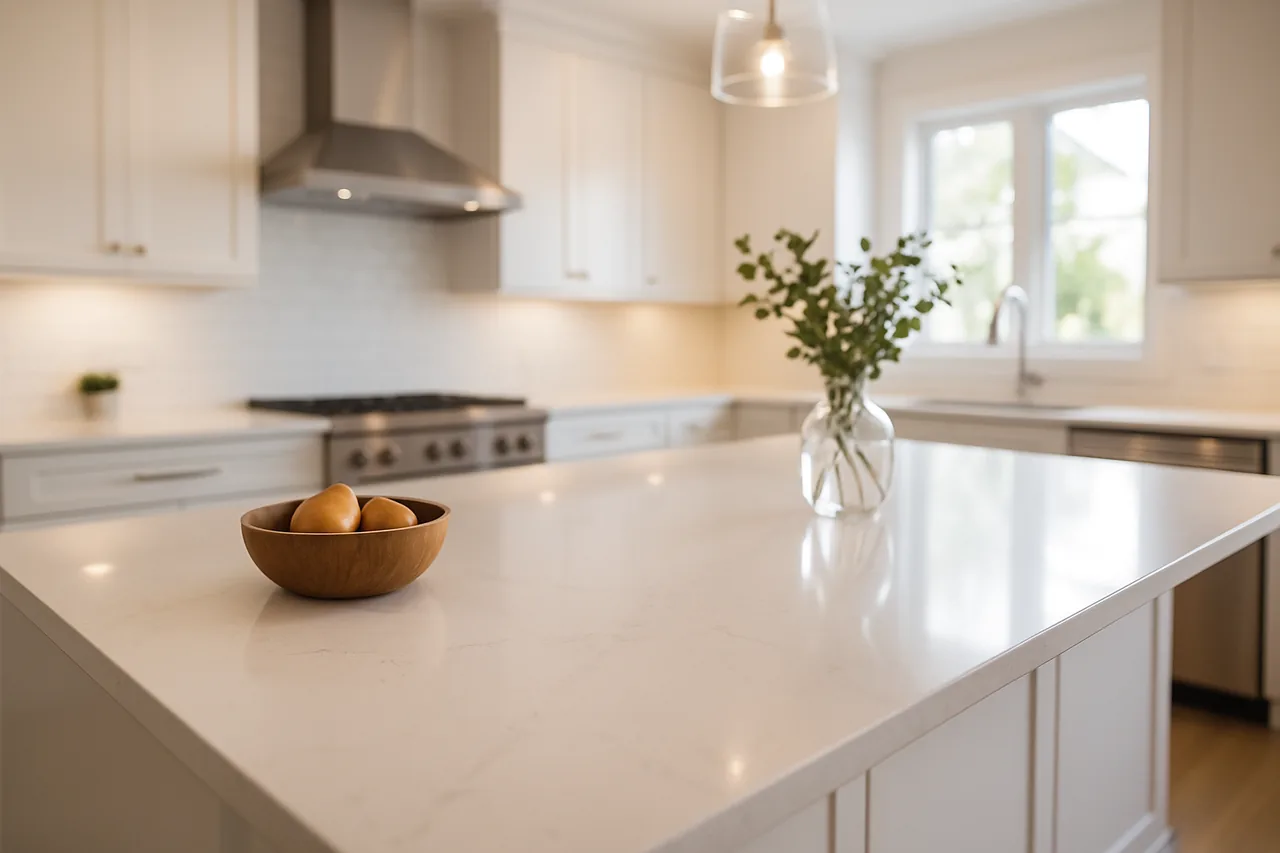
Common Kitchen Countertop Mistakes, Consequences, and Prevention
Most kitchen-counter failures are the same handful of mismatches, each with a predictable consequence and a known prevention. Naming them is how you spot a corner being cut before the slab is set.
| Mistake | What it causes | The prevention |
|---|---|---|
| Quartz beside the range, no trivet habit | A permanent scorched, yellowed ring where hot pans land | A trivet rule at the range, or a heat-tolerant stone landing strip |
| Polished marble as a prep surface | Permanent etch craters from citrus, wine, and vinegar | Choose quartzite, or confine marble honed to a baker's zone |
| Porous stone left unsealed | Oil, wine, and coffee stain the prep zone within a season | Seal on install and maintain the cadence via a water-bead test |
| Square inside cutout corners | Cracks radiate from the sink and cooktop under heat and load | Radius every inside corner in the shop, especially at the cooktop |
| Seam placed in a high-sightline run | An obvious line across the most-seen surface in the room | Locate seams at the sink or low-sightline runs, pattern-matched |
| Unsupported breakfast-bar overhang | The cantilever cracks where people lean and sit | Add steel rods or corbels for any overhang past the safe span |
| Laminate as a forever kitchen surface | Scorches at the range, swells at the seams, can't be repaired | Choose a heat-tolerant stone or non-porous quartz for a lasting kitchen |
Every row is a documented way a kitchen counter fails or disappoints early — which is why "we radius the cutouts, place the seams, and match the material to how you cook, in writing" is the most valuable sentence in a kitchen quote.
Which Countertop Is Right for Your Kitchen?
The right kitchen counter is the output of a short chain of honest answers about how your kitchen cooks and what you will maintain. Walk it in order; each branch eliminates options the room rules out, and what survives is your defensible choice.
- Do you set hot pans down without reaching for a trivet? If yes, you are choosing heat-tolerant natural stone — granite, quartzite, or soapstone — and resin-bound quartz and laminate drop out unless you'll commit to the trivet. If you're disciplined with a trivet, quartz re-enters as the low-maintenance front-runner.
- Will you actually reseal a porous stone on schedule? If a periodic seal isn't going to happen, choose a non-porous surface — quartz, porcelain, or soapstone — that never needs it. If you'll maintain a seal, porous granite and quartzite open up with their heat tolerance and unique slabs.
- How hard does the prep run live? Heavy daily scratch-cooking with kids and pets wants a hard Mohs 7 surface — quartz or quartzite — that a knife and dragged grit won't mark. A gentler kitchen or a cook who likes patina can carry softer soapstone or a honed marble zone.
- Do you cook with acid — citrus, wine, tomato — every day? If yes, polished marble is out as a prep surface (it etches on contact), and your safe ground is quartz, porcelain, quartzite, or sealed granite. If marble's veining is non-negotiable, honed and confined to a low-acid baker's zone is the only defensible use.
- What does the budget read, honestly? Laminate is the lowest entry cost, quartz and granite the value sweet spot, quartzite and porcelain premium, marble a luxury statement. Compare lifetime cost, not sticker — a scorched or etched surface re-fabricated in five years costs more than the right slab once. Size it in the quartz and granite cost guides.
Run honestly, this tree almost always returns a single defensible slab — and a fabricator who recommends the same material for every kitchen regardless of the answers is the red flag.
Not sure which surface your kitchen actually needs?
Tell us how your kitchen cooks and we'll match a vetted fabricator who names the right material for the room, radiuses the cutouts, and puts it in writing.
Food Safety, Hygiene, and the Prep Surface
Beyond heat and stains, a kitchen counter is a food-prep surface, so how it handles bacteria and moisture matters more here than in any other room. Two properties decide daily hygiene.
Why Non-Porous Wins the Food-Safety Argument
A non-porous surface — quartz, porcelain, soapstone — has no pores for liquid, food residue, or bacteria to enter, so a wipe with soap and water returns it to a sanitary state. Porous stone must be sealed to reach the same defense, and the seal has to hold; an unsealed or lapsed-seal granite can harbor what soaks into its surface near the prep zone. For raw-meat and produce prep, the non-porous surfaces have a real, not marketing, hygiene edge — one reason they dominate hard-working kitchens.
Standing Water at the Sink Run
The sink run sees standing water for hours a day, and it is where a porous or wood surface pays for a lapsed seal fastest. Non-porous materials ignore it; sealed stone shrugs it off while the seal holds; butcher block beside a sink is the classic mismatch, warping and staining exactly where the room stays wet. This is why the sink run, not the open field, is the zone that decides whether a porous kitchen surface survives — and why the sink reveal gets sealed with extra care.
What Actually Drives the Cost of a Kitchen Countertop
A kitchen quote is not a flat per-square-foot rate; the headline number a low bid leads with hides the items below, ranked by how much they move the total in this specific room.
- Material grade and slab rarity. The stone or engineered product sets the baseline — a common granite, an exotic quartzite, or a premium quartz line all price differently, and a rare natural slab with dramatic movement carries a real premium over a builder-grade one.
- Edge profile and thickness. A 3 cm single-thickness edge, a built-up laminated edge on 2 cm, or a decorative ogee all price apart — the more the fabricator shapes and polishes the edge, the more skilled hours it takes.
- Cutouts, seams, and slab layout. Each sink, cooktop, and faucet cutout is skilled shop work, seams add bonding labor, and matching veining across a joint or laying out an exotic slab for movement adds hours a simple straight run skips.
- Overhang support engineering. A breakfast-bar or island overhang past the safe unsupported span needs steel rods, corbels, or a panel installed before the slab — a real line item that a wall-hugging run avoids entirely.
- Sink and appliance detailing. An undermount sink's bracket-and-seal, drilling faucet and dispenser holes, and coordinating the cooktop cutout add labor a simple drop-in top does not.
- Old-counter removal and disposal. Tear-out is labor and haul-away is a fee, and removal can expose out-of-level cabinets or water damage that changes scope mid-job — which is why it belongs in the written quote up front.
- Sealing and finish work. A porous stone's first seal and a specialty finish (honed, leathered) are small line items the lowest bid tends to omit — and exactly the ones that set the surface's daily performance.
- Template and install access. A tight kitchen, a second-floor carry, or an island that must be maneuvered in add labor a ground-floor open plan does not.
Because these drivers swing so widely, the only honest number comes from an on-site template and assessment. Compare what moves the price across the category in our cost guides, and size your own kitchen first with the countertop cost calculator so you can read a quote critically.
Keeping a Kitchen Countertop Looking New
A kitchen counter's lifespan is set as much by daily habit as by the material, and the routine differs sharply between non-porous and porous surfaces — each habit targeting a failure mode the room creates.
For non-porous surfaces — quartz, porcelain, soapstone — daily care is warm water, mild dish soap, and a soft cloth, with no sealing ever; the only discipline quartz asks is a trivet under hot cookware and avoiding harsh, high-pH, or abrasive cleaners that can dull the finish. For porous stone — granite, quartzite, marble — the surface must be sealed and then resealed on a cadence, with a simple water-bead test telling you when the seal is thinning; wipe acidic and oily spills promptly, use a cutting board to protect both the surface and your knives, and never use bleach or acidic cleaners on stone. Butcher block needs regular food-safe oiling, fast drying around any water, and the occasional sand-and-re-oil to erase scratches and marks. The longest-lived kitchen surface is the one whose upkeep you'll actually keep up with — which is exactly why the fit test asks about sealing and heat habits before looks. When a kitchen counter is damaged rather than dirty — a chip, a crack, an etch, a scorch — countertop repair and countertop restoration can often bring it back, and worn natural stone frequently renews with professional polishing rather than replacement.
Talk through your project — free.
A free consultation and a written, itemized quote from a vetted installer. No pressure, no obligation.
Kitchen Countertop Glossary
The terms below recur in every kitchen-counter quote, spec sheet, and warranty — each defined as its working meaning on an actual kitchen job, so you can read a scope and judge whether it is complete.
- Etching vs. staining
- Etching is a chemical reaction — acid dissolving calcite into a dull crater no sealer prevents; staining is absorption of a liquid into an unsealed pore, which a sealer does prevent. Marble etches; unsealed granite stains; quartz resists both.
- Porosity
- Whether a surface has pores that absorb liquid. Non-porous materials (quartz, porcelain, soapstone) never need sealing; porous stone (granite, quartzite, marble) does, on a cadence.
- Sealer
- A penetrating treatment that fills the pores of natural stone so liquids can't wick in and stain. It blocks absorption only — it never stops acid etching — and it wears and must be reapplied.
- Mohs scale
- A relative hardness scale. Quartz and quartzite sit near Mohs 7 (harder than a steel blade); granite close behind; marble ~3 and soapstone ~2.5 are soft and scratch far more easily.
- Thermal shock
- The stress a sudden temperature change puts on a slab — a pan off the burner onto a resin-bound quartz can soften the binder or crack the surface, which is why quartz needs a trivet.
- Resin binder
- The polymer (about 7–10% of engineered quartz) that binds the ground quartz. It makes quartz non-porous and uniform, but it is the part that scorches under heat and yellows in UV.
- Sintered slab
- Porcelain fired from clay-based minerals under heat and pressure with no polymer — the reason it is non-porous, heat-resistant, and UV-stable in one surface.
- Radiused corner
- A rounded inside corner at a sink or cooktop cutout that removes the stress riser a square corner creates — the detail that prevents cracks radiating from a cutout.
- Undermount sink
- A sink mounted below the counter so crumbs wipe straight in, carried on brackets or a rail and sealed to the slab underside — the kitchen standard, best on a non-porous top that holds the seal.
- Seam
- The bonded joint where two slabs meet on a run too large for one slab. A good seam is placed low-sightline, pattern-matched, and bonded with color-matched epoxy to read as a thin line.
- Slab thickness (2 cm vs. 3 cm)
- Standard stone thicknesses. 3 cm runs a single-thickness edge and supports a bigger overhang; 2 cm is lighter and cheaper but usually needs a built-up edge and more continuous support.
- Honed finish
- A matte surface (versus polished) that hides etching and scratches far better — the finish that makes soft marble tolerable in a low-acid kitchen zone, at the cost of showing fingerprints more.
Standards, Warranty Conditions, and What a Kitchen Counter Must Meet
A manufacturer's warranty is a contract with conditions, and in a kitchen most denials are not about the product — they are about how it was used and installed.
Warranty Conditions That Hinge on the Kitchen
The conditions are specific: engineered quartz warranties assume indoor use and a trivet under hot cookware — set a pan down and scorch the resin and you've used the surface outside its terms; natural-stone coverage assumes the sealing cadence is maintained; and every material assumes the fabrication radiused the cutouts and supported the overhang. An installer who skips the radius or a homeowner who ignores the trivet has weakened coverage before a problem appears. Ask in writing that fabrication follow the manufacturer's published instructions, because that document is what a kitchen warranty claim is judged against.
What Sets the Bar for Kitchen Surfaces
Recognized guidance governs the rest. Engineered-quartz makers publish heat, chemical, and care limits per line; natural-stone practice sets sealing and finish standards; and food-contact surfaces are expected to be cleanable to a sanitary state, where non-porous materials have the edge. A kitchen counter fabricated and used to these keeps its warranty and its looks. When wear rather than damage is the issue, the better path may be polishing or restoration of natural stone rather than a full replacement — and a new counter is usually templated alongside new cabinets so both land level together.
A Real Kitchen Countertop Decision
One representative kitchen shows why the weakest point decides everything: the look pulled one way and the cooking pulled another, and the cook's real habits won.
How to Vet a Fabricator for a Kitchen Countertop
Most kitchen-counter failures are fabrication-and-match failures, so the pro matters more than the brand on the slab. These questions separate a fabricator who builds a kitchen counter to last from one who cuts stone fast.
- They match the material to how you cook
- Ask what they'd recommend for a hot-pan cook versus a hands-off one. A real answer distinguishes heat-tolerant stone from resin-bound quartz and weighs your sealing tolerance — not a vague "they're all fine."
- They radius every sink and cooktop cutout
- Ask specifically how they cut the inside corners at the sink and cooktop. A credible answer describes a radiused corner to remove the stress riser, because a square corner is where a slab cracks under heat and load.
- They template after cabinets are set and level
- Ask when they template. The right answer is after the cabinets are installed and leveled — measuring off unlevel or absent cabinets is how a counter ends up sitting proud or gapped at the wall.
- They place and match the seams deliberately
- Ask where the seams will fall and how they'll be matched. The answer should name low-sightline locations, pattern alignment on veined stone, and color-matched epoxy — not "wherever the slab runs out."
- They engineer the overhang support
- For any breakfast-bar or island overhang, ask how it's carried. A real answer names steel rods, corbels, or a support panel for spans past the safe limit — because an unsupported overhang cracks where people lean.
- They put the scope, seal, and workmanship warranty in writing
- Ask for the full scope, the sealing plan, and a labor warranty in writing before work starts. A crew willing to name a workmanship guarantee — and return if a seam opens or a corner cracks — is accountable for the fabrication, not just the product the maker covers.
Why Route Your Kitchen Countertop Through Pro Work Home Surface
Pro Work Home Surface is not a fabricator and does not cut or set your slab — we are a national authority on home surfaces that matches homeowners with vetted local countertop pros and holds them to a published bar.
- Material matched to how the kitchen cooks
- The recommendation weighs heat habits, sealing tolerance, and daily abuse — heat-tolerant stone for hot-pan cooks, non-porous surfaces for hands-off upkeep — not just the slab you liked in the showroom.
- Fabrication that prevents the room's failures
- The template is taken from set, leveled cabinets, every sink and cooktop cutout is radiused against the stress cracks square corners cause, and seams are placed low-sightline and pattern-matched on a surface seen from every angle.
- Overhang and edge engineered, not assumed
- Any breakfast-bar or island overhang past the safe span is carried by steel rods, corbels, or a support panel, and porous stone is sealed on every face and cut edge so water at the sink never wicks in.
- National coverage, local crews
- We match you with fabricators in your area nationwide, so the standard is consistent even though the crew is local — whether your project is a single run or a whole connected kitchen and island.
Countertops are one of eight categories we cover across home surfaces. If your kitchen project also touches an island with its overhang and seam demands, a bathroom vanity down the hall, or an outdoor kitchen with a different material logic entirely, the same standards apply — compare what moves the price in our cost guides, weigh the options in our learning center, size the job with our material comparison tool, and start from the countertops category hub or the full range of home surfaces.
Brands & Material Authority
Quality and construction drive long-term performance more than the label. These are widely respected names in this category:
- Cambria
- Caesarstone
- Silestone
- MSI
- Cosentino
- Corian
- Wilsonart