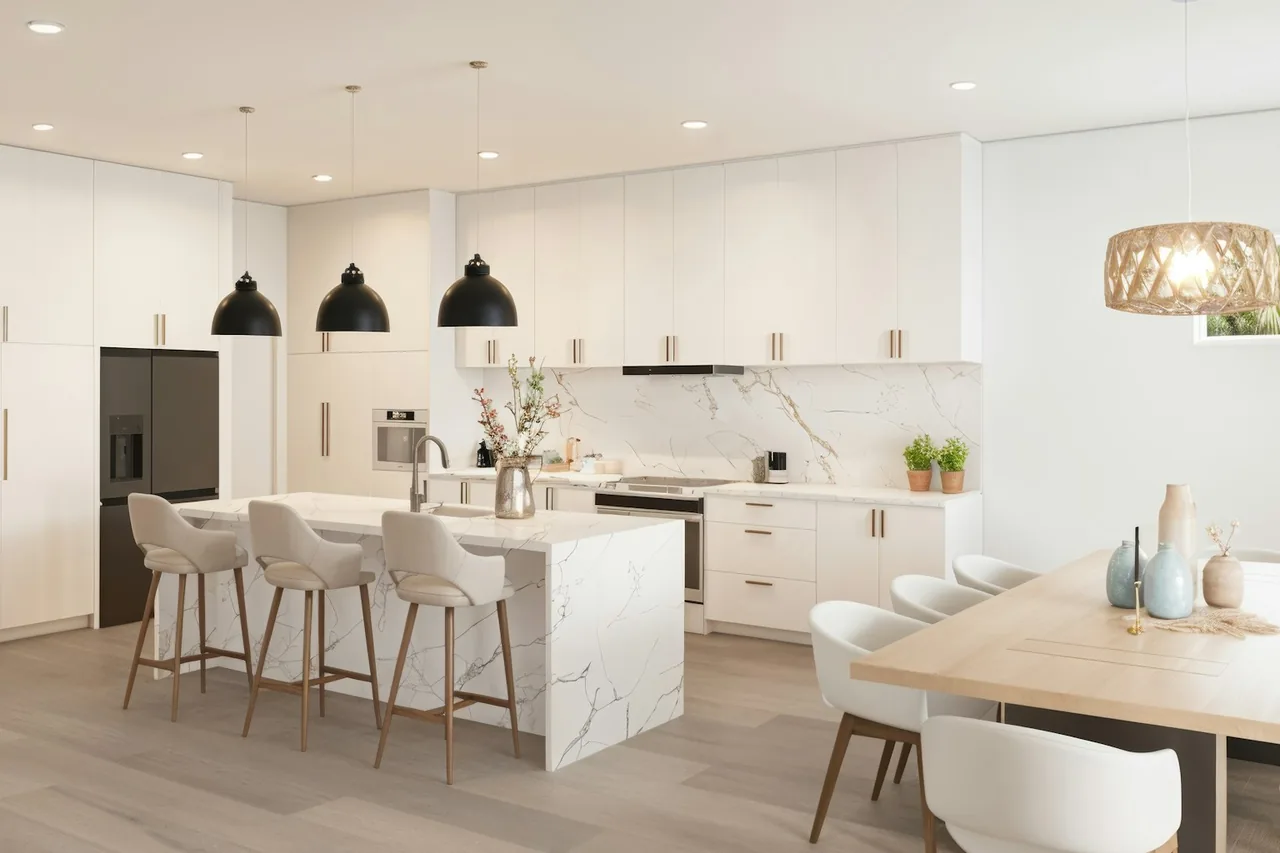
Luxury vinyl plank is the one vinyl format built as a long, rigid, wood-look board that clicks together and floats over the subfloor — the plank shape and the rigid core are what separate it from its three vinyl siblings. Pick LVP over luxury vinyl tile when you want a wood look rather than stone, over sheet vinyl when you want a click-down floor a single plank can be swapped out of, and over flexible glue-down vinyl when you want a core rigid enough to bridge an imperfect subfloor. The two numbers that decide an LVP buy are the wear-layer mil — 6, 12, or 20 mil — and the SPC-versus-WPC core, and both are settled in a written scope, not at the display. Get a free consultation from a vetted installer before you order.
What Separates Luxury Vinyl Plank From the Other Three Vinyl Formats
All four vinyl formats share a printed image under a clear wear layer, so the differences that matter are structural — shape, core, and how the floor is repaired. LVP is defined by a combination none of its siblings share: a rigid core in a long plank that reads as a hardwood board.
The Rigid Core in a Plank Shape Is the Whole Identity
Older and cheaper vinyl is flexible — a thin sheet or tile with a backing that drapes over whatever is beneath it. Luxury vinyl plank is built on a solid, dimensionally stable core that holds its shape, locks edge to edge, and floats over the subfloor as one connected click-lock floor.
Why the Plank Format Is the Point, Not an Accident
LVP is engineered to read as a hardwood board specifically — long boards, a beveled or painted micro-bevel edge, and an embossed surface texture registered to the printed grain so the dips you see line up with the dips you feel. That is why LVP, not tile-format LVT, is the floor people reach for when they want a wood look running unbroken through a kitchen, a basement, and a bath. It delivers the visual of hardwood flooring in rooms where real wood cannot survive.
What the Plank Shape Does That Sheet and Tile Cannot
Because the floor is many discrete planks locked together rather than one bonded sheet, a gouged or damaged board in a floating LVP floor can be unclicked and swapped individually — the repair story that sheet vinyl cannot match, since a damaged sheet means redoing the whole floor. Against LVT, the split is only the printed image and the board-versus-tile shape; the core technology is identical. The plank format is what makes LVP simultaneously the most wood-like and the most repairable vinyl.
The Honest Limit: A Printed, Non-Renewable Surface
The trade for that versatility is honesty about what LVP is — a printed, manufactured floor with a finite wear surface that cannot be sanded and renewed like solid wood. It is chosen for waterproofing, scratch tolerance, and a convincing wood look at a fair price, not for the heirloom permanence or resale value of a milled board. Knowing exactly what the rigid core and the wear-layer mil buy you is the difference between a plank that looks new in ten years and one that dulls in three.
Luxury Vinyl Plank vs. LVT, Waterproof Vinyl, and Sheet Vinyl
LVP is one of four vinyl flooring formats, and the right call between them is about shape, repair, and where each belongs — not about which is higher quality. Picking the format is the first decision, before color or wear layer, because it decides the look and the repair story.
The Format Comparison Matrix
The matrix below is the decision a homeowner is actually making across the four vinyl formats — the shape, the deciding spec, the look each imitates, how it is repaired, and where it fits.
| Format | Shape | Deciding spec | Look it imitates | Repair unit | Where it fits |
|---|---|---|---|---|---|
| Luxury vinyl plank | Long, narrow board | Wear-layer mil + SPC/WPC core | Hardwood plank | One plank swapped | Wood look through wet and dry rooms alike |
| Luxury vinyl tile | Square / rectangular tile | Wear-layer mil + grout option | Stone, marble, ceramic | One tile swapped | Stone look, groutable for true tile |
| Waterproof vinyl | Plank or tile, rigid core | Warranty + sealed joints | Wood or stone | One piece swapped | The wettest, highest-risk rooms |
| Sheet vinyl | Continuous roll | Backing + roll width | Wood, stone, tile (budget) | Whole sheet replaced | Small, wet, budget rooms |
LVP vs. LVT: Same Core, Wood Versus Stone
Against luxury vinyl tile (LVT), the split is purely visual: the same rigid-core technology in a different shape with a different printed image. LVP is a long plank that imitates a wood board; LVT is a square or rectangular tile that imitates stone, marble, or ceramic, and some LVT lines accept grout for a convincing true-tile finish that LVP does not offer. Choose LVP for a wood look and LVT for a stone-or-tile look — the waterproofing and durability are the same, so the shape and the printed image are the entire decision.
LVP vs. Waterproof Vinyl: A Format Versus a Property
The relationship to waterproof rigid-core vinyl is closer still, because most rigid-core LVP is waterproof vinyl in plank form — the two overlap heavily. The distinction lives at the margins: a line specifically marketed as "waterproof" is warranted and joint-sealed for the wettest rooms, while a budget flexible plank may be only water-resistant. When the room is a full bath or a below-grade basement, confirm the waterproof rating rather than assuming every plank carries it. Put plainly: LVP names the shape, "waterproof" names a spec that most — but not all — LVP already meets.
LVP vs. Sheet Vinyl: Realism and Repair for Seam Count and Price
Against sheet vinyl, LVP trades seam count for realism and repairability. Sheet arrives in wide continuous rolls with the fewest seams of any vinyl, making it the most water-resistant layout and the lowest-cost option — but it cannot match LVP's deep embossed plank texture, and a damaged sheet means redoing the whole floor while a gouged LVP plank in a floating floor is swapped individually. For a workhorse laundry or utility floor, sheet wins on price and seam count; for living spaces and a wood look meant to last, LVP wins.
The Specs That Define LVP — Wear Layer, SPC vs. WPC Core, and Thickness
Three numbers decide how a luxury vinyl plank performs, and shoppers routinely confuse them — buying on total thickness while ignoring the wear layer is the single most common LVP mistake. Get all three right for the room and the plank delivers; the core decision in particular is more consequential in LVP than in any other vinyl format, because the plank is walked as a board and felt as one.
Wear Layer: the Spec That Predicts Lifespan
The clear top film is all that stands between traffic and the printed wood grain, and once it abrades through there is nothing to sand. That makes it the single best predictor of how long the plank looks new.
How Wear Layer Is Measured, and Why It Is Not Thickness
The wear layer is the transparent top film, measured in mil — one mil is one-thousandth of an inch. It is a completely separate spec from the plank's overall thickness, which is the most common point of confusion on a showroom floor. A thick plank can carry a thin wear layer, and that board abrades early no matter how substantial it feels underfoot.
Wear-Layer Mil, Matched to Traffic
The mil number maps directly to how hard the room lives. A 6 mil layer suits a light-traffic guest room or closet; a 12 mil layer handles a busy household, hallway, or kitchen; a 20 mil layer or more stands up to heavy traffic, pets, and rolling loads, and is what commercial-grade residential planks carry. Specify a 6 mil plank into a busy entry and it looks tired within a few years, with no refinish to fall back on — so the mil is bought once, for the worst traffic the room will ever see.
Why the Mil Beats the Top-Coat Marketing
Above the wear layer many planks add a thin urethane or ceramic-bead top coat that improves scuff and stain resistance, but it is microns thick and does not replace wear-layer mil — it is a surface treatment, not the protective body. When two planks list the same overall thickness but different mil, the higher mil is the more durable floor regardless of the top-coat name on the box. Read the mil first, the top coat second.
Core Type: the SPC-vs-WPC Decision LVP Forces
The core under the print and wear layer is what makes the plank waterproof and dimensionally stable, and in a plank floor the choice between the two rigid cores is a real comfort-and-durability trade every buyer makes.
SPC — the Dense, Hard, Imperfection-Hiding Core
SPC (stone-plastic composite) is a dense, hard core of limestone and PVC that resists dents and dimples and bridges minor subfloor imperfections better than anything else in vinyl. It is the pick over concrete or an uneven substrate, and its rigidity is why an SPC plank can float over a slightly wavy slab where a thinner product would telegraph. The trade is that it is harder and slightly louder underfoot than the alternative.
WPC — the Thicker, Warmer, Softer Core
WPC (wood-plastic composite) is a slightly thicker, lower-density core that runs warmer and softer underfoot, with a bit more give for comfort in a living space. Both cores are rigid and both make the plank 100% waterproof; the difference is dent resistance and imperfection-bridging (SPC) versus underfoot comfort and warmth (WPC). Choose the core for the subfloor and the feel — SPC for hard or imperfect substrates, WPC for a flat floor where comfort leads.
Overall Thickness and the Attached Pad
Total plank thickness affects how the floor feels and how well it spans minor unevenness, but it does not determine wear resistance — a thick plank with a thin wear layer still scuffs early. Many rigid-core LVP planks also ship with an attached pad, an underlayment bonded to the plank back that quiets the floor and bridges small imperfections without a separate roll of underlayment. Read thickness and the attached pad as comfort and stability, the wear-layer mil as durability, and the core as both waterproofing and feel — separate specs for separate jobs.
The LVP Spec Table
The table below collects the specs that govern an LVP buy so the wear-layer and core trade-offs read at a glance. These are representative figures; the printed specs for your product always govern.
| Spec | What it controls | Light residential | Busy household | Heavy traffic / pets |
|---|---|---|---|---|
| Wear-layer mil | How long the wood print survives traffic | 6 mil | 12 mil | 20 mil+ |
| Core type | Waterproofing, stability, feel | Rigid WPC or SPC | SPC for hard/uneven, WPC for comfort | Dense SPC |
| Waterproof? | Suitability for wet rooms | Rigid core: 100% waterproof | Rigid core: 100% waterproof | Rigid core: 100% waterproof |
| Attached pad | Sound and minor imperfection bridging | Helpful | Helpful | Helpful |
| Overall thickness | Comfort, not wear | Read for feel only | Read for feel only | Read for feel only |
The pattern the table makes plain: buy the wear layer for the traffic and the core for the subfloor and feel — and never let overall thickness stand in for either. Compare it spec-for-spec against the other formats with the material comparison tool before settling on a plank.
Want the mil and the SPC-or-WPC core matched to your room before you buy?
We match you with a vetted installer who reads your traffic and subfloor, names the wear-layer mil and the core your space needs, and puts it in a written scope — before you commit to a plank or a price.
How Luxury Vinyl Plank Is Installed
LVP is one of the more forgiving floors to install, but "forgiving" is not "no-prep," and the most common failures come from treating it that way. The overwhelming majority of rigid-core LVP goes down as a floating click-lock floor; the six steps below are the real install sequence, and the prep that makes any of them last is flatness — the step a fast crew skips.
On-Site Subfloor and Core Assessment
The installer identifies the substrate and the room's moisture and traffic, then confirms the format and core against them — a dense SPC plank for a hard or slightly uneven slab, a warmer WPC for a flat floor where comfort leads. Whether the floor floats or glues is decided here, against the subfloor, before any product is ordered.
Moisture Check on Concrete
Over a slab, the concrete is tested by ASTM F2170 against the maker's limit before a floating waterproof plank seals vapor underneath it. The plank is waterproof from above, but vapor trapped below a sealed floating floor still finds the edges — which is why the slab is read, not assumed. The detail lives under subfloor prep.
Flatten the Subfloor to Tolerance
A dense SPC core bridges minor imperfections better than any other vinyl, but ridges, debris, and larger dips still print through or create a hollow, bouncy feel over time — especially on a thinner plank. The installer reads the subfloor against the manufacturer's flatness tolerance, grinds high spots, and fills low spots so the plank sits flat and quiet.
Acclimate the Planks to the Room
Rigid-core LVP is left in the conditioned space for the maker's stated window — commonly a day or two — so it reaches the room's temperature before install. Skipping it on a floating floor is a leading cause of gapping or peaking after the temperature settles, because the planks expand or contract after they are locked together.
Set the Expansion Gap and Click the Field
A continuous perimeter expansion gap of roughly 1/4 in. to 3/8 in. is set around the room and at every obstruction, hidden under trim, so the floating floor can move with temperature without peaking. The planks then click together over the pad, dry-racked for board direction and seam stagger so the room reads square and no short end-piece lands at a doorway.
Transitions, Trim, and Walkthrough
Thresholds, T-moldings, reducers, and baseboard or quarter-round finish the edges, conceal the expansion gap, and bridge to adjoining rooms and any staircase. The site is cleaned and the installer walks the floor with you to confirm the result and review care — no long cure time, since the floating floor is walkable immediately.
Rush the flatness or the expansion gap and a floating LVP floor telegraphs or peaks within a year — which is why a vetted installer treats the prep as the job, not the click-together as the job. The full method comparison lives under flooring installation.

Is Luxury Vinyl Plank Right for Your Space?
Whether LVP is the right vinyl — and which core and mil — is the output of a short chain of facts about the look you want, the room's moisture, its traffic, and its subfloor. Walk the decision in order; each branch narrows the choice toward a single defensible spec.
- Do you want a wood look or a stone look? LVP is the wood-look plank. If you want stone, marble, or a groutable ceramic look, the format is LVT, not plank — the core is identical, so this is purely about the printed image and the board-versus-tile shape.
- Does the room get wet or sit below grade? If yes — a kitchen, a bathroom, a laundry room, or a below-grade basement — you need a rigid SPC or WPC core that is 100% waterproof, and for a full wet room a plank specifically warranted as waterproof with sealed joints. If the room stays dry, a flexible glue-down plank is also on the table.
- How hard does the room live? A guest room takes a 6 mil wear layer; a busy kitchen, hallway, or pet household wants 12 mil to 20 mil. Buy the mil for the worst traffic the room will see — there is no refinish to recover a worn plank.
- What is the subfloor's condition? Over an imperfect or slightly uneven subfloor, a denser SPC core spans minor flaws and resists dents; over a flat, sound floor, WPC adds warmth and softness underfoot. Either way the flatness tolerance still has to be met first.
- Floating or glue-down? Floating click-lock installs fastest over an existing flat floor and lets a damaged plank be swapped later; flexible glue-down gives the most stable result in the heaviest traffic but adds adhesive and prep time. Confirm the survivor under the flooring hub.
Run honestly, this tree returns a single core, a defensible mil, and a method — and an installer who quotes the same plank for every room is the red flag.
The LVP Fit Test: Six Questions That Confirm It Belongs
Before LVP is the answer for a room, it should clear the same six-question fit test — each tied to a real property of the plank, and each a place where LVP is either the obvious call or the wrong one. Call it the LVP Fit Test: clear all six and the plank belongs; fail one and another format or material fits better.
- 1. You want a wood look, not stone
- LVP's entire design intent is a hardwood board — long plank, micro-bevel edge, embossed grain. If the room calls for a stone, marble, or groutable tile look, LVT is the format built for it; asking a plank to read as tile fights its shape. This is the first question because the shape is fixed once the format is chosen.
- 2. The room is wet or below grade — or isn't
- A rigid-core plank is 100% waterproof, which is why LVP owns kitchens, baths, laundries, and basements where real wood cannot go. In a bone-dry bedroom the full waterproof plank is not strictly required, so the fit test asks whether the room's moisture actually justifies the rigid core.
- 3. The traffic justifies the mil you'll pay for
- A busy, pet-friendly, or high-traffic room wants a 12–20 mil wear layer, and LVP carries it well. If the room is truly light-traffic, a thinner mil suffices — and if it demands a hardness beyond any resilient surface, tile may fit better.
- 4. The subfloor is imperfect enough to want a rigid core
- LVP's SPC core is the best imperfection-bridger in vinyl, so a slightly uneven slab or a floor with minor flaws is exactly where a plank shines over thin sheet. A perfectly flat substrate widens the field to every format, so this question separates where LVP is uniquely suited from where it is merely fine.
- 5. Repairability matters more than seam count
- Because the floor is discrete planks, a single damaged board can be unclicked and replaced — the repair advantage over sheet vinyl. If minimizing seams for water resistance outranks per-plank repair, sheet is the sibling to weigh; if swap-one-plank repair matters, LVP wins.
- 6. You accept a printed, non-renewable surface
- LVP cannot be sanded and refinished, and up close a sharp eye reads a printed plank as a print. If the room needs the renewability, resale value, or authenticity of real wood, hardwood is the honest pick; if performance and a convincing look at a fair price lead, LVP fits.
Clear all six and LVP is not a compromise but the correct floor; fail one and the fit test has just pointed you at the sibling format or material that fits better — which is exactly the conversation a credible installer walks with you.
Talk through your project — free.
A free consultation and a written, itemized quote from a vetted installer. No pressure, no obligation.
Why LVP Scuffs, Gaps, and Gouges — and How to Prevent It
LVP does not cup or rot, but it has its own failure modes, and they trace to a wear layer too thin for the room, the plank's sensitivity to heat, and sharp point loads — each paired below with its cause and prevention.
A Worn-Through Print: Too Little Wear-Layer Mil
The most common disappointment is a wear layer too thin for the traffic. Once the clear top film abrades through in walking paths, the wood print scuffs, dulls, and eventually wears away — and unlike hardwood, there is nothing to sand and refinish. The prevention is entirely at purchase: specify 12 mil for a busy room and 20 mil for heavy traffic and pets, because the mil is the only durability lever once the plank is down.
Gapping and Peaking: Heat and a Missing Expansion Gap
A plank floor expands and contracts with temperature, and a floating floor installed tight to the walls has nowhere to move, so it peaks at the seams; one that was never acclimated gaps as it settles. In direct, intense sun through glass, a thin plank can also expand, discolor, or soften. The prevention is a continuous perimeter expansion gap, on-site acclimation, and keeping thin planks out of sealed, glassed-in sun where some carry restrictions.
Gouges and Dents: Sharp Point Loads on a Resilient Surface
Sharp point loads — a dropped knife, a heavy appliance leg, a dragged-in pebble under a stiletto — can gouge or dent the resilient surface in ways a hard tile would resist, and a WPC core dents a little more easily than a dense SPC. The prevention is felt pads under furniture, hard floor protectors under rolling chairs, and care moving heavy appliances. A torn or gouged plank in a floating floor can usually be swapped individually rather than redoing the room; see flooring repair.
Common LVP Mistakes, Consequences, and Prevention
Most LVP disappointments are the same handful of shortcuts, each with a predictable consequence and a known prevention. Naming them is how you spot a corner being cut before the floor is down.
| Mistake | What it causes | The prevention |
|---|---|---|
| Buying by overall thickness, not wear layer | A thick-feeling plank whose wood print scuffs and dulls in a few years | Specify wear-layer mil for the traffic — 12–20 mil for busy rooms |
| WPC core over a hard, uneven slab | Dents and telegraphed imperfections a denser core would have hidden | Choose a dense SPC core for hard or imperfect substrates |
| Flexible plank in a wet room | Water reaches the substrate; no waterproof rigid body to stop it | Use a rigid SPC/WPC core rated 100% waterproof |
| No perimeter expansion gap on a floating floor | Peaking and lifted seams as the plank floor expands with heat | Leave a continuous 1/4"–3/8" gap at every wall and obstruction, under trim |
| Unflat subfloor left as-is | Telegraphed high spots and a hollow feel through thinner planks | Grind, fill, and recheck to the maker's flatness tolerance first |
| Skipping acclimation | Gapping or peaking after the room's temperature settles | Let the planks sit in the conditioned space for the maker's window |
| Steam-mopping the floor | Heat and moisture driven into click joints; a softened, clouded surface | Damp-mop with a pH-neutral cleaner; never steam vinyl |
Every row is either a wear-it-out-early mismatch or a warranty-denial trigger — which is why "we spec the mil and core for the room and flatten the subfloor first, in writing" is the most valuable sentence in an LVP quote.
What Actually Drives the Cost of a Luxury Vinyl Plank Floor
An LVP quote is not a flat per-square-foot rate; the headline number a low bid leads with hides the items below, ranked by how much they move the total.
The Cost Drivers That Move the Total Most
- Wear-layer mil and core type. The plank sets the baseline — a 20 mil wear layer over a dense SPC core costs more than a thin-wear flexible plank, and it is the spend that decides how long the floor lasts.
- Subfloor prep and leveling. The biggest swing on most jobs. Because even a rigid plank telegraphs larger flaws, grinding and filling to the flatness tolerance is real material and labor a sound, flat substrate avoids.
- Floating versus glue-down. A floating click floor and a flexible glue-down in heavy traffic are two different labor lines — and adhesive is its own material cost on the glue-down.
- Moisture handling over a slab. A slab that reads high needs attention before a sealed floating floor traps vapor — a real line item the lowest bid tends to omit.
- Old-floor removal and disposal. Tear-out is labor and haul-away is a fee, and removal often exposes substrate problems that change scope mid-job — which is why it belongs in the written quote up front.
- Plank width and layout complexity. Wider planks, diagonal layouts, and herringbone add cutting, waste, and skilled hours beyond a straight-lay floor.
- Transitions and trim. Thresholds, T-moldings, reducers, and baseboard or quarter-round at every doorway and material change add up across a whole home.
- Stairs. LVP stair treads and nosing are slow, exacting work priced separately from field flooring; a run that continues onto stairs raises the total.
Because these drivers swing so widely, the only honest number comes from an on-site assessment. Compare what moves the price in our vinyl flooring cost guide and across the cost guides, and size your own room with the flooring cost calculator so you can read a quote critically.
Get an itemized scope, not a headline rate.
A vetted installer prices the plank, prep, removal, transitions, and stairs as separate lines — so you see the whole job, free and with no obligation.
How to Buy Luxury Vinyl Plank — and Vet Who Installs It
Because most LVP failures are install failures, the plank you pick and the crew that lays it both matter. These six questions settle the buy and separate an installer who preps the subfloor and specs the room from one that just clicks planks together fast.
- Buy the wear layer for the traffic, not the price
- A 6 mil layer is fine for a guest room; a busy kitchen, hallway, or pet household wants 12 mil to 20 mil. It decides how long the plank looks new, and there is no refinish to fall back on — so resist buying on total thickness alone.
- Match the core to the subfloor and feel you want
- Ask which core the installer recommends and why. A denser SPC core hides imperfections and resists dents over concrete or an uneven substrate; a WPC core runs warmer and softer for a flat living space. A real answer ties the core to your floor, not to what is on sale.
- Confirm the waterproof rating for the wettest rooms
- For a full bath or below-grade basement, verify the plank is warranted waterproof with sealed click joints, not merely water-resistant. Most rigid-core LVP qualifies, but a budget flexible plank may not — don't assume the shape guarantees the spec.
- They check and correct flatness, not just sweep
- Because a plank telegraphs larger flaws, ask how they hit the flatness tolerance. A credible answer involves a straightedge, grinding high spots, and filling low spots — not rolling the new floor over what is already there. Recognized product lines like COREtec, Shaw, and Mannington all publish that tolerance.
- They set the expansion gap and acclimate the planks
- Ask how long the plank sits in the room first and how the perimeter gap is handled. A crew installing straight off the delivery truck, tight to the walls, is skipping the two steps that prevent gapping and peaking after the temperature settles.
- They put the scope and labor warranty in writing
- Ask for the full scope, the timeline, and the workmanship warranty before work starts. A crew willing to name a labor guarantee — and to return if a seam lifts or peaks — is accountable for the install, not just the plank the maker covers.
Two honest answers — the mil-and-core they recommend and how they flatten the subfloor — tell you more about an LVP crew than any display; the rest of the list confirms it.
Luxury Vinyl Plank Glossary
The terms below recur in every LVP quote, spec sheet, and warranty — each defined as its working meaning on an actual job, so you can read a scope and judge whether it is complete.
- LVP
- Luxury vinyl plank — rigid-core vinyl in a long, narrow board that mimics a hardwood plank, clicks together, and is fully waterproof in its rigid-core form. The wood-look, plank-shaped member of the vinyl family.
- Wear layer
- The clear top film over the printed wood grain, the spec that predicts how long the plank survives traffic — measured in mil, and the one thing that cannot be renewed once worn.
- Mil
- One-thousandth of an inch — the unit the wear layer is measured in. 6 mil is light residential, 12 mil a busy household, 20 mil heavy traffic and pets. Not the same as plank thickness.
- SPC core
- Stone-plastic composite — a dense, hard, rigid core of limestone and PVC that resists dents and dimples and hides minor subfloor imperfections; the densest waterproof core and the pick for hard or uneven substrates.
- WPC core
- Wood-plastic composite — a slightly thicker, warmer, softer rigid core that is also fully waterproof, chosen for underfoot comfort over a flat substrate.
- Rigid core
- A solid, dimensionally stable core (SPC or WPC) that makes an LVP plank 100% waterproof and able to span minor flatness flaws — as opposed to a flexible backing that drapes over the subfloor.
- Attached pad
- An underlayment bonded to the back of the plank at the factory that quiets the floor and bridges small imperfections, removing the need for a separate roll of underlayment under the floating floor.
- Click-lock
- The tongue-and-groove locking edge that joins plank to plank in a floating floor, letting the field click together without adhesive and letting a single plank be unclicked for repair.
- Floating floor
- A floor that clicks plank-to-plank and rests on the subfloor over a pad rather than fastening to it — fast to install and dependent on a perimeter expansion gap.
- Expansion gap
- The deliberate space — roughly 1/4" to 3/8" — left around the perimeter so a floating plank floor can expand and contract with temperature without peaking; hidden under trim.
- Micro-bevel
- The small chamfered edge milled or painted onto each plank that defines the board-to-board line, deepening the illusion of individual hardwood boards and disguising minor height differences at the seams.
- ASTM F2170
- The in-situ relative-humidity test that reads concrete-slab moisture from probes sealed at 40% of slab depth — run before a sealed floating plank traps vapor over a slab.
Standards, Warranty Conditions, and Our LVP Bar
An LVP warranty is a contract with conditions, and many denials are not about the plank — they are about how it was specified and installed.
Warranty Conditions That Hinge on the Install
The conditions are specific and testable: the correct attached pad or approved underlayment; a continuous expansion gap on the floating floor; sealed click joints in wet rooms; the approved adhesive and trowel notch on a glue-down; and, over a slab, moisture within the stated limit. An installer who floats a plank floor tight to the walls or substitutes a cheaper adhesive has voided your coverage before you notice. Ask in writing that the install follow the manufacturer's published instructions — that document is what a claim is judged against.
What the Waterproof Rating Actually Promises
"Waterproof" applies to the plank body, not automatically to the whole floor. A rigid-core plank will not swell when wet, but a wet-room install still depends on sealed joints and perimeter detailing so water cannot reach the substrate through the seams. Read the moisture or waterproof warranty for the exposure it actually covers — a label that says waterproof and a warranty that covers a full bath are two different claims, and the warranty is the one that governs. The dedicated a waterproof vinyl core line is where that rating is strongest.
Our Luxury Vinyl Plank Standards
Pro Work Home Surface is not a contractor and does not lay your floor — we match you with vetted local installers and hold them to a published bar. On every LVP project we connect, the wear-layer mil is specified for your traffic and the SPC-or-WPC core for your subfloor and feel, in writing; the substrate is read against the manufacturer's flatness tolerance and corrected, and concrete moisture-tested before a floating plank can trap vapor; and the install follows the maker's instructions — continuous expansion gap, sealed joints in wet rooms, approved method for the format — so the work meets your warranty's conditions. When wear rather than damage is the issue, the path may be full replacement over a fresh install, and structural questions about the deck belong with the subfloor team first.
A Real Luxury Vinyl Plank Decision
One representative scenario shows how the wear layer and the core override a price target: the mil and the moisture, not the plank's thickness, drove every call below.
Why Route Your Luxury Vinyl Plank Project Through Pro Work Home Surface
Pro Work Home Surface is not a contractor and does not lay your floor — we are a national authority on home surfaces that matches homeowners with vetted local installers and holds them to a published bar.
- A free consultation and an itemized written scope
- Every connection starts with a no-obligation consult and a written quote that lines out plank, prep, removal, transitions, and stairs separately — so you read the whole job, not a headline rate.
- Wear layer and core matched to the room, in writing
- Installers are screened on what decides a plank floor's life: specifying the wear-layer mil for your traffic — 12 mil or higher for busy rooms — and the SPC-or-WPC core for your subfloor and feel, with the reason explained before you buy.
- Subfloor flattened and moisture-checked first
- The substrate is read against the manufacturer's flatness tolerance and corrected, and concrete is moisture-tested before a floating waterproof plank can trap vapor — the prep that stops telegraphing and lifting.
- National coverage, local crews
- We match you with installers in your area nationwide, so the standard is consistent even though the crew is local — whether your project is a single room or a whole home.
LVP is one of four vinyl formats we cover across home surfaces. Compare it with luxury vinyl tile for a stone look, a dedicated waterproof rigid-core line for the wettest rooms, or economical sheet vinyl for a budget wet floor — and if the room is dry and high-traffic, settle the closest cross-shop in our laminate vs. vinyl and tile vs. LVP guides or weigh real wood in hardwood vs. vinyl. Size the job with the the cost estimator, and start from the flooring category hub or the full range of home surfaces.
Brands & Material Authority
Quality and construction drive long-term performance more than the label. These are widely respected names in this category:
- Shaw
- Mohawk
- COREtec
- Armstrong
- Pergo
- Mannington
- Bruce
- Karndean