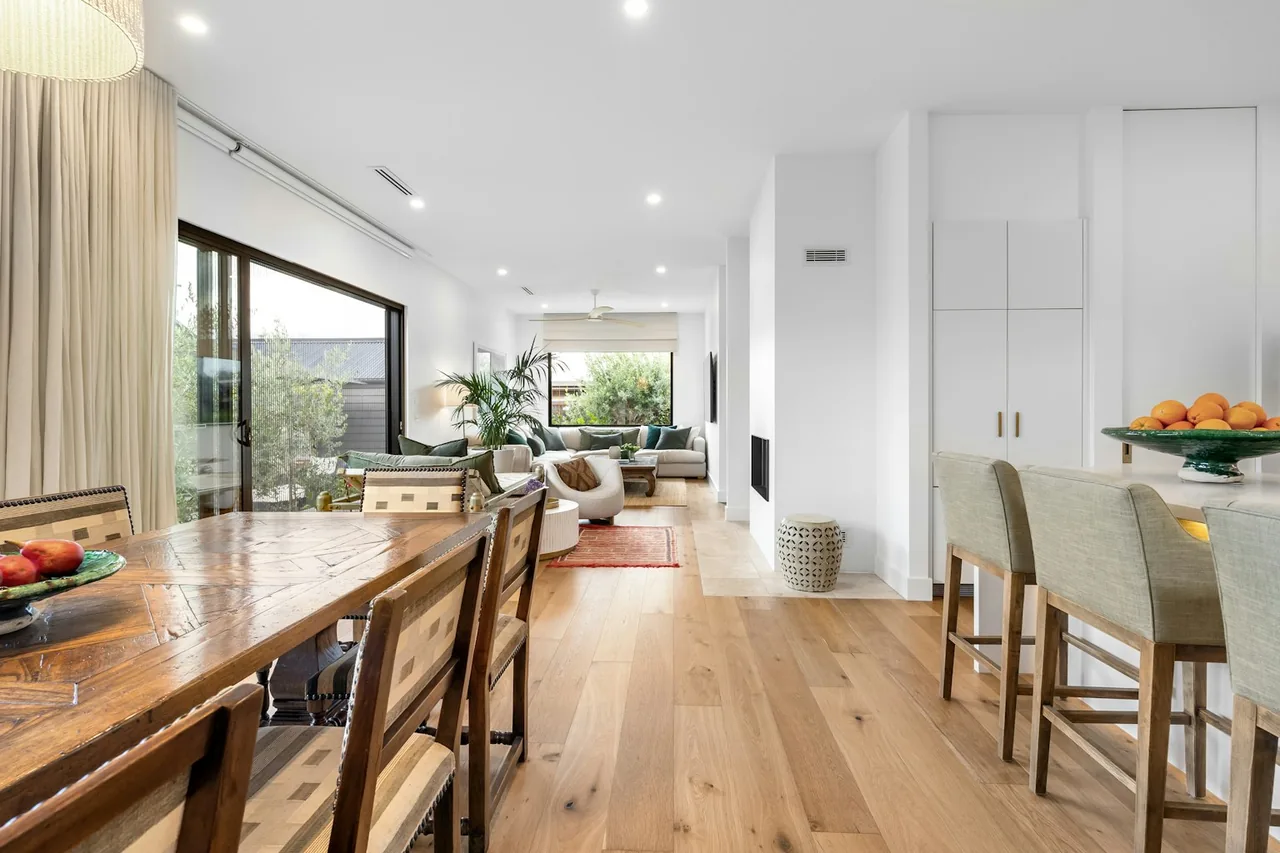
Laminate is the budget countertop: a thin sheet of high-pressure laminate (HPL) — printed paper fused under heat and pressure with resin — bonded to a particleboard or MDF core. Two facts decide whether it fits you and almost nothing else does: it delivers a non-porous, low-maintenance, almost endlessly patterned surface at the lowest cost of any countertop, and it cannot be repaired or refinished, so a deep scratch, a burn, or a water-swollen core means replacement. The vulnerability lives in the particleboard core and the exposed edges and seams, not the laminate face. Get a free consultation and a written, itemized scope from a vetted fabricator before fabrication — the grade, the sealed edges, and the sink decision in that document are where a laminate counter that lasts a decade is made.
Laminate Is a Two-Part Construction First, a Pattern Second
Buyers shop laminate by the pattern, but the thing that decides how long it lasts is the construction underneath: a durable printed skin over a moisture-vulnerable core. Understanding the two parts is the first fork, because the face and the core fail in completely different ways.
The Two Parts and Where the Vulnerability Lives
A laminate counter is a composite of two distinct components:
- The visible HPL surface — multiple layers of kraft paper and a printed décor sheet saturated with resin and fused under high pressure into a hard, thin laminate. It is genuinely durable: non-porous, easy to clean, and reasonably scratch- and stain-resistant for daily use.
- The substrate — almost always particleboard or MDF, which gives the thin laminate rigidity and thickness, and which swells and is ruined if water reaches it.
The face is the strong part and the core is the weak part, so nearly every laminate failure is really a core or edge failure, not a surface one — which is why the edges and the sink, covered below, matter more than the pattern you pick.
Where Laminate Genuinely Wins
Laminate wins on two unambiguous fronts: cost and selection. It is the least expensive countertop by a wide margin, and it comes in a vast range of patterns — convincing stone and wood looks, solid colors, and textures — with modern printing and embossed-in-register finishes that read far more realistically than the laminate of decades past. It is the practical choice for a budget kitchen countertop, a rental or flip, a laundry or utility space, a kid's bath, or any bathroom vanity where spend is the priority. It is also light and DIY-friendly relative to stone — the countertop for getting a clean, easy-care, good-looking surface in place affordably.
Where Laminate Is the Wrong Material
Laminate is the wrong call for a buyer who sets hot pans down without thinking, cuts directly on the counter, wants a forever surface, or expects to repair damage rather than replace it. If permanence and heat tolerance matter, an engineered or natural stone fits better. The honest test is not whether laminate looks good — modern laminate does — it is whether you accept a surface that is excellent value and easy care but cannot be refinished when it fails.
Where Laminate Fails — Heat, Deep Scratches, Water at the Core, and Seams
Laminate's limits are specific and stem from its thin-skin-over-particleboard construction. Each one has a clear mechanism, and knowing them is how you decide if the savings are worth it.
Heat and Deep Cuts: Permanent and Unrepairable
The hard limit is heat: a pan straight off the burner will scorch, blister, or melt the laminate surface, and that damage is permanent and cannot be sanded out, so trivets are mandatory. The second is deep scratches and cuts: while the HPL resists everyday scuffing, cutting directly on it scratches the décor layer, and a deep gouge exposes the core — neither of which can be refinished — so cutting boards are non-negotiable. Both failures share the same root: the printed layer is thin, and once you cut or burn through it, there is no material to restore.
Water at the Substrate: The Failure That Ends Laminate Counters
The most consequential limit for longevity is water at the substrate. The laminate face is non-porous, but if water reaches the particleboard core through an unsealed seam, a worn edge, or the sink cutout, the core swells, delaminates, and is ruined. The area around the sink is where laminate counters most often fail, which is exactly why the sink type and the edge sealing — not the pattern — determine how long the counter lasts in the one zone that is always wet.
Seams, Edges, and the No-Repair Reality
The fourth limit is the seam and edge reality: laminate sheets meet in visible seams on long runs, and the edge is a finished detail — a self-edge strip, a bevel, or a rolled post-formed edge — rather than the solid material of stone. The overarching limit is that laminate is not repairable or refinishable: every other countertop on this site can be restored in some way, but laminate, when damaged, is replaced. That single fact reframes the whole material — prevention is the entire care strategy, because there is no second chance.
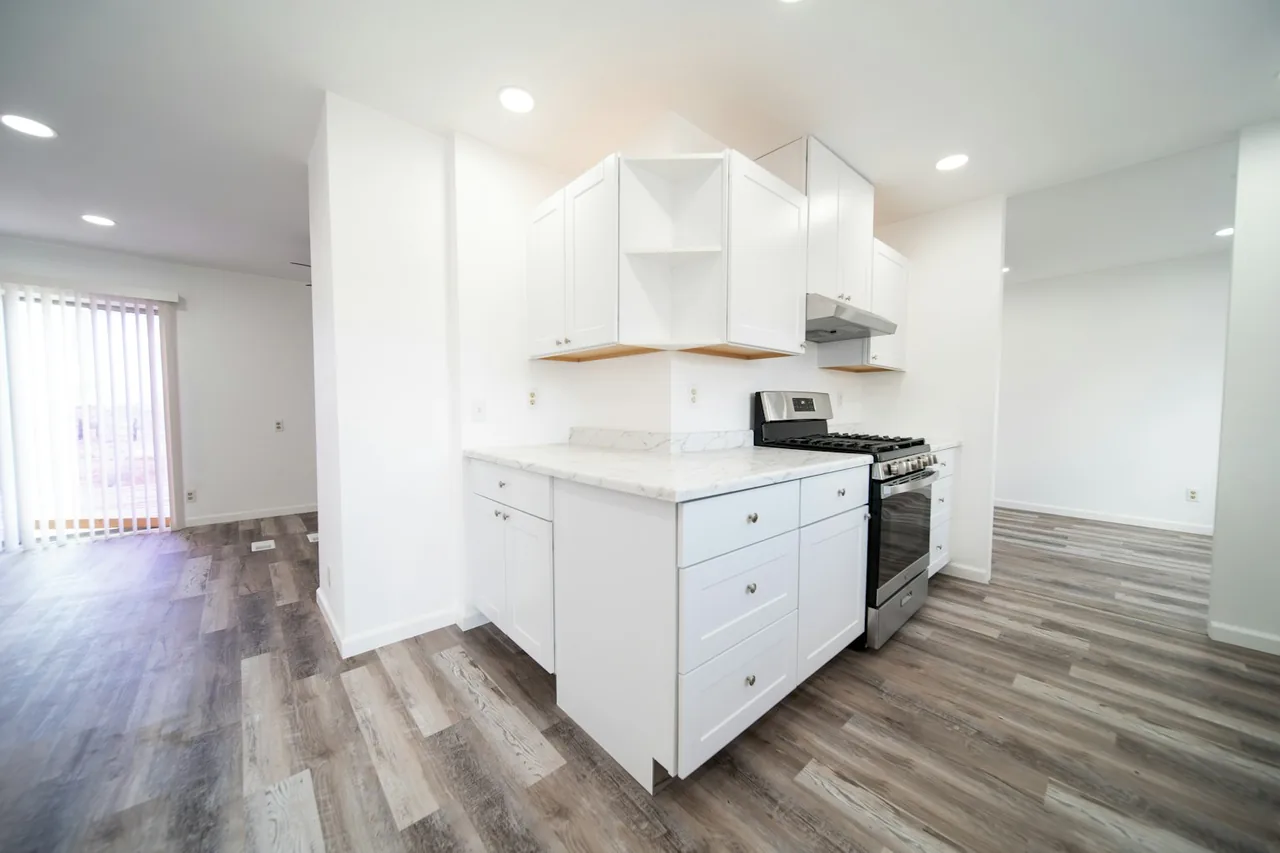
Laminate vs. Quartz, Stone, and the Other Countertops
Laminate sits at the value end of the countertop spectrum, so the comparison is fundamentally about what you give up to save the most money — and what you actually keep. The honest framing is that laminate trades permanence and high-end feel for the lowest cost and easiest care.
The Material Comparison Matrix
The matrix below lines laminate up against the alternatives on the specs that separate them — relative cost, heat, the repair path, sink compatibility, and weight.
| Material | Relative cost | Heat tolerance | Repairable? | Best sink type | Weight |
|---|---|---|---|---|---|
| Laminate | Lowest | Low — permanent scorch | No — replace only | Drop-in (top-mount) | Light |
| Quartz | High | Moderate — resin scorches | By a pro | Undermount or drop-in | Heavy |
| Granite | High | High | By a pro | Undermount or drop-in | Heavy |
| Butcher block | Mid | Low — scorches | Yes — sands and re-oils | Drop-in (protects edge) | Medium |
| Porcelain | High | High | By a pro | Undermount or drop-in | Lighter slab |
| Solid surface | Mid | Low–moderate | Yes — sands, seamless | Undermount (integral) | Medium |
Read across the table and laminate is the value outlier: lowest cost and lightest weight, but the only material with no repair path at all — which is the precise trade you are making when you choose it.
What You Give Up, and the Closest Rival
Against quartz, laminate shares the non-porous, no-sealing, easy-clean virtue — but quartz is a thick, solid, relatively heat-tolerant, pro-repairable engineered stone, while laminate is a thin skin over particleboard that scorches and can't be repaired. Against natural stone like granite, quartzite, and marble, laminate offers their look at a fraction of the price with none of their weight, heat tolerance, or permanence. It is the budget alternative to porcelain and the affordable stand-in for butcher block's wood look — but unlike real wood, a laminate wood-look can't be sanded and re-oiled. Its closest mid-tier rival in spirit is solid surface, which is also seamable but, unlike laminate, repairable. To weigh value against permanence spec for spec, see the countertops hub and the material comparison tool.
The Specs That Matter — HPL Grade, Wear Rating, and Substrate
Not all laminate is equal, and the specs that separate a counter that lasts a decade from one that delaminates in two years are mostly invisible at the showroom. Buying on pattern alone, ignoring the grade and substrate, is the classic laminate mistake.
HPL Grade and Wear Rating
The laminate sheet itself carries two specs that predict how the surface survives, and both are easy to overlook behind an attractive pattern.
HPL vs. Lower-Pressure Laminate
Genuine high-pressure laminate, fused at high heat and pressure, is more durable and impact-resistant than thinner, lower-pressure decorative laminates. For a countertop you want HPL — ideally a postforming or general-purpose grade rated for horizontal surface use — not the lighter decorative laminate meant for vertical or low-wear applications.
Reading the Abrasion / Wear Rating
Better laminates carry a defined wear rating — an AC-style abrasion class or the laminate industry's NEMA/ISO wear measure — and a higher rating means the décor layer resists scuffing and dulling longer in daily use. The rating is the closest laminate has to a durability number, so it deserves the same attention you would give a PEI rating on tile or a Janka number on wood.
Why the Rating Can't Fix Heat or Deep Cuts
The wear rating governs surface abrasion, not the material's hard limits. Even the highest-rated HPL scorches under a hot pan and gouges under a knife, because those failures cut through the printed layer entirely rather than wearing it. So the rating improves how the surface ages day to day — it does not turn laminate into a heat-tolerant or cuttable surface, and a buyer who expects it to is choosing the wrong material.
Substrate Quality and Thickness
The particleboard or MDF core determines rigidity and, critically, moisture behavior. A denser, moisture-resistant substrate — and full thickness, commonly a nominal 3/4" core making roughly a 1.5" finished edge with a buildup — holds up far better at the sink than a thin, cheap core. The substrate is where the longevity actually lives, so a moisture-resistant core is worth more to a laminate counter's lifespan than any upgrade to the pattern.
Finish and Texture
Gloss, matte, and textured or embossed finishes wear and show scratches differently: a matte or textured finish typically hides daily marks better than high gloss, which shows every scuff and fingerprint. The finish is a real durability-of-appearance choice, not just a look — and on a budget surface that can't be refinished, choosing a finish that disguises wear is a practical way to keep it looking new longer.
The Laminate Spec Summary
The table below collects the specs that actually predict how a laminate counter performs, what each governs, and the practical read on getting it right — the numbers behind a sheet that looks identical to a cheaper one in the showroom.
| Spec | What to look for | What it governs | Practical read |
|---|---|---|---|
| Laminate grade | Genuine HPL, horizontal-rated | Durability, impact resistance | HPL, not lower-pressure decorative laminate |
| Wear rating | AC-style / NEMA class | Surface abrasion and dulling | Higher class stays new longer; won't fix heat or cuts |
| Substrate | Dense, moisture-resistant core | Rigidity and water behavior | The core, not the face, is what swells and fails |
| Thickness | Nominal 3/4" core, ~1.5" edge | Stiffness and edge look | Full thickness holds up far better at the sink |
| Finish | Matte / textured vs. gloss | How visibly it shows wear | Matte hides daily marks on a non-refinishable surface |
Read together, these are what separate a laminate counter that lasts a decade from one that delaminates in two years — and not one of them is the pattern, which is the only thing most buyers actually compare.
Edge Profiles, Finishes, and What to Buy
Because laminate is a thin sheet on a core, the most important "what to buy" decisions after the pattern are the edge and how the seams and sink are handled — these are where cheap laminate looks cheap and where water gets in. There is no slab to profile; the edge is a fabricated detail.
Post-Formed vs. Self-Edge
The post-formed edge heat-bends the laminate in a continuous curve from the deck down over a rolled front edge and up an integrated backsplash, with no seam at the front — the classic seamless-front look that hides the substrate well and is cost-effective. The self-edge (square edge) applies a separate strip of the same laminate to a square front edge, leaving a fine visible seam line at the top corner; it reads cleaner and more modern, but that corner seam is a slight vulnerability. The choice is both aesthetic and a water-protection decision, since the edge is what keeps moisture off the core.
Beveled, Decorative, and Wood Edges
Bevels and applied wood or metal edge trims dress up the front and can hide the brown substrate line that gives budget laminate away — a common upgrade for a more finished appearance. On a material where the edge is a fabricated detail rather than solid stone, these trims are one of the few ways to make laminate read more premium, and they are inexpensive relative to the impression they create.
Décor Matching at Corners and Seams
On L-shaped or long runs, how the pattern meets at a miter or butt seam separates careful work from sloppy work, so it is worth asking how seams and the backsplash are handled before you commit. The single most important detail to specify, though, is the sink type, covered in install — because laminate and undermount sinks are usually a poor match, that decision quietly shapes the whole counter.
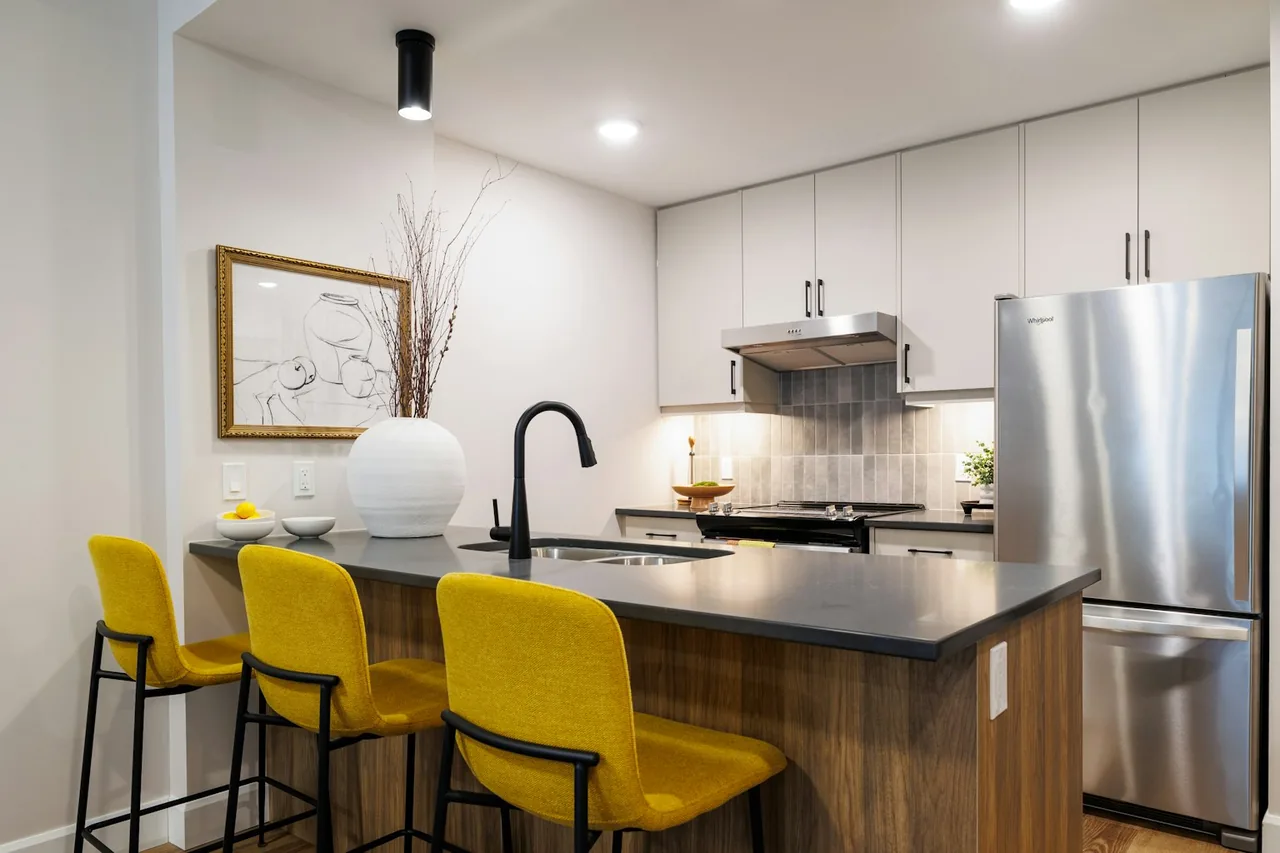
How Laminate Is Fabricated and Installed
Laminate is the most accessible countertop to fabricate and install, but every step orbits one vulnerability — protecting the particleboard core from water, especially at the sink. The six steps below are the full arc from measuring to the final walkthrough.
Measuring and Choosing Prefab vs. Custom
The runs are measured and the path is chosen: prefabricated post-formed counters come from a factory in stock lengths with the edge and backsplash already bent on, while custom laminate is fabricated to exact dimensions. Prefab is fast and inexpensive; custom allows specific sizes, edges, and seam placement.
Cutting the Substrate and Bonding the Laminate
For custom work, the laminate is bonded to a cut particleboard or MDF substrate with contact adhesive, and the edges are applied. A denser, moisture-resistant core is the upgrade that matters here, because the substrate — not the laminate face — is what fails when water reaches it.
Making Cutouts for the Sink and Cooktop
Cutouts are made for the sink, cooktop, and faucet, exposing the raw core edge at each. This raw edge is the most vulnerable spot on the whole counter, so how it is sealed and which sink covers it — decided next — determines whether the counter survives the wet zone.
Joining and Sealing Seams
Seams on long or L-shaped runs are joined with miter bolts and sealed, kept tight and placed away from the wettest zones. A quality install treats every seam as a potential water path to the core, so each is sealed rather than simply butted together.
Choosing and Setting the Sink
Laminate is best paired with a drop-in (top-mount) sink, whose rim sits on top and seals the cut edge against water. An undermount sink is generally not recommended with standard laminate, because it leaves the raw particleboard edge exposed to constant moisture, which swells and ruins the core — the default guidance is drop-in.
Sealing Every Edge and Walkthrough
Every cut edge, especially the sink cutout and seams, is sealed so water can't reach the core, the light counter is set with straightforward support, and the installer walks it with you. The care handoff is short but firm: trivets always, cutting boards always, and wipe up standing water near the sink immediately.
Skip the edge sealing or pair standard laminate with an undermount sink and the core swells at the one zone that is always wet — the most common way these counters die — which is why a vetted fabricator treats sealed edges and a drop-in sink as fixed, not optional. For how seam strategy and cutouts work across materials, see countertop fabrication and countertop installation.
Talk through your project — free.
A free consultation and a written, itemized quote from a vetted installer. No pressure, no obligation.
Common Laminate Mistakes, Consequences, and Prevention
Most laminate failures are the same handful of shortcuts, each with a predictable consequence and a known prevention. Naming them is how you spot a corner being cut before it is buried under your counter — or before you cause the damage yourself, since laminate offers no second chance.
| Mistake | What it causes | The prevention |
|---|---|---|
| Buying on pattern, ignoring grade | A thin, low-wear sheet that dulls and delaminates early | Choose genuine HPL with a defined wear rating, rated for horizontal use |
| A cheap, non-moisture-resistant core | A substrate that swells fast when water reaches it | Specify a dense, moisture-resistant core at full thickness |
| Pairing an undermount sink with standard laminate | The raw cutout edge wicks water and the core swells and is ruined | Use a drop-in sink whose rim covers and seals the cut edge |
| Leaving cut edges and seams unsealed | Water reaches the core through edges and seams — the top failure | Seal every cut edge, the sink cutout, and all seams |
| Setting hot pans on the surface | A permanent scorch, blister, or melt that can't be refinished | Use trivets always — heat damage to laminate is irreversible |
| Cutting directly on the counter | A scratched décor layer or a gouge exposing the core | Use cutting boards always; the printed layer can't be restored |
| Scrubbing with abrasive pads | A dulled or scratched finish, worst on high gloss | Clean with mild soap and a soft cloth; skip scouring pads |
Every row is a permanent or core-killing failure, because laminate cannot be refinished — which is why "real HPL on a moisture-resistant core, every edge sealed, a drop-in sink" is the sentence that separates a laminate counter that lasts a decade from one that swells in two years.
Is Laminate Right for Your Space?
Whether laminate fits is not a matter of taste — it is the output of a short chain of facts about your budget, your habits, and the placement. Walk the decision in order; each branch removes a mismatch, and what survives is the honest answer.
- Is budget the priority and permanence not? If you want the lowest-cost counter and an easy future replacement — a rental, flip, starter kitchen, or utility space — laminate is purpose-built. If you want a forever surface, a more permanent material fits better.
- Will you commit to trivets and cutting boards? Heat and deep cuts cause permanent, unrepairable damage. If you'll honor trivets and boards, laminate lasts; if you know you'll set hot pans down or cut directly on the counter, choose a heat-tolerant, repairable material instead.
- Can you use a drop-in sink? Laminate pairs best with a drop-in that covers the cut edge; undermount is generally not recommended with standard laminate. If your design demands an undermount, a non-porous solid material is the safer choice for that wet zone.
- Will you buy grade, not just pattern? Genuine HPL with a defined wear rating on a moisture-resistant core is what separates a counter that lasts a decade from one that delaminates. If you're willing to spend the modest budget on grade and substrate, laminate delivers; buying the cheapest sheet is how it disappoints.
- Will you keep water off the seams and edges? The core swells if water reaches it through an unsealed seam or edge. If you'll wipe up standing water promptly and the install seals every edge, laminate survives the kitchen; if not, the sink zone will fail.
Run honestly, this tree returns a clear verdict: laminate for the budget-driven homeowner who honors its limits — and a pause for anyone who wants permanence, heat tolerance, an undermount sink, or the ability to repair damage.
Not sure laminate's limits fit your kitchen?
Tell us about your space and we will match a vetted fabricator who recommends the grade, substrate, edge, and sink — and puts the whole plan in writing before fabrication.
What Actually Drives the Cost of a Laminate Counter
A laminate-counter quote is modest compared to stone, but it is still not a single number — the price is driven by the grade and the work, not the area alone, and the items below are ranked by how much they move the total.
- HPL grade and pattern. Genuine HPL with a higher wear rating and a premium pattern costs more than a basic decorative sheet, and the grade is the lever that most affects how long the surface lasts — the place to spend the budget, not save it.
- Substrate quality and thickness. A denser, moisture-resistant core at full thickness costs more than a thin, cheap one, and it is what determines survival at the sink — a small upcharge for a large longevity gain.
- Prefab vs. custom fabrication. Prefabricated post-formed counters in stock lengths are the cheapest path; custom fabrication to exact dimensions with specific seams and edges is more labor and cost.
- Edge profile. A standard post-formed or self-edge is modest; beveled, wood, or metal edge trims add material and labor while hiding the substrate line for a more finished look.
- Seam and cutout work. L-shaped runs, long spans, and sink, cooktop, and faucet cutouts add joining and sealing labor — modest individually, but they add up across a whole kitchen.
- Sink type and sealing. A drop-in sink and proper edge sealing are inexpensive but essential; the work to protect the core is small money that prevents the counter's most common failure.
- Removal and disposal. Tearing out an old counter and hauling it away is labor and a fee, and removal can expose cabinet issues — which is why it belongs in the written quote up front even on a budget job.
Because laminate's drivers are modest but real, the honest move is an itemized quote that prices the grade, substrate, edge, and sink separately so the budget goes to longevity, not just pattern. Compare what moves the price across the category in our cost guides and weigh laminate against other materials with the countertop cost calculator before you read a quote.
Get an itemized laminate scope, not a headline rate.
A vetted fabricator prices the HPL grade, substrate, edge, and sink as separate lines — so your budget goes to longevity, free and with no obligation.
The Laminate Fit Test: Six Calls That Decide If You'll Be Happy
Laminate is the right choice for a clear, honest set of priorities. Run your project through the Laminate Fit Test — six calls, each a documented source of frustration when skipped — and a laminate counter that satisfies emerges; miss one and the savings turn into a complaint.
- 1. Choose it when budget is the priority and permanence isn't
- Laminate is by far the lowest-cost countertop and the easiest to replace later. It's ideal for rentals, flips, starter kitchens, utility spaces, and any project where spend matters more than a forever surface — and the wrong call when permanence is the goal.
- 2. Buy HPL grade and a moisture-resistant substrate, not the cheapest sheet
- Genuine high-pressure laminate with a defined wear rating, on a dense, moisture-resistant core, is what separates a counter that lasts a decade from one that delaminates. Don't buy on pattern alone — the longevity lives in the grade and the core.
- 3. Commit to trivets and cutting boards before you commit to laminate
- Heat and deep cuts cause permanent, unrepairable damage. If you know you'll set hot pans down or cut directly on the counter, choose a heat-tolerant, repairable material instead, because laminate gives you no way to undo a scorch or a gouge.
- 4. Plan a drop-in sink and obsess over sealed edges
- Laminate pairs best with a drop-in sink that covers the cut edge; undermount is generally not recommended. Every seam and the sink cutout must be sealed so water never reaches the particleboard core — the most common laminate failure by far.
- 5. Pick the edge profile for the look and the substrate protection
- A post-formed edge gives a seamless front and hides the core well; a self-edge or bevel reads more modern but handles the corner seam differently. The edge is both an aesthetic and a water-protection decision, so choose it for both.
- 6. Choose a finish that disguises wear
- A matte or textured finish hides daily scuffs and fingerprints far better than high gloss on a surface that can't be refinished. On a budget counter you won't restore, picking a forgiving finish keeps it looking new longer.
Score your project against all six and the choice is rarely ambiguous — laminate is right for the budget-driven homeowner who honors its limits and wrong for the one who skips them.
Laminate Countertop Glossary
The terms below recur in every laminate quote, spec sheet, and care guide — each defined as its working meaning on an actual job, so you can read a scope and judge whether it is complete.
- High-pressure laminate (HPL)
- The countertop-grade laminate sheet — kraft paper and a printed décor sheet saturated with resin and fused under high heat and pressure — more durable and impact-resistant than thinner decorative laminates.
- Décor sheet
- The thin printed layer that carries the laminate's pattern — stone, wood, solid, or texture — sitting at the surface and unable to be restored once cut or burned through.
- Substrate (core)
- The particleboard or MDF beneath the laminate that gives it rigidity and thickness; the moisture-vulnerable part that swells and is ruined if water reaches it.
- Particleboard vs. MDF
- Two engineered-wood cores; MDF is denser and smoother, particleboard is lighter and cheaper, and a moisture-resistant version of either holds up far better at the sink.
- Abrasion / wear rating
- The laminate's resistance to surface scuffing and dulling, expressed as an AC-style class or a NEMA/ISO measure — the closest thing laminate has to a durability number.
- Post-formed edge
- An edge made by heat-bending the laminate in a continuous curve over a rolled front and up an integrated backsplash, with no front seam — the classic seamless budget look.
- Self-edge
- A square front edge faced with a separate strip of the same laminate, leaving a fine seam at the top corner — cleaner and more modern, but with a slight corner vulnerability.
- Backsplash (integrated)
- The upturned laminate where the counter meets the wall; on a post-formed counter it is bent in as one continuous piece, sealing the back edge against water.
- Drop-in (top-mount) sink
- A sink whose rim sits on top of the counter and covers the cut edge of the cutout — the recommended sink for laminate because it seals the vulnerable core edge.
- Undermount sink
- A sink mounted below the counter that leaves the raw cutout edge exposed; generally not recommended with standard laminate because the exposed core swells from constant moisture.
- Delamination
- The separation of the laminate face from its core, typically after water swells the substrate or the adhesive bond fails — a common end-state for a laminate counter at the sink.
- Miter bolt
- The fastener that draws two laminate sections tight at a seam, especially at an L-shaped corner, so the joint stays closed and can be sealed against water.
Standards, Care Commitments, and When Laminate Lasts
Laminate sheets carry manufacturer specs, but the counter's longevity is a function of the grade, the substrate, the sealing, and how it is treated — so the standards live in the workmanship and the care plan as much as in any printed certificate.
The Workmanship Standards That Decide Longevity
The conditions are specific and testable: genuine HPL with a defined wear rating bonded to a dense, moisture-resistant core, every cut edge and seam sealed, a drop-in sink recommended over undermount, and seams kept tight and placed away from the wettest zones. A fabricator who uses a thin sheet, a cheap core, or leaves the cutout edge unsealed has built in the swollen-core failure before you notice. Ask in writing for the HPL grade, the substrate spec, and confirmation that edges and the sink cutout are sealed — that document is what separates a laminate counter that lasts a decade from one that delaminates in two years.
The Care Commitment You Make in Return
The other half of longevity is yours, and on laminate it is the whole strategy, because the material largely cannot be repaired or refinished. Daily cleaning is genuinely low-maintenance — wipe with mild soap and water or a gentle household cleaner and a soft cloth; the non-porous face resists stains and doesn't harbor bacteria — while avoiding abrasive cleaners and scouring pads that dull the décor layer. The three rules that actually matter are protective: trivets always (heat permanently scorches), cutting boards always (knives gouge), and keep water off seams and edges. Tiny chips can sometimes be disguised with a color-matched seam filler, but a scorch, deep gouge, delaminating seam, or swollen core means replacing the section or the counter — see replacement and installation rather than restoration, which applies to repairable stone and wood. Laminate also never appears in a sealing schedule, since the face is already non-porous.
A Real Laminate Decision
One representative scenario shows where laminate is the smart call — budget and a clean look, not permanence, decided every call below.
How to Vet a Laminate Fabricator
Laminate outcomes are decided by grade, substrate, sealed edges, and the right sink, so the fabricator matters more than the pattern in the sample book. These questions separate a shop that builds laminate to last from one that slaps a cheap sheet on a cheap core.
- They specify genuine HPL with a wear rating
- Ask whether the sheet is true high-pressure laminate rated for horizontal use and what its wear rating is. A credible answer names HPL and a defined abrasion class — not just a pattern number — because the grade is what predicts how the surface ages.
- They use a dense, moisture-resistant core
- Ask about the substrate. A real answer describes a dense, moisture-resistant particleboard or MDF core at full thickness, since the core — not the laminate — is what swells and fails when water reaches it.
- They recommend a drop-in sink and explain why
- Ask how they handle the sink. A professional steers you to a drop-in that covers the cut edge and explains why an undermount is risky with standard laminate, rather than treating both as equivalent.
- They seal every cut edge and seam
- Ask how the cutout edges and seams are protected. A trustworthy fabricator seals every cut edge, the sink cutout, and all seams against water — directly addressing the swollen-core failure that ends most laminate counters.
- They place seams cleanly and match the décor
- Ask how seams and corners are joined and where they fall. A careful answer keeps seams tight, away from the wettest zones, and matches the pattern at miters — the difference between careful and sloppy work.
- They tell you the limits honestly and put it in writing
- Ask what laminate can't do, and for the scope in writing. A trustworthy shop says plainly that laminate is great value but scorches, gouges, and can't be refinished, and names the grade, substrate, edge, and sink in the quote before work starts.
Why Route Your Laminate Project Through Pro Work Home Surface
Pro Work Home Surface is not a contractor and does not fabricate your counter — we are a national authority on home surfaces that matches homeowners with vetted local fabricators and installers and holds them to a published bar.
- A free consultation and an itemized written scope
- Every connection starts with a no-obligation consult and a written quote that lines out the HPL grade, substrate, edge, and sink separately — so your budget goes to longevity, not just a headline rate.
- Real HPL on a moisture-resistant core
- Genuine high-pressure laminate with a defined wear rating is bonded to a dense, moisture-resistant substrate — because the difference between a laminate counter that lasts and one that delaminates lives in the grade and the core, not the pattern.
- Seal every edge and the sink cutout
- All seams and especially the sink cutout are sealed so water cannot reach the particleboard, and a drop-in sink is recommended over undermount with standard laminate — directly preventing the swollen-core failure that ends most laminate counters.
- Tight seams, clean edges, honest limits
- Seams are kept tight, sealed, and placed away from the wettest zones, the edge profile is finished cleanly, and you're told the truth up front: laminate is non-porous and great value, but it scorches, gouges, and can't be refinished, so trivets and boards are non-negotiable.
Countertops are one of eight categories we cover across home surfaces. If your project later needs a damaged section replaced through installation rather than a repair, the same standards apply — compare laminate against the alternatives on the countertops hub, weigh what moves the price in our cost guides, read the laminate-vs-quartz trade-offs in our guides, and line them up with the spec-comparison tools. Updating the cabinets underneath too? See cabinets, or start from the full range of home surfaces.
Brands & Material Authority
Quality and construction drive long-term performance more than the label. These are widely respected names in this category:
- Cambria
- Caesarstone
- Silestone
- MSI
- Cosentino
- Corian
- Wilsonart