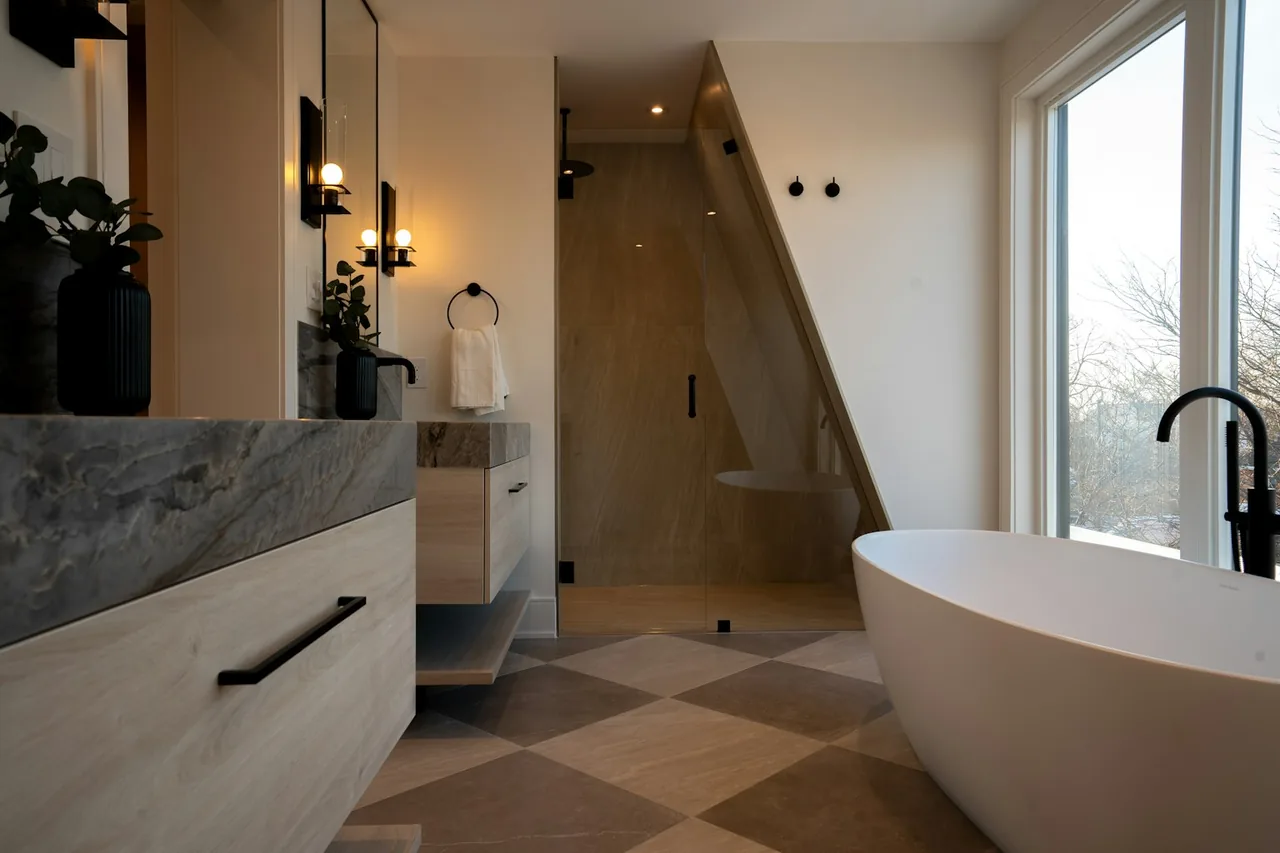
Ceramic floor tile is glazed fired clay — softer, more absorbent, and far easier to cut than porcelain — the practical, lower-cost choice for dry, moderate-traffic interior floors and the default for walls. Its defining trait is higher water absorption, commonly 3% to 7% by ASTM C373, which is exactly why it belongs indoors, away from freeze and standing water where its porcelain sibling rules. Pick ceramic over porcelain, marble, or slate where budget and workability lead and the room stays dry and moderate; step up to porcelain the moment water, freeze, or heavy traffic enter the picture. Get a free consultation and a written, itemized scope from a vetted installer before you buy, because the absorption number, the PEI rating, and the substrate are decided there, not in the showroom.
Ceramic Is Defined by Workability, Not Density — and That Sets Its Lane
Every tile is fired clay or cut stone, but ceramic's lower firing leaves a softer, more absorbent body that is a joy to cut and a liability where water lives — and that single trade decides every room it belongs in.
Glazed Clay Built for the Saw, Not the Freeze
Ceramic tile is made from natural red or white clay, shaped, coated with a liquid glass glaze that fuses to the surface in the kiln, and fired at a lower temperature than porcelain. That lower firing leaves the clay body more porous and less dense — and that difference, not the look, is what separates ceramic from the porcelain it is constantly compared against.
The Glaze Does the Work, the Clay Sets the Limit
On ceramic, the glaze is where the tile earns its keep: it is the hard, colored, sealed surface you walk on and clean, and it carries the entire design, since the clay body underneath is usually a plain terracotta or off-white. That has one consequence worth naming — a chip on a glazed ceramic tile reveals the pale clay beneath, a visible scar that through-body porcelain avoids because its color runs full-depth.
Why Ceramic Is Easy at the Saw
Because the body is softer and more absorbent, ceramic cuts cleanly and quickly with a simple snap cutter or an inexpensive wet saw, drills easily for fixtures, and is forgiving to handle — the reasons it dominates DIY projects and keeps labor lower than porcelain. That workability is a real, bankable advantage on detailed wall work and intricate patterns, where porcelain's hardness slows every cut.
The Cost of That Softness
The price of easy cutting is durability: the softer body and the surface-only glaze mean ceramic chips more readily at edges, wears through faster under heavy traffic if the glaze is under-rated, and cannot take the freeze-thaw or standing water that a vitrified porcelain shrugs off. None of that makes ceramic a lesser tile — it makes it a different tool, ideal inside its lane and a false economy outside it.
Ceramic vs. Its Sibling Tiles — Absorption and Cost Set the Split
Within the tile family, ceramic is the value and workability option, and the deciding spec across the set is water absorption by ASTM C373 — the number that says whether a tile can take a freeze or a soaking, and the one that draws ceramic's boundary.
The Ceramic-vs-Siblings Matrix
The matrix below rates ceramic against the other six tiles on the deciding spec each is judged by, so ceramic's lane reads at a glance. These are representative figures; the printed data sheet for your specific tile always governs.
| Tile | Deciding spec (ASTM C373 absorption) | Wet / freeze rating | Cut & cost | Best-fit rooms |
|---|---|---|---|---|
| Ceramic (this page) | 3%–7% typical | Interior only, not freeze-safe | Easy cut, lowest cost | Dry, moderate floors, walls, backsplash |
| Porcelain | Under 0.5% | Frost-proof, fully wet-rated | Hard cut, higher cost | Wet rooms, heavy traffic, outdoors |
| Marble | Porous stone (varies) | Etches with acid; dry rooms | Cut + seal; premium | Dry, low-acid, low-traffic luxury |
| Travertine | Porous limestone, high | Etches; fill voids; dry-moderate | Cut + fill + seal | Rustic dry-to-moderate floors |
| Slate | Low-moderate (varies) | Good; not acid-sensitive | Cut + light seal | Entries, mudrooms, natural grip |
| Mosaic | By material (often porcelain) | Grout joints add wet grip | Sheet-set, seal grout | Shower pans, curves, accents |
| Wood-look | Under 0.5% (porcelain) | Frost-proof, fully waterproof | Hard cut, long planks | Wood look in wet rooms |
The pattern is clear: ceramic is the friendliest and cheapest tile to buy and cut, but its absorption keeps it out of the wet and freeze-prone rooms that porcelain, its wood-look cousin, and the denser stones own. Compare them spec-for-spec with the material comparison tool before you settle on one.
Ceramic vs. Porcelain: the Defining Comparison
The comparison that decides most ceramic projects is against porcelain floor tile. Porcelain absorbs under 0.5% water, is denser and harder, and is rated for wet rooms, heavy traffic, and freeze-prone outdoor use. Ceramic absorbs more, is softer, and is best kept to dry, low-to-moderate interior floors — but it is cheaper to buy, dramatically easier to cut and install, and entirely adequate where those conditions hold. The honest rule: if the floor will get soaked, freeze, or take heavy traffic, choose porcelain; if it stays dry and moderate, ceramic does the same job for less.
Ceramic vs. Natural Stone and the Look-Alikes
Against the natural stones — marble, travertine, and slate — ceramic trades natural character for zero sealing and lower cost. The stones need periodic sealing and, in marble's case, careful acid avoidance; glazed ceramic needs neither, because the glaze is already a sealed surface. Where ceramic cannot compete is the depth and authenticity of real stone or wood, though glazed prints have narrowed that gap. For a true wood look in a wet room you would step up to wood-look porcelain, not ceramic, because the room's water rules ceramic out. Compare the whole lineup on the tile flooring hub.
Want to know if ceramic fits your room — or if you need porcelain?
We match you with a vetted installer who reads the absorption and traffic for your space and flags the surfaces that should step up to porcelain — in a written scope, before you commit.
The Specs That Define Ceramic — Absorption, PEI III, DCOF, and the Glaze
Three numbers and one structural fact tell you where a ceramic tile belongs, and reading them is the difference between a floor that lasts and a wall-rated tile wearing through in a hallway. Buying on the picture alone is how an absorptive ceramic cracks in a freeze or a light-duty glaze scuffs where people walk.
Water Absorption 3% to 7% — the Ceramic Signature
Measured by ASTM C373, ceramic typically absorbs 3% to 7% — well above porcelain's sub-0.5% line, and enough that it is not freeze-thaw stable outdoors and not the right pick for a floor that sees standing water. That higher absorption is exactly why ceramic is for dry, interior use; match the absorption to the room before anything else.
PEI III — the Right Floor Rating for Ceramic
The PEI scale grades a glaze's wear. Most ceramic floor tile is rated PEI III, suited to moderate residential traffic — bedrooms, baths, and light-use floors — while PEI I and II ceramics are walls only.
Why a Wall-Rated Ceramic Fails on a Floor
Putting a wall-rated PEI I or II ceramic on a floor wears the glaze visibly where people walk, leaving dull, scuffed traffic paths through an otherwise intact tile — and that wear cannot be refinished. The prevention is a one-line check at purchase: confirm the tile is rated PEI III for a floor before color ever enters the decision. Ceramic's softer body gives it less headroom than porcelain, so the rating matters more, not less.
DCOF ≥ 0.42 — Slip Safety Still Applies
Even on a lighter-duty ceramic floor, any area that gets wet needs a textured surface meeting DCOF ≥ 0.42 per ANSI A137.1. Many decorative ceramics are glossy and slick when wet; reserve those for walls and dry floors, and specify a matte, slip-rated glaze for a ceramic bathroom floor or entry.
The Glaze Is the Durable Surface — and the Limit
On ceramic, durability lives entirely in the fired glaze. A scratched or chipped glaze exposes the soft, pale clay body beneath, which is why ceramic shows edge chips more than through-body porcelain. The glaze's hardness and the PEI rating, not the clay body, decide how the floor wears. Above the tile spec sits the install standard: TCNA (Tile Council of North America) and ANSI define the substrate stiffness, mortar, coverage, and movement joints a lasting tile floor requires — the same standards porcelain demands. Ceramic's lower price does not lower the setting bar.
The Ceramic Spec Table
The table below collects ceramic's own ratings, what each measures, and the threshold that matters, so the spec sheet reads at a glance. These are representative figures; the printed data sheet for your specific tile always governs.
| Spec | What it measures | Recognized standard | Ceramic figure / threshold |
|---|---|---|---|
| Water absorption | Porosity of the fired body | ASTM C373 | 3%–7% — interior, not freeze-safe |
| PEI rating | Glaze abrasion / traffic | PEI I–V scale | PEI III for floors; I–II walls only |
| DCOF | Wet slip resistance | ANSI A137.1 | ≥ 0.42 for wet floors (matte glaze) |
| Glaze | The durable wear surface | Manufacturer spec | Chips reveal pale body; keep spares |
| Setting | Substrate rigidity | TCNA / ANSI deflection | L/360 plus backer or membrane |
The pattern the table makes plain: absorption keeps ceramic indoors, PEI keeps the glaze right for the traffic, and the TCNA setting keeps it from cracking — the lower price changes none of it.
Not sure ceramic clears your room's traffic and slip?
Tell us about your space and we will match a vetted installer who reads the PEI, absorption, and slip rating for the room, keeps ceramic in its lane, and puts it in writing — before you buy.
How Ceramic Tile Is Installed
Ceramic is the most forgiving tile to cut and handle, which tempts shortcuts on the part that actually matters: the substrate and setting bed. The six steps below are the full arc, with the two failure-preventers — a rigid substrate and movement joints — called out where they fall.
Substrate and Deflection Assessment
The installer confirms a substrate stiff enough not to deflect, because a floor that bounces cracks rigid ceramic just as it cracks porcelain. Most floors want at least an L/360 deflection limit. A bouncy joist system is reinforced first under subfloor prep — ceramic's lower cost does not make it more forgiving of a flexing deck.
Backer Board or Uncoupling Membrane
Over a wood subfloor, a layer of cement backer board or an uncoupling membrane isolates the tile from substrate movement — never ceramic straight onto a flexing subfloor. Over concrete it means a flat, sound, clean slab. This layer is what lets a rigid tile survive a substrate that moves at all.
Waterproofing the Wet Walls and Surrounds
Ceramic's lane is dry-to-moderate, but on shower walls and wet surrounds a waterproofing membrane still goes behind the tile so water never reaches the substrate. The wet shower floor itself moves to a slip-rated mosaic or porcelain — outside ceramic's absorption lane for standing water.
Setting in Thin-Set With Full Coverage
Ceramic's more-absorbent body bonds readily with a standard polymer-modified thin-set, and it cuts on a snap cutter or basic wet saw. The installer still back-butters and checks coverage so the mortar fully contacts the back of each tile — a hollow ceramic tile sounds and pops just like a hollow porcelain one.
Movement Joints at Perimeter and Field
Soft, flexible movement joints go at the perimeter and across large fields, per TCNA detail, so the floor can expand without cracking the rigid tile. This step is identical to porcelain's; the cheaper tile does not skip it.
Grout, Seal, and Walkthrough
Joints are packed with grout at the correct width, cement grout is sealed where specified, and the installer walks the floor with you to confirm coverage and a slip-rated surface in any wet area. Spare tiles from the same lot are set aside for future chip repairs; transitions and any stair work finish the edges.
Skip or rush the substrate or the movement joints and the failure each prevents — a cracked field, a popping tile — shows up regardless of how cheap or workable the tile is. That is why a vetted installer treats the setting standards as fixed; the broader sequence lives under flooring installation.
Talk through your project — free.
A free consultation and a written, itemized quote from a vetted installer. No pressure, no obligation.
Is Ceramic Right for Your Space?
Whether ceramic belongs in a room is the output of a short chain of facts about the room's water, its traffic, and your budget. Walk the decision in order; each branch confirms ceramic's lane or points you to porcelain.
- Does the room get wet, freeze, or go outdoors? If yes, ceramic's 3% to 7% absorption rules it out — choose porcelain under 0.5%. If the room stays dry, ceramic is in the running.
- How hard does the room live? A dry, moderate-traffic room fits a PEI III ceramic floor. A heavy-traffic entry or a busy kitchen floor is porcelain territory, where ceramic's glaze would wear and edges would chip.
- Is the surface a wall or a floor? Ceramic is the default for walls, backsplashes, and shower surrounds — its easy cutting shines on detailed work. On a floor, confirm PEI III; never put a wall-rated PEI I or II tile underfoot.
- Does any part get wet? A ceramic bath or entry floor needs a matte glaze meeting DCOF ≥ 0.42; keep glossy decorative ceramics on walls and dry floors where slip is not in play.
- Is budget or workability the driver? Ceramic's lower tile cost and easy cutting are its whole case; if the room's conditions hold, that saving is real. If they do not, the saving is a false economy. Confirm the survivors under the flooring hub.
Run honestly, this tree returns either a defensible ceramic call inside its lane or a clear signal to step up to porcelain — and an installer who puts glossy ceramic on a wet shower floor is the red flag.
Where Ceramic Works Best — and Where It Doesn't Belong
Ceramic earns its place wherever the conditions are mild and the budget matters, and it gets into trouble wherever they are not.
Where Ceramic Earns Its Place
It shines on walls and dry-to-moderate interior floors: backsplashes, shower walls and surrounds (walls, not the wet shower floor), feature walls, and floors in lower-traffic rooms. A powder room, a guest bathroom floor that does not take a beating, or a light-use laundry-room floor are all reasonable ceramic territory when a slip-rated, PEI III tile is chosen. Its easy cutting also makes it the friendliest tile for intricate patterns and detailed wall work.
Where Its Absorption and Softness Betray It
Where ceramic does not belong is anywhere its absorption and softness become liabilities. It is the wrong tile outdoors and in any freeze-prone space, where trapped water expands and cracks the body. It is a poor choice for a heavy-traffic a kitchen floor or a busy entry, where the glaze wears and edges chip — porcelain is the move there. And it should not be the wet shower floor itself; that calls for a slip-rated mosaic or porcelain over a waterproofed pan. Ceramic is genuinely fine within its lane and a false economy outside it — and when a ceramic floor has cracked from substrate movement, the repair reaches into the deck; see flooring repair.
Common Ceramic Mistakes, Consequences, and Prevention
Most ceramic failures are the same handful of shortcuts, each with a predictable consequence and a known prevention. Naming them is how you spot a corner being cut before it is buried under your floor.
| Mistake | What it causes | The prevention |
|---|---|---|
| Ceramic outdoors or in a freeze | Trapped water expands and cracks the absorptive body | Use porcelain under 0.5% absorption anywhere it can freeze |
| Wall-rated ceramic on a floor | The glaze wears through where people walk, unrepairable | Buy PEI III for any floor; PEI I–II are walls only |
| Glossy ceramic on a wet floor | A slip hazard in a bath, entry, or laundry | Specify a matte glaze meeting DCOF ≥ 0.42 |
| Ceramic on a wet shower floor | Water gets into a too-absorbent tile; slip risk | Use a slip-rated mosaic or porcelain over a waterproofed pan |
| Ceramic over a bouncy subfloor | Cracked tiles and cracked grout as the floor flexes | Reinforce to L/360 and add backer board or membrane |
| No movement joints | Straight-line cracks across the field as the floor expands | Soft joints at the perimeter and across large fields per TCNA |
| No spare tiles kept | A chipped tile becomes a mismatched patch from a new lot | Set aside tiles from the original production lot at install |
Every row is a documented cause of a cracked, worn, or hazardous floor — which is why "we keep ceramic in its lane and set to TCNA and ANSI, in writing" is the most valuable sentence in a ceramic quote.
What Actually Drives the Cost of a Ceramic Floor
A ceramic quote is not a flat per-square-foot rate; the headline number a low bid leads with hides the items below, ranked by how much they move the total — and ceramic's savings live in the tile and the cutting, not in a lower setting standard.
The Cost Drivers That Move the Total Most
- Substrate prep and reinforcement. The biggest swing on most jobs. Reinforcing a bouncy structure to the deflection limit, then adding backer board or an uncoupling membrane, is real labor and material a sound, rigid substrate avoids — and it is what keeps ceramic from cracking, the same as any tile.
- Tile material and pattern detail. Ceramic is cheaper per square foot than porcelain or stone, but intricate patterns, borders, and detailed wall work add cutting and skilled hours even on an easy-to-cut tile.
- Waterproofing wet walls and surrounds. Shower walls and wet surrounds need a waterproofing membrane behind the tile — a real line item the lowest bid tends to omit, even on a ceramic job.
- Setting labor and movement joints. Full-coverage setting, back-buttering, and detailing soft movement joints to TCNA spec are skilled hours a fast, thin-bed job skips at the floor's expense.
- Old-floor removal and disposal. Tearing out an old floor is labor and haul-away is a fee, and removal often exposes substrate problems that change scope mid-job.
- Slip-rated substitutions. Where a wet surface exceeds ceramic's lane, stepping to a porcelain or mosaic on that one area adds cost — cheap insurance against a slip hazard or a freeze failure.
- Transitions and stairs. Thresholds, edge trim, and any tiled stairs are exacting work priced separately from field tile.
Because these drivers swing so widely, the only honest number comes from an on-site assessment. Compare what moves the price in our tile flooring cost guide and across the cost guides, and size your own room with the tile calculator so you can read a quote critically.
Get an itemized ceramic scope, not a headline rate.
A vetted installer prices the substrate, setting, tile, and any porcelain substitutions as separate lines — so you see the whole job, free and with no obligation.
How to Choose and Buy Ceramic for Your Space
The right ceramic is the match of absorption, PEI rating, and slip safety to a dry-to-moderate room — settled before color, because ceramic's lane is narrower than porcelain's and staying inside it is the whole decision. Call this the Ceramic Fit Test: run all six and the tile fits the room; miss one and you are buying a future problem.
- Keep ceramic to dry, interior, moderate-traffic floors
- Reserve ceramic for rooms that stay dry and do not take heavy traffic, and for walls. Its 3% to 7% absorption rules it out outdoors, in a freeze, and under standing water — choose porcelain there.
- Buy PEI III for any floor, never a wall tile
- Floor ceramic should be rated PEI III for moderate residential traffic. PEI I and II ceramics are walls only — put one on a floor and the glaze wears through where people walk, with no way to refinish it.
- Demand a slip rating in wet areas
- A ceramic bath or entry floor needs a textured, matte glaze meeting DCOF ≥ 0.42. Glossy decorative ceramics are slick when wet — keep those on walls and dry floors.
- Step up to porcelain on the wet, slip-critical surface
- Where one surface in a room gets soaked — a shower floor, a mudroom — put a slip-rated porcelain or mosaic there and keep ceramic on the dry surfaces. Matching by surface holds the look and the budget.
- Order spare tiles for chip repairs
- Because the soft body chips and a glaze chip shows the pale clay underneath, set aside a few tiles from the same production lot. A matching spare turns a chipped tile into a quick swap instead of a mismatched patch.
- Order overage for cuts and waste
- Buy roughly 10% more than the room's square footage — more for diagonal or detailed patterns — from one dye lot, so cuts, waste, and the spare stock all come from matching tile.
Settle absorption, traffic, and slip first and the look becomes a free choice instead of a gamble — which is exactly the order a credible installer walks with you.
Caring for Ceramic — Glaze Is Easy, Grout and Chips Are the Watch Points
Glazed ceramic is one of the easiest surfaces to keep clean, and its maintenance burden, like porcelain's, lives mostly in the grout — with the added watch point of the softer body.
The glazed face needs only sweeping or vacuuming for grit and damp-mopping with a pH-neutral cleaner; the glaze does not stain or absorb under normal use, since it is a sealed glass surface. The grout between tiles is the weak point — porous cement grout absorbs dirt and benefits from sealing, and dingy grout is usually what makes a ceramic floor look tired even when the tiles are fine. Skip harsh acidic cleaners, which can etch glaze over time and damage grout. The one extra concern with ceramic is chipping: because the body is soft and the glaze surface-only, a hard impact at an edge can chip the tile and expose the pale clay beneath. Keep a few spare tiles from the original lot, because an individual cracked or chipped tile can be cut out and replaced; see flooring repair and weigh the numbers in our tile flooring cost guide.
Ceramic Tile Glossary
The terms below recur in every ceramic quote, spec sheet, and warranty — each defined as its working meaning on an actual job, so you can read a scope and judge whether it is complete.
- Water absorption
- The percentage of water a tile takes on, measured by ASTM C373 — ceramic commonly absorbs 3% to 7%, which keeps it indoors and away from freeze and standing water.
- Glaze
- The liquid-glass surface fused to ceramic in the kiln — the hard, colored, sealed layer you walk on and clean, and where all of ceramic's durability and design live.
- PEI rating
- The Porcelain Enamel Institute scale (I–V) grading a glaze's resistance to abrasion — ceramic floor tile wants PEI III; I and II are walls only.
- DCOF
- Dynamic coefficient of friction — the wet slip-resistance rating per ANSI A137.1. Interior wet floors want ≥ 0.42; glossy ceramics often fall below it.
- Bisque
- The fired clay body beneath the glaze — usually a plain terracotta or off-white on ceramic, which is why a chipped glaze shows a pale scar.
- Snap cutter
- A simple hand tool that scores and snaps ceramic tile — one reason ceramic is so much easier and cheaper to cut than dense porcelain, which needs a wet saw.
- Thin-set mortar
- The cement-based adhesive that bonds tile to the substrate, troweled to a size set by the tile and pattern; full coverage is what keeps a ceramic tile from sounding hollow.
- Backer board
- A rigid cement panel installed over a wood subfloor to give tile a stable, non-flexing bed — an alternative to or paired with an uncoupling membrane.
- Uncoupling membrane
- A layer that isolates the tile from minor substrate movement, letting the substrate shift slightly without cracking the rigid tile above it.
- Movement joint
- A soft, flexible joint at the perimeter and across large fields, per TCNA detail, that absorbs expansion so the tile does not crack in a straight line.
- Deflection (L/360)
- The allowable flex of the floor structure under load — span in inches divided by 360. Ceramic cracks over a structure that flexes more, the same as any rigid tile.
- TCNA
- The Tile Council of North America, whose handbook (with ANSI) defines the substrate, mortar, coverage, and movement joints a lasting ceramic floor requires — the standard is the same as porcelain's.
Standards, Warranty Conditions, and When a Permit Applies
A ceramic warranty is a contract with conditions, and most failures are not about the tile — they are about the substrate and setting it was installed over, or a tile used outside its lane.
Warranty Conditions That Hinge on the Install
The conditions are specific and testable: a deflection-rated substrate; full mortar coverage; movement joints at the perimeter and across large fields; a waterproofing membrane on wet walls; the correct PEI rating for the traffic; and the right grout and sealing. A ceramic maker's warranty covers the tile, not an installer's skipped membrane or a wall tile put on a floor — which is why the setting standard and the rating, in writing, are what protect the floor. Ask that the install follow the TCNA handbook and ANSI standards explicitly.
The Standards Bodies That Set the Bar
For ceramic, the TCNA and ANSI govern substrate, mortar, coverage, waterproofing, and movement joints, and ASTM defines the tests behind the specs — C373 for water absorption and the methods behind PEI and DCOF. A floor built to these holds its warranty and its shape.
When a Ceramic Permit Applies
Replacing a floor like-for-like usually does not require a permit, but repairing or reinforcing structural subflooring or floor joists to carry tile, or work tied to a larger renovation, often does. A reputable installer tells you when a permit applies rather than working around it, and structural questions about the deck belong with the subfloor team first. When an old tile floor is failing rather than dated, the path may be full replacement.
A Real Ceramic Decision
One representative scenario shows how ceramic's lane is defined: the room's conditions, not the look, decided where ceramic could and could not go.
How to Vet a Ceramic Installer
Ceramic failures are almost always install failures or a tile used outside its lane, so the installer matters far more than the tile on the sample board. These questions separate a crew that builds a floor to TCNA standards from one that thin-sets ceramic over whatever is there.
- They keep ceramic in its lane
- Ask whether ceramic suits every surface in your project. A credible installer flags any wet, freeze-prone, or heavy-traffic surface and recommends porcelain there — not "ceramic works everywhere."
- They buy the PEI rating for the floor
- Ask what PEI rating the floor tile carries. A real answer names PEI III for a moderate floor and refuses to put a wall-rated PEI I or II tile underfoot.
- They assess deflection and reinforce
- Ask how they confirm the substrate is rigid enough. A credible answer names an L/360 deflection limit and a plan to stiffen a bouncy floor plus backer or membrane — not "we'll tile right over it."
- They waterproof wet walls behind the tile
- For shower walls and surrounds, ask how they waterproof. A credible answer describes a membrane behind the tile — not "the ceramic and grout keep the water out," which they do not.
- They check coverage and detail movement joints
- Ask how they confirm full coverage and where they put movement joints. Back-buttering, a coverage check, and soft joints at the perimeter and across large fields are the marks of a crew that prevents hollow tiles and field cracks.
- They put the scope and labor warranty in writing
- Ask for the full scope — substrate, waterproofing, setting, grout — the timeline, and the workmanship warranty before work starts. A crew willing to name a labor guarantee, and to return if a tile cracks or pops, is accountable for the setting, not just the tile.
Two honest answers — whether they keep ceramic in its lane and how they confirm deflection — tell you more about a ceramic crew than any sample board; the rest of the list confirms it.
Why Route Your Ceramic Project Through Pro Work Home Surface
Pro Work Home Surface is not a contractor and does not lay your floor — we are a national authority on home surfaces that matches homeowners with vetted local installers and holds them to a published bar.
- A free consultation and an itemized written scope
- Every connection starts with a no-obligation consult and a written quote that lines out substrate, setting, tile, and any porcelain substitutions separately — so you read the whole job, not a headline rate.
- Ceramic kept in its lane, in writing
- A PEI III rating for any floor, a slip-rated DCOF ≥ 0.42 glaze for wet areas, and an honest call to step up to porcelain wherever water, freeze, or heavy traffic exceed what ceramic's 3% to 7% absorption can take.
- Substrate and setting built to TCNA and ANSI
- A deflection-rated, flat substrate with backer board or an uncoupling membrane, full mortar coverage checked behind every tile, and movement joints at the perimeter and across large fields — the same setting standard porcelain gets, despite the lower tile cost.
- National coverage, local crews
- We match you with installers in your area nationwide, so the standard is consistent even though the crew is local — whether your project is a single bath or a whole floor.
Ceramic is one tile among several we cover across home surfaces. If your project also touches restoring stained grout, fixing a cracked or chipped tile, or a full tear-out and replacement, the same standards apply — settle the closest cross-shop in our tile vs. LVP guide, weigh the numbers in our tile flooring cost guide, dig into the how-and-why in our surface guides, and start from the tile hub, the flooring category hub, or the full range of home surfaces.
Brands & Material Authority
Quality and construction drive long-term performance more than the label. These are widely respected names in this category:
- Shaw
- Mohawk
- COREtec
- Armstrong
- Pergo
- Mannington
- Bruce
- Karndean