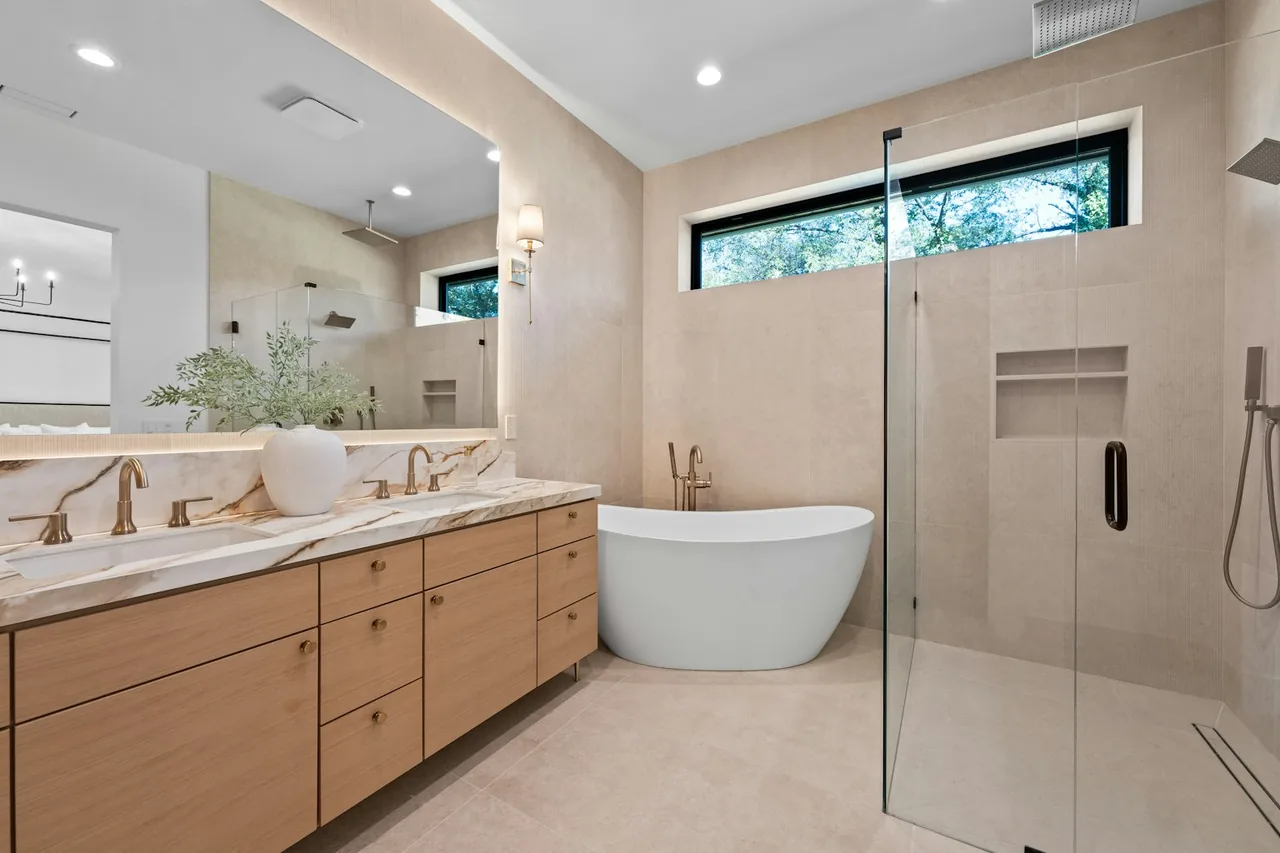
Travertine floor tile is a natural limestone — a form of tufa deposited by mineral springs — riddled with small natural cavities and carrying a warm, earthy color no fired tile matches. Its signature, and the first decision it forces, is those voids: travertine is sold filled (voids grouted smooth) or unfilled (open and textured), and that single choice drives slip, cleaning, and look. Like all calcite stone it is soft at about Mohs 3, porous, etches with acid, and must be sealed. Choose travertine over marble, slate, or porcelain for a rustic, organic stone look in a dry-to-moderate room — and settle filled vs. unfilled first. Get a free consultation and a written, itemized scope from a vetted installer before you buy, because the fill choice, the finish, and the sealing plan are decided there, not in the showroom.
Travertine Is Defined by Its Voids — the Fill Decision Comes First
Every stone tile has a defining trait; travertine's is holes. The natural cavities in the stone are not a defect — they are how travertine formed — and how you handle them decides how the floor looks, grips, and cleans.
Limestone Laid Down by Springs
Travertine is a variety of limestone that precipitates out of mineral-rich spring and groundwater, trapping gas bubbles as it forms — which is why the finished stone is honeycombed with small voids. That origin gives it two defining traits: it is calcite-based, so it shares marble's chemistry, and it is naturally porous and pitted, giving the warm, textured, organic look that is travertine's whole appeal. The color runs cream, beige, gold, and walnut in soft bands, reading rustic where marble reads formal.
Filled vs. Unfilled — the First Decision
Travertine's voids are handled two ways, and the choice changes everything downstream. Filled travertine has its cavities grouted flush at the factory or on site, giving a smoother, more uniform, easier-to-clean surface. Unfilled travertine leaves the holes open, for a more textured, rustic look with extra natural grip — but those open pits collect dirt and, on a floor, are often filled later anyway. The fill decision drives slip resistance, cleaning effort, and appearance all at once, which is why it is settled before finish or color.
Honed, Tumbled, Polished, and Brushed
On top of the fill choice sits the surface finish. Honed travertine is smooth and matte, the most common floor finish, balancing look and grip. Tumbled travertine has softened, rounded edges and a weathered, antique texture with strong slip resistance — a favorite for a rustic floor. Polished travertine is glossy but slicker and shows etching; brushed is textured and grippy. For a floor, honed or tumbled is almost always the call; polished belongs where water and acid rarely reach.
Mohs 3 — the Calcite Softness, Again
Like marble, travertine sits at about Mohs 3 on the scratch scale — soft enough to scratch from grit and chip at edges — and being calcite it etches on contact with acids, sealed or not. The voids add a second wear path: an edge at an open pit can spall if the fill fails. That softness and pitting are why travertine wants a dry-to-moderate room and a sealing regimen, not a busy, wet, or acidic floor.
Travertine vs. Its Sibling Tiles — Porosity and Fill Set It Apart
Within the tile family, travertine is the rustic, pitted stone, and the deciding specs against its siblings are porosity and the fill state — the pair that predicts cleaning effort, slip, and how much sealing the floor will need. Where porcelain is judged on absorption and marble on veining, travertine is judged on its voids.
The Travertine-vs-Siblings Matrix
The matrix below rates travertine against the other six tiles on the deciding spec each is judged by, so the trade reads at a glance. These are representative figures; the specific stone, fill, and finish always govern.
| Tile | Deciding spec (porosity / character) | Wet / slip note | Sealing & care | Best-fit rooms |
|---|---|---|---|---|
| Travertine (this page) | Porous, pitted; filled or unfilled | Tumbled/honed grip; fill first | Seal; maintain fill; wipe acid | Rustic dry-to-moderate floors, patios |
| Marble | Denser; tight veining | Polished slick; hone for grip | Seal often; etches | Formal, dry, low-traffic luxury |
| Slate | Hard, cleft; not acid-sensitive | Natural cleft grips | Light seal; low fuss | Entries, mudrooms, wet-ish areas |
| Porcelain | Very hard; inert; under 0.5% | Matte finish for wet | Never sealed | Wet rooms, heavy traffic, outdoors |
| Ceramic | Softer glaze; inert | Matte glaze for wet | No sealing (glaze) | Dry, moderate interior floors |
| Mosaic | By material; joints add grip | Grout joints grip wet | Seal grout / stone | Shower pans, curves, accents |
| Wood-look | Very hard (porcelain); inert | Fully waterproof | Never sealed | Wood look in wet rooms |
The pattern is clear: travertine and marble share the soft, acid-sensitive calcite chemistry, but travertine's open pits give it a rustic texture and an extra maintenance path — the fill — that no other tile has. Compare them spec-for-spec with the material comparison tool before you settle on one.
Travertine vs. Marble and Slate: the Stone Split
Among the stones, travertine is closest to marble in chemistry — both calcite, soft, and etch-prone — but the look and feel diverge sharply: marble is dense and formal with tight veining, travertine is porous and rustic with open cells and earth tones. Against slate, travertine is softer and acid-sensitive where slate is hard and inert; slate is the low-maintenance stone, travertine the warm, textured one. If you want rustic character and accept the sealing, travertine; if you want a hard, grippy stone with less fuss, slate.
Travertine vs. the Porcelain That Imitates It
The honest cross-shop is real travertine versus porcelain floor tile printed to look like travertine. Travertine-look porcelain delivers the pitted, earthy appearance with none of the chemistry: it is under 0.5% absorption, does not etch, needs no sealing, has no voids to fill or maintain, and is rated for wet rooms and heavy traffic. What it cannot fully replicate is the genuine depth and cool touch of real stone. Choose real travertine where authenticity and the organic feel are the point and the room is dry-to-moderate; choose the porcelain where you want the look in a bath, a busy floor, or outdoors in a freeze. Compare the whole lineup on the tile flooring hub.
Filled or unfilled? Not sure travertine fits your room?
We match you with a vetted installer who reads the room's water, traffic, and acid against travertine's porosity, recommends filled vs. unfilled, and puts it in writing — before you commit.
The Specs That Define Travertine — Porosity, Fill, Mohs, and DCOF
Four properties tell you whether a travertine belongs on your floor and in your room, and reading them is the difference between a warm, lasting floor and one that stains, spalls, and etches. Buying on the earthy look alone, ignoring the porosity, is the classic travertine mistake.
Porosity and Sealing
Travertine is the most porous of the common floor stones, so it absorbs liquids readily and stains if they sit — coffee, wine, oil. A penetrating sealer is not optional on a travertine floor: it goes on at install and periodically after, slowing absorption and buying time to wipe a spill. As with all calcite stone, sealing reduces staining but does not stop acid etching.
Fill State and Spalling
The fill state is a spec in its own right. A filled floor cleans more easily and grips less at the surface; an unfilled or open-pit floor grips more but collects dirt and can spall — chip at a pit edge — if the fill later fails and a void opens under traffic. Maintaining the fill is part of owning travertine, and re-filling popped voids is routine care, not a defect.
DCOF and Slip — Why Tumbled and Honed Win
The DCOF (dynamic coefficient of friction) per ANSI A137.1 rates wet slip resistance. Travertine's natural texture helps: tumbled and honed finishes, and unfilled surfaces, grip better and more readily clear the DCOF ≥ 0.42 benchmark for interior wet floors, which is part of why travertine is popular around pools. Polished travertine, by contrast, is slicker and shows etching — the wrong finish for a wet floor.
The Travertine Spec Table
The table below collects travertine's own properties, what each governs, and the practical threshold, so the trade reads at a glance. These are representative figures; the specific stone, fill, and finish always govern.
| Property | What it governs | Recognized measure | Travertine figure / note |
|---|---|---|---|
| Porosity | Staining from spills | Absorption (high) | Seal on install and periodically |
| Fill state | Look, cleaning, spalling | Filled vs. unfilled | Filled cleans; unfilled grips |
| Hardness | Scratch and chip resistance | Mohs 1–10 scale | ~Mohs 3 — soft; dry-to-moderate |
| Acid sensitivity | Etching from acidic contact | Calcite reactivity | Etches; sealer does not prevent it |
| DCOF | Wet slip resistance | ANSI A137.1 | Tumbled/honed grip; polished slick |
The pattern the table makes plain: travertine's warmth is inseparable from its porosity and voids — the fill, the finish, and the sealing plan are how you live with a soft, cellular stone. Above the stone spec sits the setting standard: TCNA (Tile Council of North America) and ANSI define the substrate, mortar, and movement joints, with stone often wanting the stricter L/720 rigidity.
Not sure which travertine finish and fill your room needs?
Tell us about your space and we will match a vetted installer who reads the water, traffic, and acid, steers honed/tumbled and filled vs. unfilled, and puts the sealing plan in writing — before you buy.
How Travertine Tile Is Installed
Travertine's softness, porosity, and voids make it a stone job, and the fill and sealing sequence set it apart from any fired tile. The six steps below are the full arc, with the travertine-specific calls — void filling, sealing, and stiffer substrate — called out where they fall.
Substrate and Deflection Assessment
The installer confirms a substrate stiff enough not to deflect, and natural stone often wants the stricter L/720 deflection limit rather than L/360, because soft travertine cracks and spalls where a floor flexes. A bouncy joist system is reinforced first under subfloor prep.
Backer Board or Uncoupling Membrane
Over a wood subfloor, cement backer board or an uncoupling membrane isolates the travertine from substrate movement — non-negotiable under a soft, porous stone. Over concrete it means a flat, sound, clean slab. The flatter the bed, the less lippage shows across a natural stone floor.
Setting and Grouting, With Void Fill
Travertine is set in a stone-appropriate thin-set with full back-buttered coverage, and any open voids are filled — at the factory, or on site with a matching grout or filler — so the surface is sound. Unfilled floors are often filled during grouting so pits do not become dirt traps or spall points.
Sealing Before and After Grouting
Porous travertine is sealed before grouting so pigmented grout does not stain the stone, then grouted, then sealed again — the sealing sequence unique to stone. A travertine floor that is not sealed will stain from the first spill, so this step is not optional.
Movement Joints at Perimeter and Field
Soft, flexible movement joints go at the perimeter and across large fields per TCNA detail, so the floor expands without cracking. Straight-line cracks across a stone floor are the signature of this step being skipped.
Final Seal and Walkthrough
A final penetrating seal goes down, the installer confirms the fill is sound and the finish even, and walks the floor with you to review the sealing cadence, the acid avoidance, and the fill maintenance the stone will need. Transitions and any stair work finish the edges.
Skip the stiffer substrate, the void fill, or the sealing sequence and the failure each prevents — a cracked or spalled stone, a dirt-trapping pit, a stained floor — is far harder to fix in travertine than in a fired tile. That is why a vetted installer treats travertine as a stone job; the broader sequence lives under flooring installation.
Talk through your project — free.
A free consultation and a written, itemized quote from a vetted installer. No pressure, no obligation.
Is Travertine Right for Your Space?
Whether travertine belongs in a room is the output of a short chain of facts about the room's water, its acid exposure, and how much sealing and fill maintenance the household will give it. Walk the decision in order; each branch confirms travertine or points you to a harder stone or the porcelain look-alike.
- Will acids reach the floor? A kitchen with citrus, wine, and vinegar will etch travertine no matter how well sealed. If acid is routine, choose a travertine-look a porcelain floor instead — it does not etch.
- Filled or unfilled? A floor you want easy to clean leans filled; a rustic look with maximum grip leans unfilled or tumbled — accepting that pits collect dirt and may need re-filling. Settle this before finish.
- How wet is the room? Tumbled and honed travertine grips well and suits a dry-to-moderate bathroom floor or a pool surround; a wet shower floor still leans toward a mosaic or slip-rated tile, and polished travertine is wrong anywhere wet.
- Will the household seal and maintain the fill? Travertine rewards a sealing cadence and occasional re-filling of popped voids. If that upkeep is unwelcome, the honest answer is a lower-maintenance stone or the porcelain look-alike.
- Is the substrate stiff enough for stone? Travertine wants L/720 rigidity. A bouncy floor must be reinforced first, because a soft, cellular stone is unforgiving of a flexing deck. Confirm the survivors under the flooring hub.
Run honestly, this tree returns either a defensible travertine room or a clear signal to choose a harder stone or the porcelain look-alike — and an installer who puts polished, unsealed travertine on a wet kitchen floor is the red flag.
Where Travertine Belongs — and Where Its Pores Betray It
Travertine is the warmest, most organic floor stone and the most porous, which is why naming both sides matters.
Where Travertine Earns Its Place
Travertine belongs in dry-to-moderate rooms and outdoor spaces where its warm, rustic character is the point: a foyer, a Mediterranean-style living room or hallway, a dry-to-moderate bathroom floor in a honed or tumbled finish, and especially a pool deck or covered patio in a mild climate, where its natural grip and cool touch shine. In these rooms, sealed and with the fill maintained, travertine ages into a mellow patina that is central to its appeal.
Where Its Porosity Betrays It
Travertine is the wrong floor for a busy, acidic kitchen, where etching and staining are guaranteed; for a wet shower floor, where a mosaic or slip-rated tile is correct; for a high-traffic entry that sees grit and de-icing salt; and for any household unwilling to seal and maintain the fill. In a freeze-prone climate its porosity makes an exterior floor risky. In all of these, a travertine-look porcelain tile flooring gives the look without the failure — and when real travertine has stained or spalled, renewal is a stone-restoration and re-fill job, not a mop; see floor restoration.
Common Travertine Mistakes, Consequences, and Prevention
Most travertine disappointments are the same handful of mismatches between the stone's porosity and the room, each with a predictable consequence and a known prevention. Naming them is how you avoid a stained, spalled, or etched floor.
| Mistake | What it causes | The prevention |
|---|---|---|
| Skipping or delaying sealing | The porous stone stains from the first spill | Seal before and after grouting, then on a cadence |
| Assuming sealer prevents etching | Acidic spills leave dull etch marks on sealed stone | Understand sealer stops stains, not etch; wipe acids at once |
| Polished travertine on a wet floor | A slip hazard, and etching shows against the shine | Use a honed or tumbled finish for grip |
| Unfilled floor left unmaintained | Pits collect dirt and spall as voids open | Fill voids on install and re-fill popped pits as care |
| Travertine in a busy acidic kitchen | Etching and staining across the traffic and drip zones | Use a travertine-look porcelain in kitchens |
| Travertine over a bouncy subfloor | Cracked and spalled stone as the floor flexes | Reinforce to L/720 plus backer or membrane |
| Acidic cleaners on travertine | Etched, dulled surface across the floor | Use only pH-neutral, stone-safe cleaners |
Every row is a documented cause of a stained, spalled, or etched stone floor — which is why "we fill, seal in sequence, and match travertine to the room, in writing" is the most valuable sentence in a travertine quote.
What Actually Drives the Cost of a Travertine Floor
A travertine quote is not a flat per-square-foot rate; the headline number a low bid leads with hides the items below, ranked by how much they move the total — and with travertine, the stone grade, the fill, and the specialist setting are most of the job.
The Cost Drivers That Move the Total Most
- Stone grade and fill state. Travertine ranges by grade, color consistency, and whether it comes pre-filled; a premium, tightly filled, consistent stone costs more than a rustic, voided lot, and on-site filling adds labor.
- Substrate prep and reinforcement to L/720. A large swing on most jobs. Reinforcing a structure to the stricter stone deflection limit, then adding backer or a membrane, is real labor a sound, rigid substrate avoids — and it is what keeps soft travertine from cracking and spalling.
- Specialist stone setting and sealing. Full coverage, void filling, and the seal-grout-seal sequence are skilled stone hours priced above ordinary tile labor.
- Sealing on install and ongoing. Sealing before and after grouting is an install line item, and the recurring reseal and fill maintenance are ongoing costs a fired tile does not carry.
- Finish and layout. Tumbled and brushed finishes, and patterns like the classic Versailles/French pattern travertine is famous for, add cutting, waste, and skilled hours beyond a straight grid.
- Old-floor removal and disposal. Tear-out is labor, haul-away is a fee, and removal often exposes substrate problems that change scope mid-job.
- Transitions and stairs. Thresholds, stone edge profiles, and any travertine stairs are exacting work priced separately from field tile.
Because these drivers swing so widely, the only honest number comes from an on-site assessment. Compare what moves the price in our tile flooring cost guide and across the cost guides, and size your own room with the tile calculator so you can read a quote critically.
Get an itemized travertine scope, not a headline rate.
A vetted installer prices the stone, the stiffened substrate, the void fill, the specialist setting, and the sealing as separate lines — so you see the whole job, free and with no obligation.
How to Choose and Buy Travertine for Your Space
The right travertine is the match of fill, finish, and room to the stone's porosity — settled before the earthy look wins you over, because travertine's constraints are its voids and chemistry, and the color is the variable. Call this the Travertine Fit Test: run all six and the stone fits the room; miss one and you are buying a future stain, spall, or etch.
- Settle filled vs. unfilled first
- A floor you want easy to clean leans filled; a rustic look with maximum grip leans unfilled or tumbled, accepting that pits collect dirt and may need re-filling. This choice drives slip, cleaning, and look.
- Choose honed or tumbled for a floor
- Honed is smooth and balanced; tumbled is rustic and grippy. Both suit floors and clear closer to DCOF ≥ 0.42 wet; reserve polished for low-water, low-acid rooms.
- Keep travertine to dry-to-moderate, low-acid rooms
- Its high porosity and calcite chemistry rule out busy acidic kitchens and wet shower floors; a foyer, a Mediterranean living space, or a pool deck in a mild climate is its lane. Use porcelain where acid or heavy water rule.
- Plan sealing and fill maintenance up front
- Budget a seal on install and a recurring reseal, plus occasional re-filling of popped voids. Accept that sealing reduces staining but not etching. If that upkeep is unwelcome, choose a lower-maintenance stone or porcelain.
- Commit to pH-neutral cleaners
- Acidic cleaners etch the whole floor; only stone-safe, pH-neutral products belong on travertine, and acidic spills must be wiped immediately.
- Order overage from the same lot
- Travertine is natural and variable; buy roughly 10% more than the room's square footage from the matching lot, so cuts, waste, and future repairs all read the same and blend.
Settle the fill, the finish, and the sealing plan first and the color becomes a free choice instead of a gamble — which is exactly the order a credible stone installer walks with you.
Caring for Travertine — Seal the Pores, Defend Against Acid, Mind the Voids
Travertine's care is a three-front discipline: sealing to slow stains, acid avoidance to prevent etching, and fill maintenance to keep the voids sound.
Day-to-day, dust-mop for grit and clean only with a pH-neutral, stone-safe cleaner; never use vinegar, citrus, or generic acidic cleaners, which etch the calcite on contact. Maintain the penetrating sealer on the cadence your stone and traffic dictate — travertine's high porosity means it wants sealing more diligently than denser stone. Wipe acidic spills immediately, because sealer buys time against staining but nothing against etching. On unfilled or open-pit floors, re-fill voids that pop or collect dirt as routine maintenance, not as a repair. When travertine has stained, spalled, or etched, renewal is stone restoration and re-filling by a specialist, not a household mop; see floor restoration and weigh the numbers in our tile flooring cost guide.
Travertine Tile Glossary
The terms below recur in every travertine quote, spec sheet, and care instruction — each defined as its working meaning on an actual stone job, so you can read a scope and judge whether it is complete.
- Limestone
- The sedimentary, calcite-based rock family travertine belongs to — the reason travertine shares marble's acid sensitivity and softness.
- Tufa
- The porous stone deposited by mineral springs that forms travertine, trapping gas bubbles as it precipitates — the origin of the stone's signature voids.
- Filled
- Travertine whose natural cavities are grouted flush, giving a smoother, more uniform, easier-to-clean surface with less surface grip.
- Unfilled
- Travertine left with its holes open for a rustic, textured, grippier surface — pits that collect dirt and may need filling later on a floor.
- Honed finish
- A smooth, matte surface — the most common travertine floor finish, balancing look and grip.
- Tumbled finish
- Travertine with softened, rounded edges and a weathered, antique texture and strong slip resistance — a favorite for rustic floors.
- Spalling
- Chipping or flaking at a pit edge when fill fails and a void opens under traffic — a travertine-specific wear path prevented by maintaining the fill.
- Etching
- The dull mark an acid leaves reacting with the calcite surface — distinct from staining, and not prevented by sealing.
- Sealer
- A penetrating treatment that slows how fast liquids absorb and stain the porous stone, buying time to wipe a spill; it does not stop acid etching.
- Mohs hardness
- A 1–10 scratch-hardness scale; travertine at ~Mohs 3 is soft, so grit and impacts scratch and chip it.
- DCOF
- Dynamic coefficient of friction — the wet slip-resistance rating per ANSI A137.1. Tumbled and honed travertine grip well; polished is slick.
- TCNA
- The Tile Council of North America, whose handbook (with ANSI) defines the substrate, mortar, coverage, and movement joints a lasting stone floor requires.
Standards, Warranty Conditions, and When a Permit Applies
Travertine is a natural material, so its "warranty" is really the setting standard plus the care regimen — most disappointments are not defects but porosity meeting the wrong room or the wrong maintenance.
Setting Conditions That Protect the Floor
The conditions are specific and testable: a deflection-rated substrate, often L/720 for stone; full coverage under the soft stone; the voids filled and the surface sound; movement joints at the perimeter and across large fields; and the sealing sequence before and after grouting. Natural stone carries inherent variation — color banding, voids, and fissures are features of travertine, not defects — which is why a stone specialist sets expectations in writing about what the stone will and will not do.
The Standards Bodies That Set the Bar
For stone, the TCNA and ANSI govern substrate, mortar, coverage, and movement joints, and the Natural Stone Institute publishes stone-setting and care practice. A floor set to these — on a stiff enough substrate, filled and sealed correctly — holds its look far longer.
When a Travertine Permit Applies
Replacing a floor like-for-like usually does not require a permit, but reinforcing structural subflooring or joists to carry the stricter stone load, or work tied to a larger renovation, often does — and travertine and mortar are heavy on a marginal structure. A reputable installer tells you when a permit applies rather than working around it, and structural questions belong with the subfloor team first. When an old travertine floor is stained and spalled rather than dated, the path may be stone restoration or full replacement.
A Real Travertine Decision
One representative scenario shows how porosity and the fill choice override a stone look: the absorption and the slip texture, not the color, drove every call below.
How to Vet a Travertine Installer
Travertine is a stone job with an extra step — the fill — so the installer's stone knowledge matters far more than a sample board. These questions separate a stone specialist who protects the floor from a crew that thin-sets travertine like ceramic.
- They advise on filled vs. unfilled for the room
- Ask which they recommend and why. A real answer ties filled vs. unfilled to your room's cleaning and slip needs — not "whatever you like."
- They seal before and after grouting
- Ask about the sealing steps. A stone specialist seals the porous stone before grouting so grout does not stain it, grouts, then seals again, and explains the reseal cadence.
- They fill voids and plan for re-filling
- Ask how they handle the pits. A credible answer describes filling open voids on install and explains that re-filling popped pits is routine care on an unfilled floor.
- They assess deflection to the stone limit
- Ask how they confirm rigidity. A real answer names the stricter L/720 stone deflection limit and a plan to reinforce a bouncy floor — not the L/360 they would accept for resilient flooring.
- They recommend honed or tumbled for wet floors
- Ask which finish for a bath or pool deck. A credible installer steers to honed or tumbled for grip and flags polished travertine headed for a wet floor.
- They put the scope, sealing, and care in writing
- Ask for the full scope — substrate, setting, fill, sealing — the timeline, the workmanship warranty, and the care regimen before work starts. A crew that documents the maintenance is accountable for a floor that lasts.
Two honest answers — the filled-vs-unfilled recommendation and the deflection limit they set to — tell you more about a travertine crew than any sample board; the rest of the list confirms it.
Why Route Your Travertine Project Through Pro Work Home Surface
Pro Work Home Surface is not a contractor and does not lay your floor — we are a national authority on home surfaces that matches homeowners with vetted local installers and holds them to a published bar.
- A free consultation and an itemized written scope
- Every connection starts with a no-obligation consult and a written quote that lines out stone, substrate, specialist setting, fill, and sealing separately — so you read the whole job, not a headline rate.
- Travertine matched to the room, honestly
- Installers are screened to read the room's water, traffic, and acid against travertine's porosity — recommending filled vs. unfilled and honed vs. tumbled for the room, and a travertine-look porcelain wherever real stone would etch or stain.
- Filled, set, and sealed as stone, per TCNA and the Natural Stone Institute
- A deflection-rated, flat substrate (often L/720) with backer or membrane, full coverage, voids filled and sound, movement joints, and the sealing sequence before and after grouting.
- National coverage, local crews
- We match you with stone-capable installers in your area nationwide, so the standard is consistent even though the crew is local — whether your project is a single room or a whole floor and patio.
Travertine is one stone among several we cover across home surfaces. If your project also touches restoring stained or spalled stone, fixing a cracked or chipped tile, or a full tear-out and replacement, the same standards apply — settle the closest cross-shop in our tile vs. LVP guide, weigh the numbers in our tile flooring cost guide, dig into the how-and-why in our surface guides, and start from the tile hub, the flooring category hub, or the full range of home surfaces.
Brands & Material Authority
Quality and construction drive long-term performance more than the label. These are widely respected names in this category:
- Shaw
- Mohawk
- COREtec
- Armstrong
- Pergo
- Mannington
- Bruce
- Karndean